When Markets Collide

When the market of ideas meets the market of government, what’s a free marketeer to do?

Two interesting headlines in the New York Times (NYT) today. I know, you serious business people and government wonks don’t get your fix there, but still, of interest: the Supreme Court allows greenhouse cost estimates to be used by the Environmental Protection Agency (EPA) when assessing the harms from emissions, and various states openly threaten Blackrock and other investment funds to back off supporting “woke” causes.

In the first story, essentially the EPA has had since the Obama administration, with an interlude during Trump’s, an interagency working group that created a framework to determine the costs of greenhouse emissions. That is, the cost to people, their communities, not the literal cost companies pay to emit greenhouse gases. Basically, when determining damages, or potential damages, there is a model to use for assessing the cost of the impact emissions had. Louisiana, along with other states, sued to block this.

The ruling isn’t a full endorsement. Basically it says, “the basic idea is sound and you can’t complain without an actual example to point at.” The door is open to states to object down the line to specific applications of this framework, so it’s not done and dusted yet. If an energy company applied to build a new refinery, and the EPA used this formula in their assessment of the impact, Louisiana could sue to block in that case alone. However, the general idea is sound, says SCOTUS.

In the other case, states similarly invested in fossil fuels and conservative politics have, in various ways, threatened financial investment companies for supporting causes the states do not like. For example, Texas has a law that prevents their retirement funds from doing business with companies that boycott fossil fuels, at least according to the state comptroller. Additionally, Utah and Idaho have kvetched about Standard & Poors using environmental factors when evaluating how creditworthy a state is. A hypothetical might run like this: a state that is cash-rich because they’ve gone all-in on reaping oil and coal from the ground, with no regulations on waste or emissions related to same, might not have the credit rating that a similarly rich state with pristine air and water might have.

To the first case, we have the power of government, along the lines of Congress having delegated rule-making expertise to the agency that might know what it’s talking about, saying that penalties will be measured in part according to damage from emissions. You have to do a better job of not building sludge factories next to high schools, my dear sovereign states.

In the second, we have private companies, wealth managers and the like, in some ways instigating but in other ways reacting to the idea that investments should be “clean”. There are some investors who want the peace of mind that comes from knowing their money is not tied to industries they do not support. In some cases, leaders of these wealth management funds have said, “we’re not going to invest in that” and keep on making money anyway. That’s the market. Bets are placed, winnings are collected, losses are left on the table.

Having studied finance and sat on a board or two with investments, I will repeat the common wisdom against so-called socially responsible investing, without advocating that wisdom. Generally the idea is that you should invest for max money, and then use that money to support the causes you like, rather than not invest in a wealth-generating asset class. I say, do whatever you want, and if that means avoiding fossil fuels, or companies with products or policies you do no support, fine. What’s curious to me is that rather than advocating for people to invest in these asset classes, states are seeking to punish wealth managers and other financial services companies.

That, as I think about it, is the current prevailing mood in conservative thought: punish, not reward. Which, by-the-by, is not an effective way to train people, or pets for that matter. Punishment may have a short-term positive effect: stop doing what you’re doing. However, it does not have long-term positive effects; it curtails free thinking, it stifles innovation. If you – a person, or an organization – are afraid to try something new because you were punished the last time you tried something new, you’ll become risk-averse, and less likely to grow and develop – as a person, as an organization, or as a whole economy.

This is not a sufficient outcome for the states. They want to punish companies for taking positions – bets – that they do not support. It’s not necessarily limited to the environment; they may not like whatever they see as “woke” causes, a phrase which is trending in conservative brains as shorthand for, “a thing I do not like”. I for one consider cold coffee to be woke. Coffee was meant to be served hot.

Anyway. What happened to freedom of speech, or markets, or whatever? Is this not an attempt at “cancel culture” in reverse? Thrashing for embargoes to stop the Evil Corporations from doing things you disagree with? It sounds like nothing so much as my middle school history teaching talking about boycotting of Nestle for their business in Apartheid-era South Africa.
Zee Planes

David and I took a short vacation recently to Maryland; the occasion was a friend getting married, but we decided to make a long weekend of it to see some sights, rather than drive six hours each way just for the wedding.

The location was a peninsula near the Patuxent River Naval Air Station, which turns out to have been one of the US Navy’s flight test centers; shortly after, we learned that the Smithsonian Air & Space Museum has a facility out near Dulles airport, where they keep many, many historical aircraft and aerospace artifacts. This would be a great place to see a lot of aircraft without having to contend with D.C. traffic (much).

Bell X-1

Oh boy, were there a lot of planes. The Patuxent facility was all military planes, mostly from the 1960s and onwards, most of which were outdoors. Highlights were an X-35 and, very rare, its competitor the X-32.

X-35C
X-32

They also had a recently-added Blue Angels F/A-18 Hornet; the Smithsonian had one as well. And, they had a V-22 Osprey.

F/A-18 Blue Angels Plane
Cockpit Interior

Most of the rest blurred into a series of varied aircraft with similar looks or names, many of which we were passingly familiar with, but have rarely been up close to. Inside the museum was a small exhibit devoted specifically to naval aviators who had gone on to space. The area in general was a Navy town, and the Patuxent NAS Museum clearly a navy place.

They had a separate building which had the “guts” of planes, as well as models of various aircraft carriers. Scopes, sonobuoys, electronic warfare computers, and incredibly, various engines cleaned and cut away to show how they worked. We watched some boy scouts rotate the business end of a turbo prop while we could see the gears whirring inside.

As it happened, one of the fathers along with the scouts had worked on that engine, and gave David a thorough explanation of that engine, and a Harrier V/STOL. Turned out he worked on the only civilian version currently in use, so I’ll guess he was the second-from the right on this photo.

The day after the wedding, we checked out of our hotel and went to Dulles. After a brief detour for extra caffeine, we arrived easily; really, if you like planes and are in the area, it’s an easy drive off the ring roads.

They have planes that are old.

Competitor

Historic (the Enola Gay, which dropped the first atomic bomb used in war).

The Enola Gay

Really, really cool. David had only recently shown me a video about the Shrike Commander.

Shrike Commander

Also hang gliders, sailplanes, and high-altitude parachuting.

High Altitude Parachuting - Previous Highest Record (Capsule)
High Altitude Parachuting - Highest Record

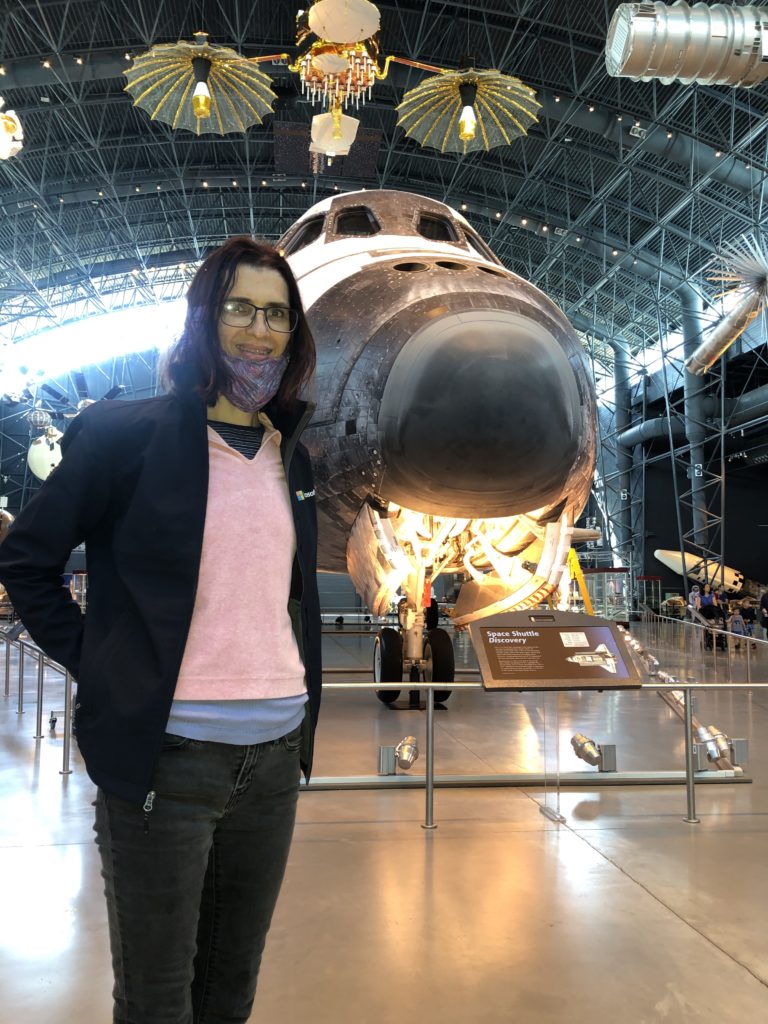
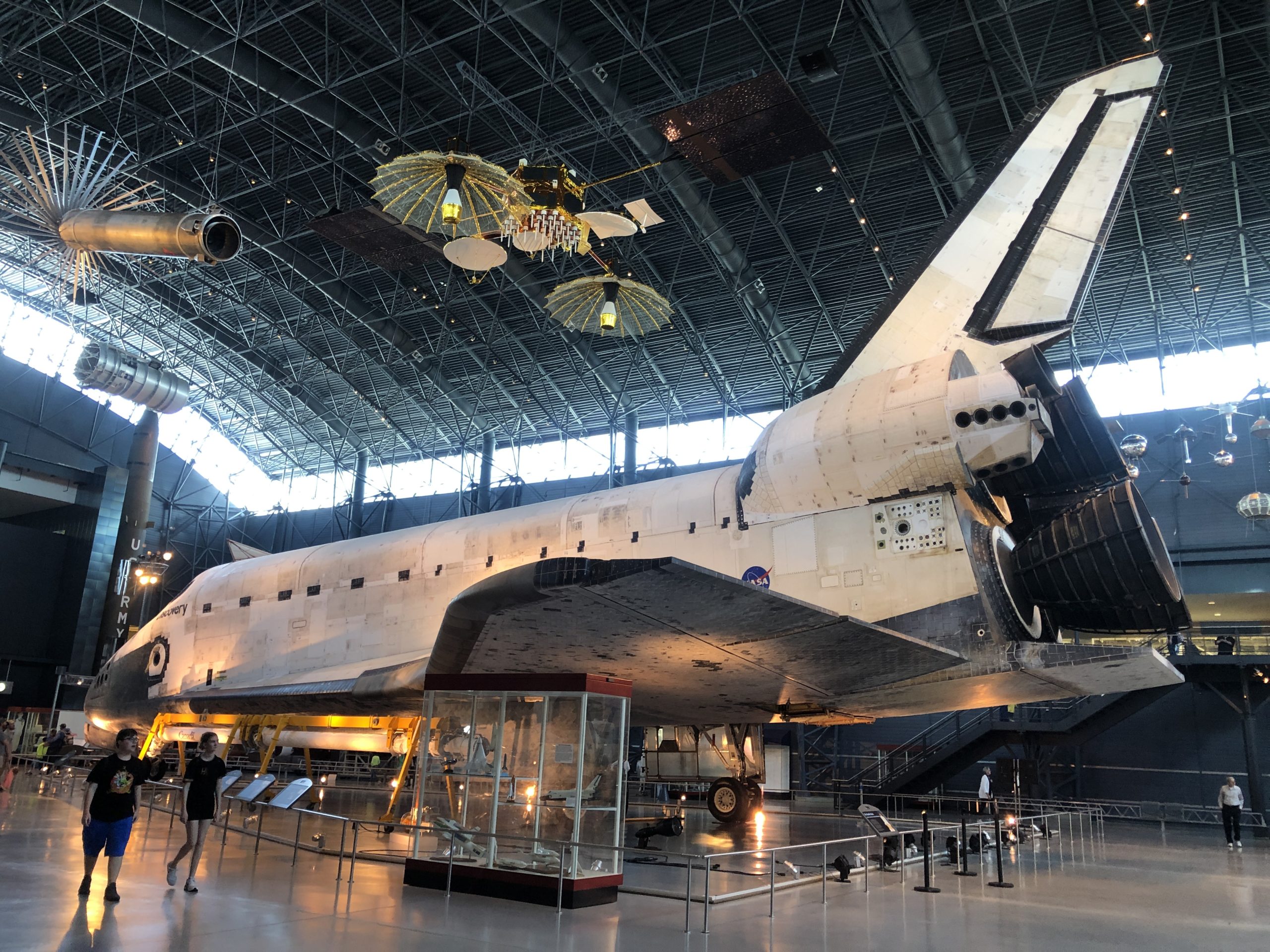
My favorite part was the space wing. They have the Space Shuttle Discovery, as well as various 1960s capsules, rockets, and artifacts.

Space Hall
Space Shuttle Discovery - Full View

The most interesting to me was that at one point NASA considered a glided flight option to recover the Gemini capsule. An inflatable wing would allow it to paraglide to the ground. While it was flight-tested, ultimately NASA decided to stick with the drop-in-the-ocean method for recovering spacecraft.

Prototype Glide Lander for Gemini

Lastly, they had an SR-71 Blackbird. One of the fastest planes ever made, this was the demon beast of military planes I grew up with. It’s not a fighter; it just takes observations and flies very, very fast. This one flew from Los Angeles to Washington, D.C. in 68 minutes.

SR-71 Blackbird (side view)

Notable, you can view the restoration hanger, which has several projects going on at once. The red plane was one that Amelia Earhart used to set a record.

Restoration Hanger

Altogether, between the two museums we saw a lot of aircraft. If you’re in the area, both are worth a visit; Patuxent was a neat find, and Smithsonian should already be on every aviation nerd’s list.

Julie and Discovery
Julie and Discovery.

The Hotel

We were in an old building, apparently an antique store with a coffee cafe on the side. After caffeine and a nosh, we wandered the store, and realized it was not just antiques, but all kinds of things: souvenirs, scented candles, fancy tchotchkes, etc. We even got a little lost, moving from room to room to room, eventually finding our way out past the elderly man at the register.

We had a bit of conversation, remarking on the building, and got to talking history. He’d been working there over fifty years, since 1970; evidently it’s been in the family since the 1930s, and dates back to the 1700s. This withstood later scrutiny of the outside; the building was clearing a stone box, later had balconies added, perhaps a third floor, with a couple of extensions off to the side.

It had been a hotel for a long time, a stagecoach stop between Trenton and Philadelphia. We were in Pennsylvania after all, just over the river from New Jersey, by a tributary of the Delaware. He said only one President he knew of had stayed there, once: Grover Cleveland.

“Big fan,” I said. I rattled off the basic trivia: Sherrif, Governor, President; first Democrat elected to President after the Civil War, only two-term non-consecutive President.

“I hope we don’t have one of those again,” said the man. Clarifying, “you know who I mean.”

“Pretty sure I do,” I replied, taking his implication.

“And I’m a Republican!”

“I know plenty of others like you.”

We said pleasant goodbyes. Notable, in Bucks County, PA.

When You Know Someone

There’s a young woman at the Korean bodega in my nabe, who is very friendly and helpful. The bodega is owned by Koreans, first one family who appears to have sold out and retired, and for the past two years or so, a new family of husband and wife, teenage daughter, and grandmother. The young woman was clearly not family, so it wasn’t clear how she fit in.

In November, I learned she is Burmese, aka from Myanmar, as that country held elections. She was happy for democracy, in a way that most Americans could take for granted while at the same time being concerned, with our own Presidential election just weeks away at that point in time. Myanmar is a troubling country, having been a military dictatorship for about half a century until 2011.

At that point, a new constitutional government was created, but one that retained power for the military and limited political opposition. It was not until 2015 that open elections were held, and in the November 2020 election the main opposition party took the majority.

The tanks rolled in the beginning of February.

Very often, when viewing news of political uprisings far from America, the distance is emotional as well as geographic. This is especially true when the country is not one the United States has strong ties to, or that an individual might not have ties to.

As an adolescent living in the American military community when the Berlin Wall fell, I felt close to the demands for freedom in former Soviet-dominated countries. Even before then, the Chinese crackdown at Tianimen Square held my interest. The struggle is real, as they say. I am not one to look at uprisings and shrug them off as just another poor country that can’t govern itself.

Yet, here is this young woman who, if you ask, will share her concerns. Does she have family there? Yes. Are they safe? There’s really no sense of “safe” there at the moment.

It’s easy to criticize a military coup superseding a lawful election in another country, yet events in America paint a picture not entirely dissimilar. The differences are, we don’t have a history of long-term military rule, and the military did not partake in the insurrection. However, the claims of a rigged election, and a losing side that contemplated every option to stay in power, are exactly on point.

I can’t go to the store now without thinking of this woman in my neighborhood, and whether I will see her, and if so, inquire about her family’s safety. To see news of Myanmar makes me think of people hiding in their homes, unable or afraid to use the internet, to communicate, to share what is happening.

We are after all only six degrees apart from anyone else in the world. Sometimes, not even that many.

Re-Enactment

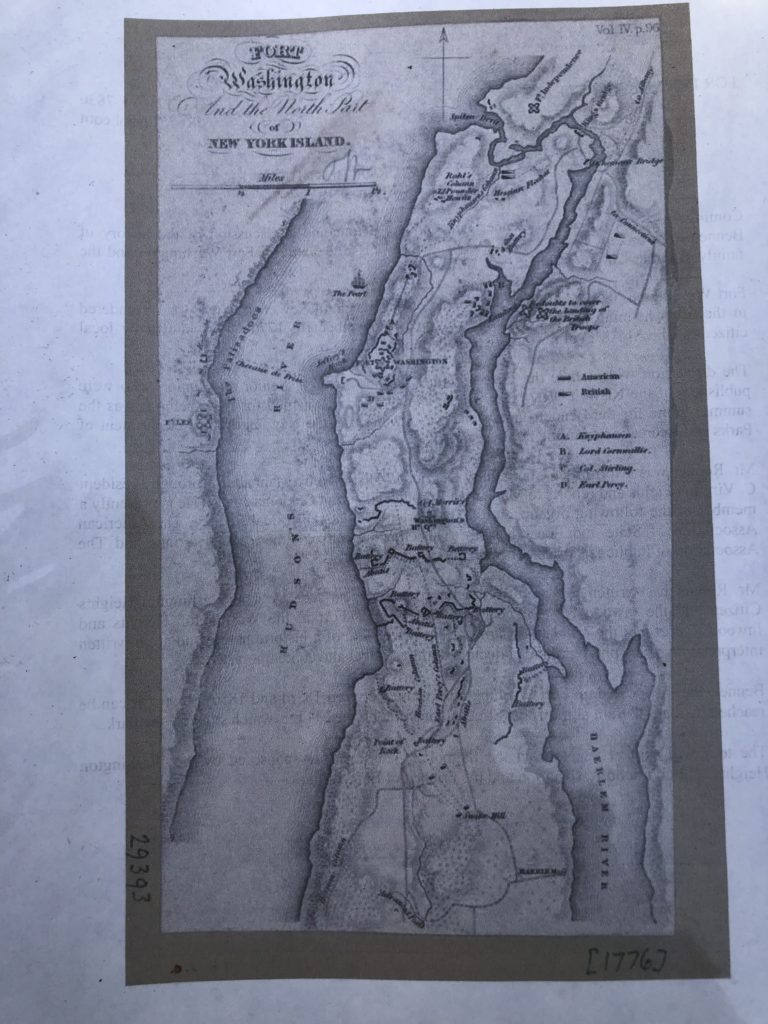
I live near Fort Tryon Park in New York City, site of the Battle of Fort Washington, one of several important battles fought by the retreating Continental Army during the American Revolutionary War.

The park is near the top of a sizable hill in the area, and the lawn where the re-enacting took place is just below the redoubts where Margaret Corbin took her husband’s place in battle after his injury, continuing the canon fire against the oncoming Hessian and British troops. She was badly wounded, but survived.

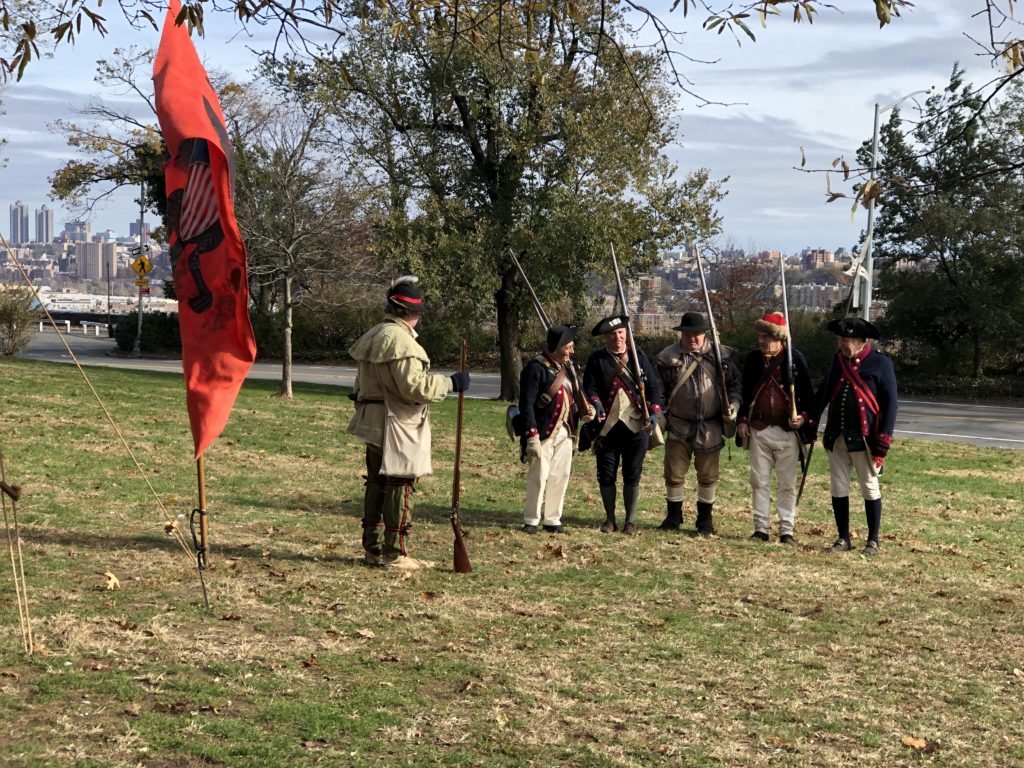
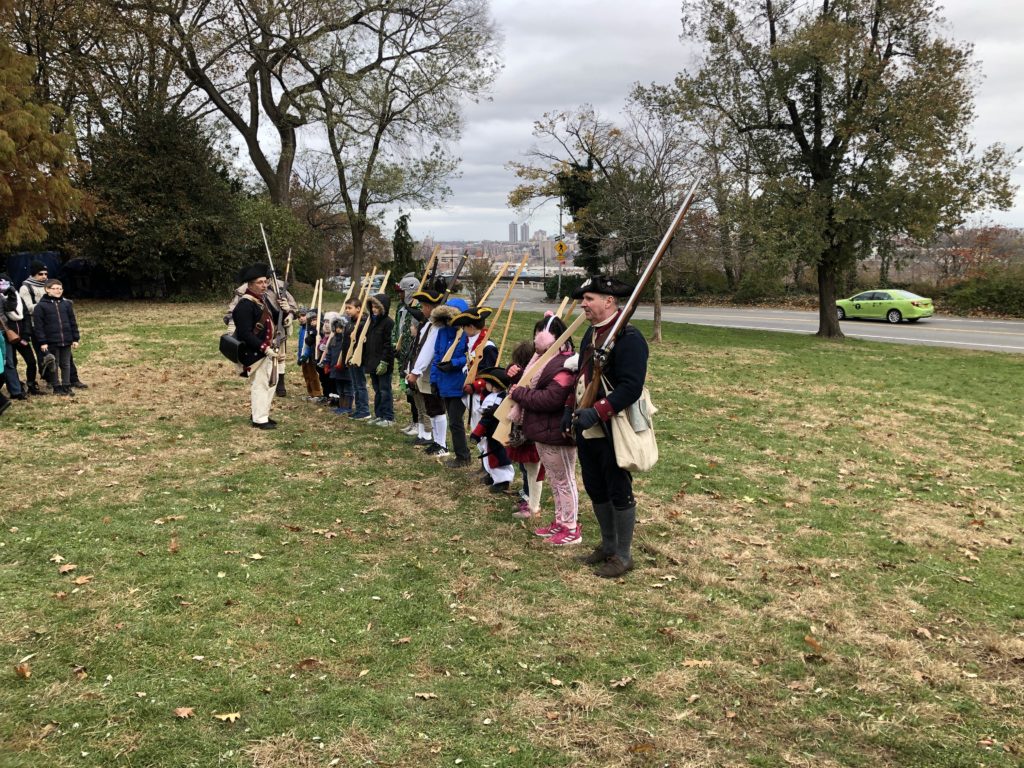
I was able to briefly attend a re-enactment of the battle, an event held annually in the park. It was, as our local parks administrator put it, a low-key affair. A small tent formed the “headquarters” for the re-enactors. There was one fellow dressed as George Washington himself, and perhaps half a dozen Americans dressed in non-uniform “uniforms”, just as the actual Continental Army was.

Continental Army
Continental Army.

About three redcoats showed up, mostly from New Jersey; according to one, Monmouth County has a sizable number of re-enactors. Driving over the George Washington Bridge (ironically) and its $15 toll was the greatest deterrent to British invasion.

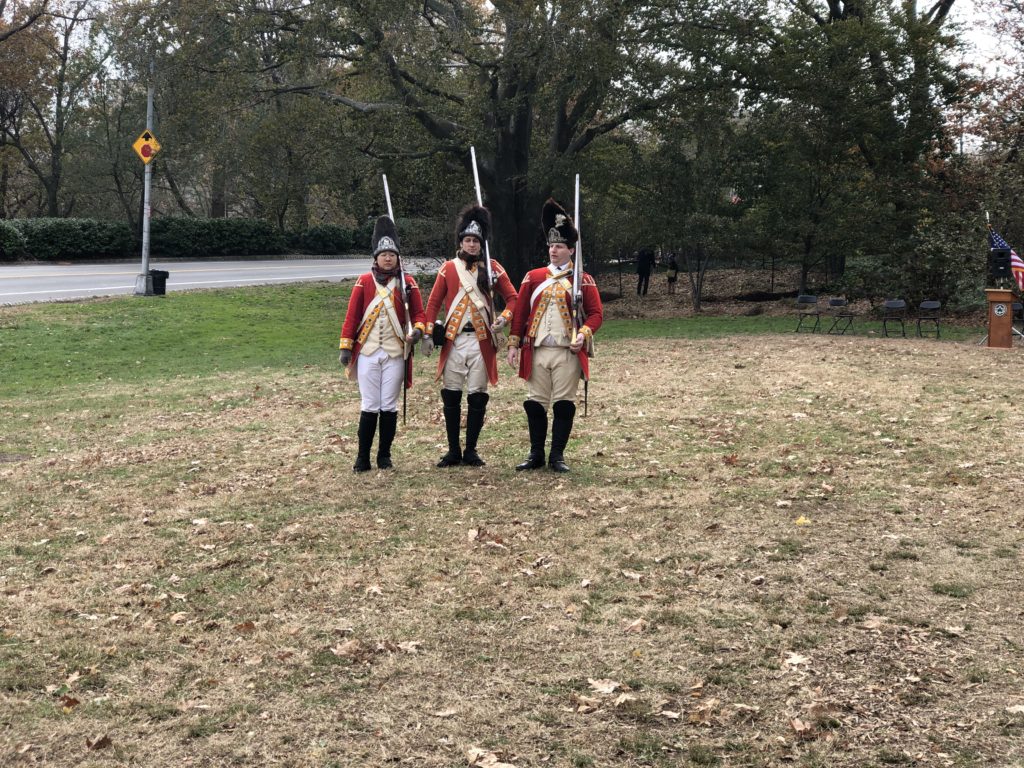
The Redcoats
The Redcoats.

Several amateur historians had laid out tables with printouts of articles and biographies they’d written. It was a bit windy, and cold; fortunately the New Leaf cafe in the park provided complimentary hot cider and small pastries. There were also laminated reprints of old newspaper articles about the re-enactment; one that I read dated back over a century.

Old Northern Manhattan
Old Northern Manhattan.

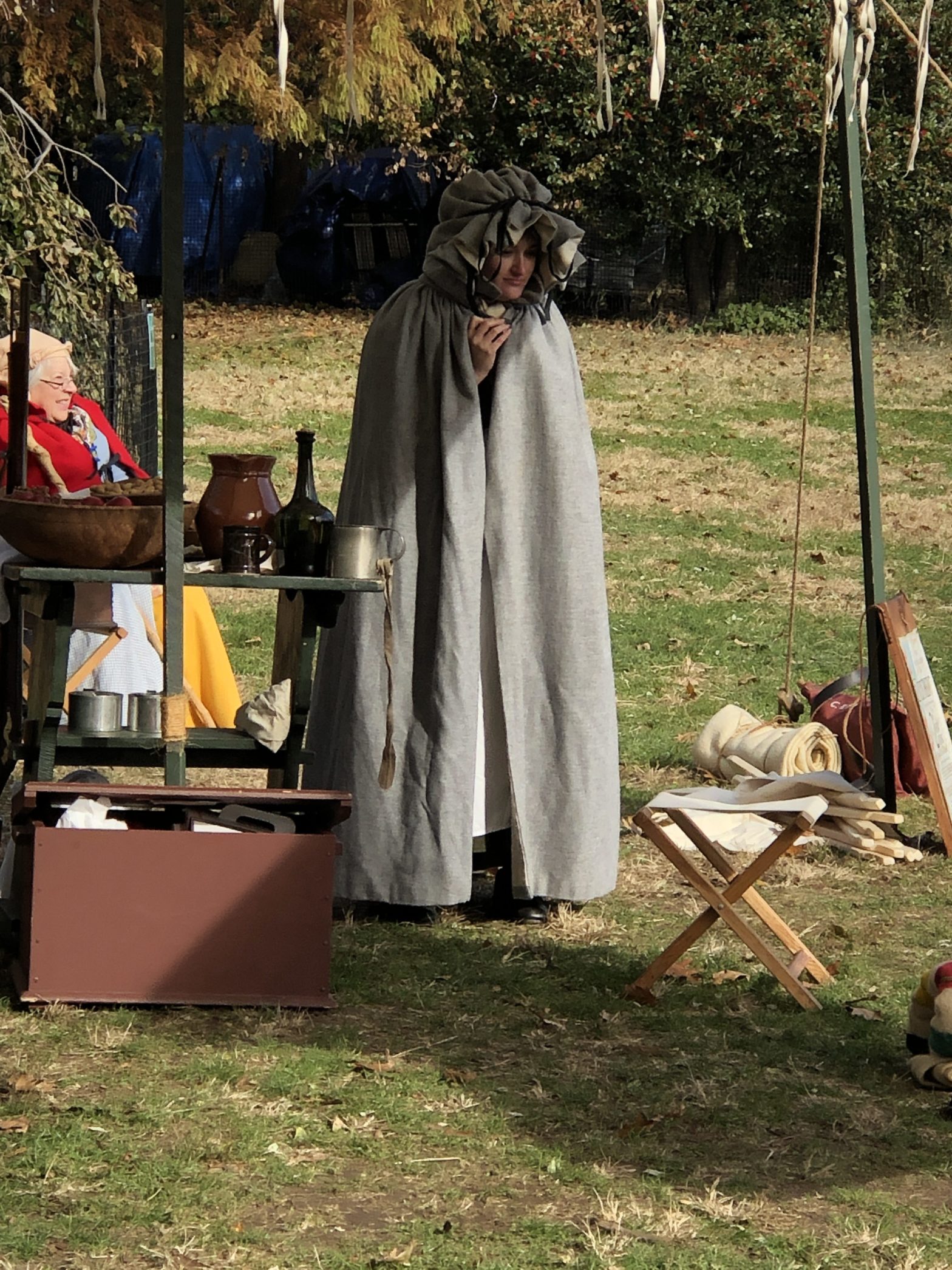
One woman dressed in period garb led fifteen-minute “tours” of Margaret Corbin’s life. The main road through the park is named for her (Margaret Corbin Drive), and she’s something of a local hero: troubled childhood, married young, and followed her husband, who served as a cannon loader in the Continental Army. In the battle, as he fell injured, she took his place, and was later captured, but released to care for the inform, while many of her fellow soldiers were sent to languish in British prison ships in the East River.

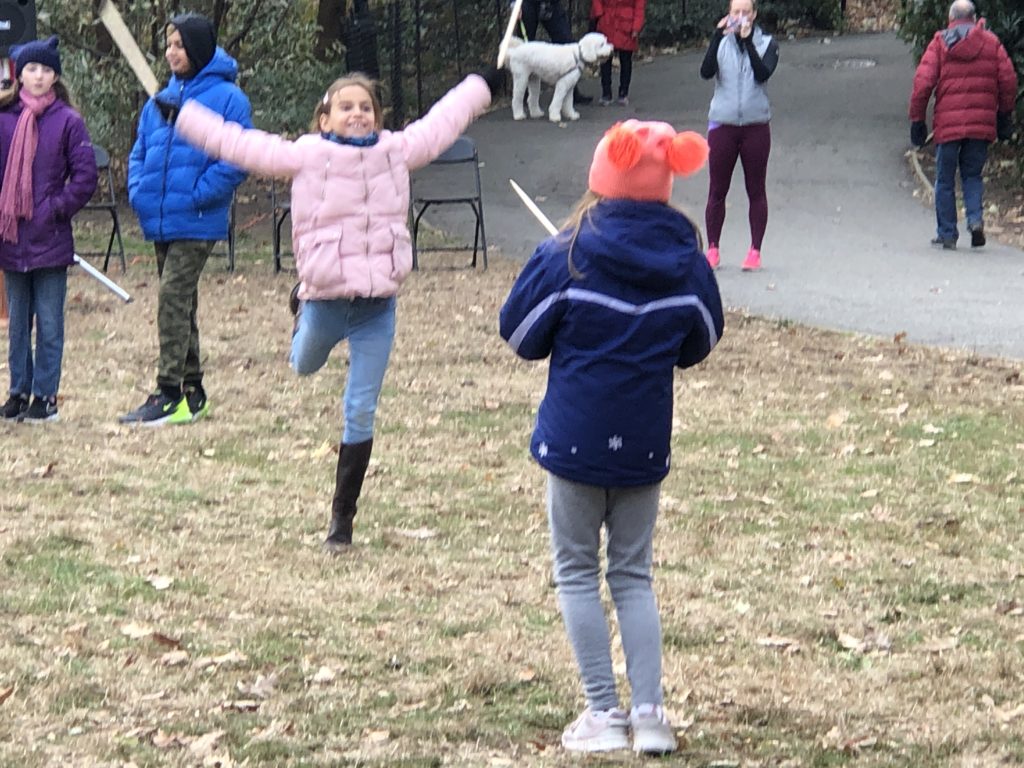
I waited and waited for the battle to start; even the re-enactors were unclear as to when; I suspect they were waiting for a sizable crowd. Loudspeakers were set up playing Colonial-era fife & drum music; children played happily with stick-and-hoop sets, which looked remarkably more fun than is commonly expected in the modern era of franchise toys and mobile device games.

At Play
Stick and Hoop Win.

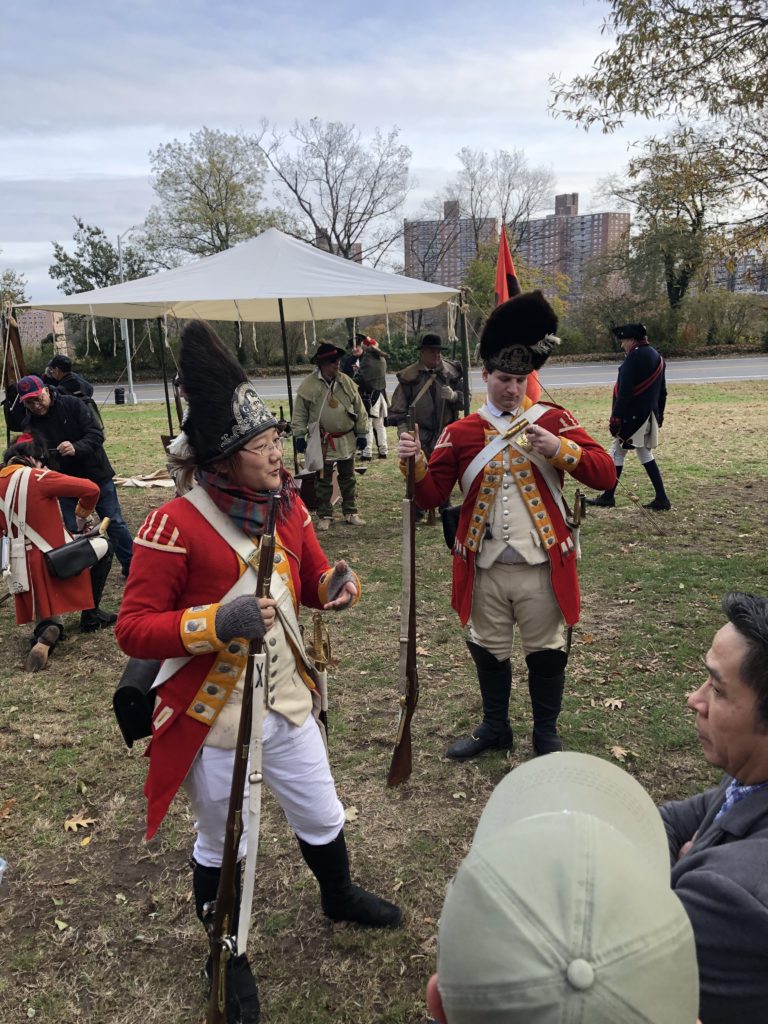
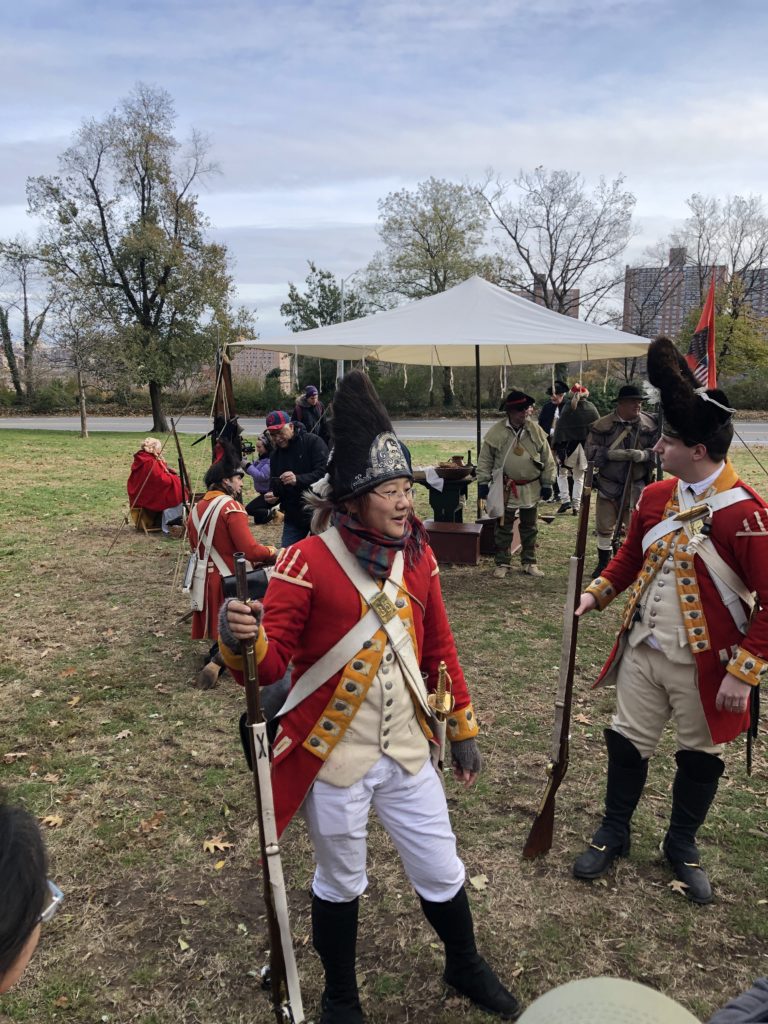
I spoke with a couple of the re-enactors, both on the British side. One was a woman who not only clearly loved the history behind the uniforms and gear, but was also very good at explaining it all, to children and adults alike. I asked her about the tall, pointed fur hats they wore, and she said basically, they were meant to make the already tall, robust assault troops known as Grenadiers look even taller and more robust.

Redcoats
Redcoat Grenadier.

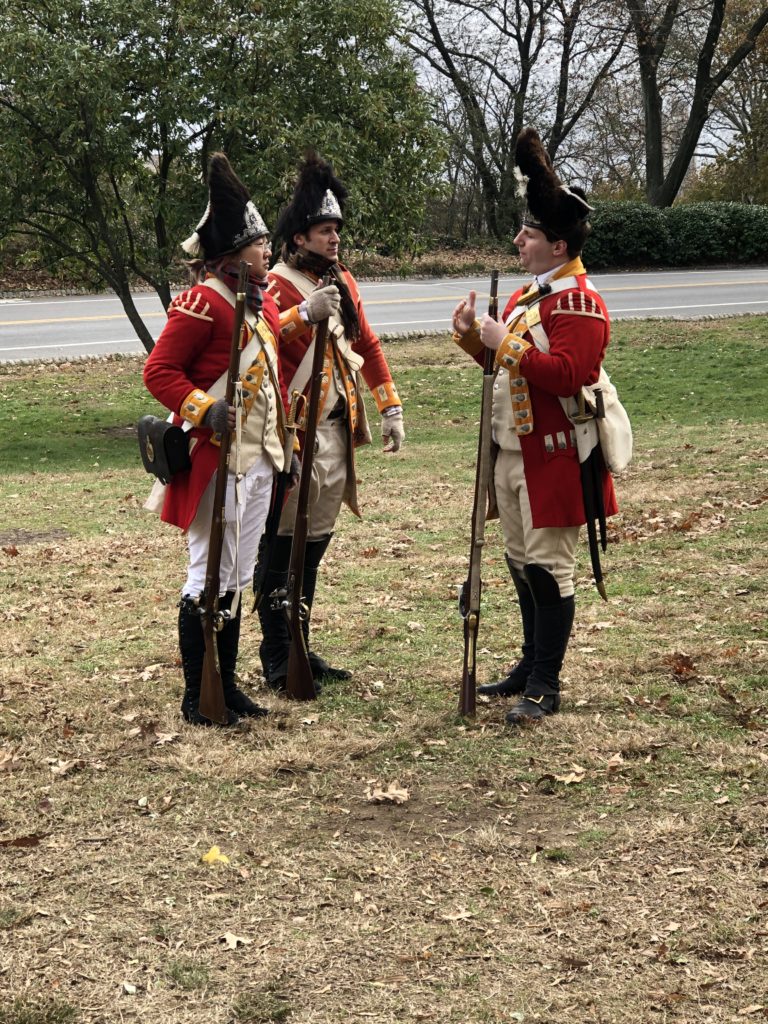
A fellow re-enactor said he’d been at this for eighteen years, and later, seemed to take the role of commanding the other two troops as they walked in parade drills.

Redcoats Drilling.
Redcoats Drilling.
Redcoats on Parade
Redcoats on Parade.

As I looked around, I tried to imagine the landscape largely devoid of human activity; mostly farmland, even Native American country. No Bronx rooftops, or long winding drive with an NYC taxi cab racing behind the Continental Army. Imagining the park without the grooming and care that it gets now, imagining what it would have been like to race up and down hills delivering messages, sighting cannons at incoming enemy troops; being fired upon, and stormed by large men in red coats, with burning matches hanging from their collars, hurling explosives and wielding large, pointy bayonets affixed to their muskets. Despite the small showing, the scene was very vivid to me.

New Recruits
New Recruits.

Unfortunately, I gave up on waiting; it was cold, and I had work to do. Still, it was good fun, feeling a part of that history, and a part of the neighborhood. Having just completed reading a biography of George Washington, the battle and its importance in American history was still fresh in mind, and it was a great feeling to experience it, however vicariously, with a simple walk in my neighborhood.

Renaming History

“Man at the Community Board meeting wants to rename Fort Tryon Park,” said the Engineer.

“To what? Did he offer any other names to ‘try on’?” The Musician scooped up butter for his toast, and they settled down around the table.

“That is silly,” said Madame. “It has always been Fort Tryon Park.”

“That’s what the woman from Parks said. Fort Tryon Park. So named since the Revolution.” The Engineer carefully sliced his eggs open, to let the runny bits spill out. “But he opposed it since that was the name of the English governor at that time. Said the man tried to kidnap George Washington himself. Rather, he hired or ordered men to attempt that.”

“Sounds like he was just doing his job,” said the Musician.

“Well that’s what I thought. But also apparently the governor was considered cruel even by his own people.”

“The British?”

“Presumably so. All up and down the East Coast. He was governor of North Carolina before that.”

“Perhaps it is not so terrible an idea,” said Madame. “I mean, it is strange to keep a park named after an opposing side’s leader. Especially since everything else around here is named after George Washington.”

“Every melody has its counter,” said the Musician.

“I feel things should maintain their history no matter how ignoble. And, in any case, the woman from Parks said even the Americans back then called it Fort Tryon. Even though it was originally part of the Fort Washington defenses, after the Americans were defeated, it was renamed Fort Tryon and after the war no one bothered to rename it.”

“How strange,” said Madame.

“After that, it was essentially private property until the Rockefellers gave it to the city and it became the park it is today.”

“It occurs to me,” said the Musician, “that perhaps there is wisdom in keeping the name as it is. Would we even be talking about this Tryon man if not for the name of the park?”

“We could name it after Margaret Corbin,” said Madame. “She was the wife of an American solider who took his place on the line when he was injured. She only has the road named after her. Margeret Corbin Drive.”

“Now that is an idea I could get behind,” said the Engineer. “But the bigger question is, do we bother honoring our enemies, at least those we defeated? The British won the battle and renamed the fort, but lost the war. Perhaps little informational signs in the park.”

“I do not know. I only go there for the flower garden. And the view.” Madame sighed as she sipped her coffee.