Cruising Lake Champlain, Part 1

It was a surprising idea, even a worrisome one, proposed by David’s father: in order to have a vacation in Vermont, which at the time required New Yorkers to quarantine on visit, why not live and sail on the family sailboat?

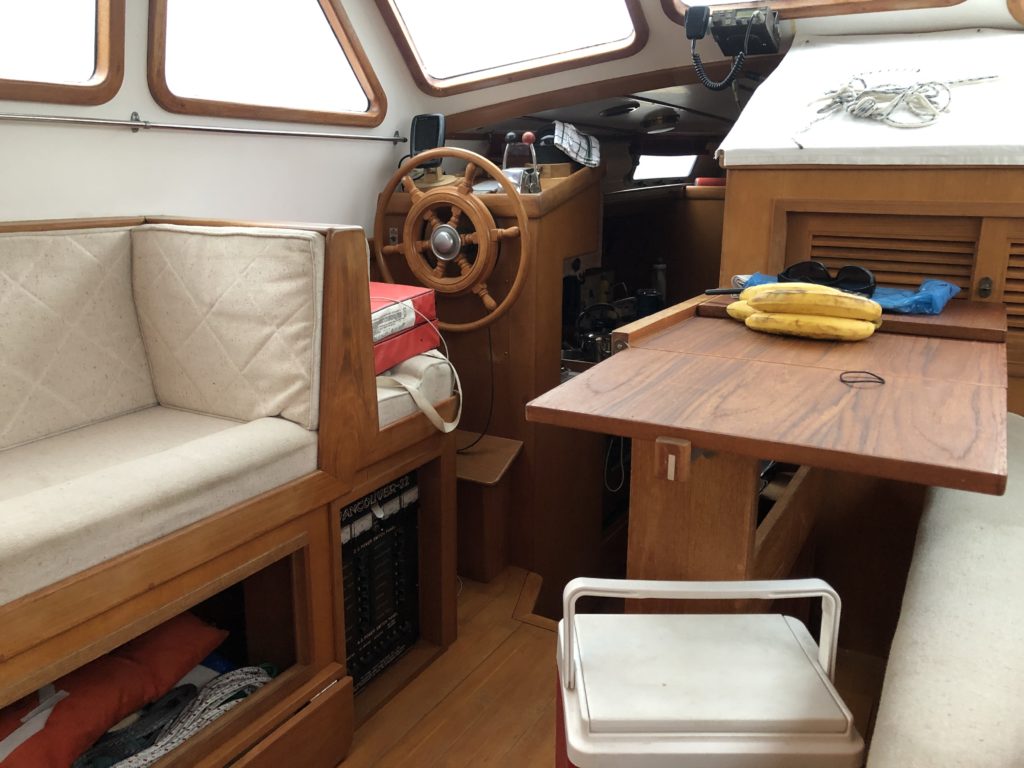
David has experience sailing, but nothing this big. He’s taken me out a few times on boats in the 23-26 foot range, as well as a sunfish, but nothing like this: a Vancouver 32 cutter with enclosed pilothouse. The Wind Rose is a fine ship, one that could comfortably sleep the two of us, with a two-range galley and inboard diesel motor.

It was really, really hard to say no, and after an initial trial weekend, we decided to give it a go.

We drove up in early October; by then, the lake water would be cooling and the air turning crisp. We were a little worried about overnight air temperatures, so we brought a lot of layers: blankets, clothes, extra jackets, wool socks. This was in addition to the food for galley cooking: breakfast, lunch, and dinner, as well as snacks. We also brought on potable water, because while the ship has water tanks suitable for rinsing dishes, the water tanks are thirty-five years old and, according to the owner, difficult to clean.

While it was a bit embarrassing how much stuff we had, we were fortunate to load up at a slip in the marina, a bit south of Burlington, Vermont. We had charts and some good anchorages marked on them. We took a look at the weather and went for a bit of a sail, before returning to the marina for our first overnight stay. We’d done some preliminary research.

Cruising Lake Champlain, October 2020
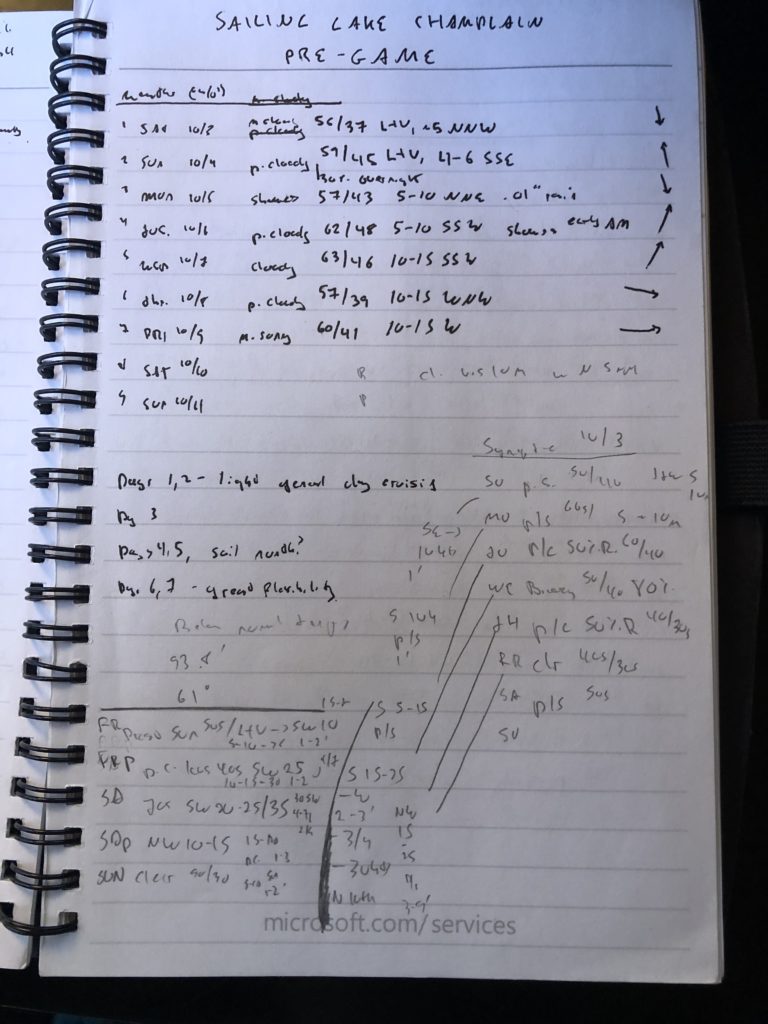
Pre-Planning.

Overall, the forecast for wind kept us south. While we might have headed north, we wanted to take the first few days easy, and not get stuck too far away to come back without much effort.

We awoke early and had breakfast, then started determining our routine: listening to the weather forecast over the radio and determining our goals for the day.

Day 1
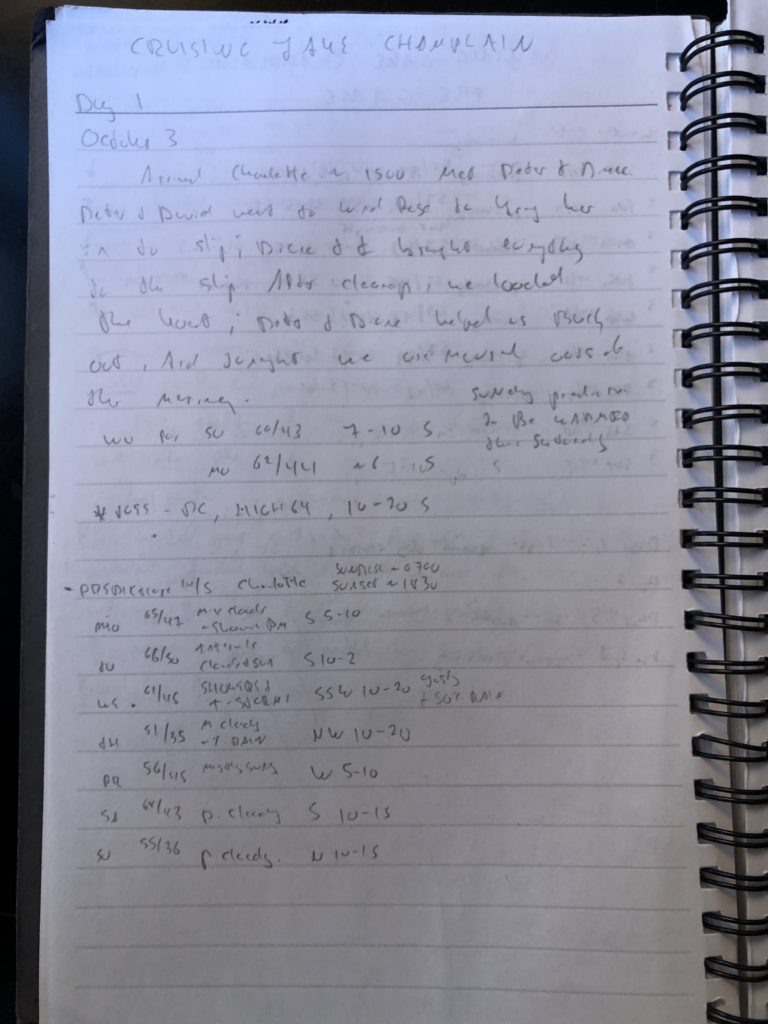
Cruising Lake Champlain, October 2020

Arrived Charlotte ~1500. Met P&D. P and David went to Wind Rose to bring her in to the slip; D and I brought everything to the slip. After cleanup, we loaded the boat; P&D helped us back out. And tonight we are moored outside the marina.

Essentially, we sailed for a couple of hours and came right back to the boat’s normal harbor, content to sleep aboard the vessel.

Day 2
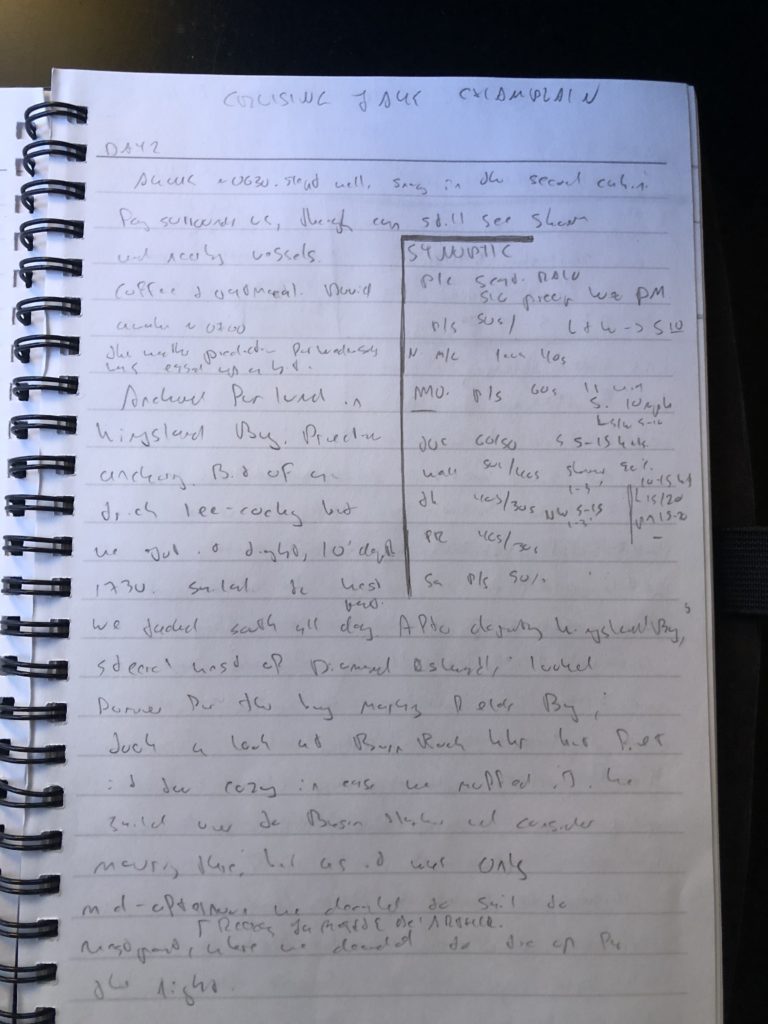
Cruising Lake Champlain, October 2020

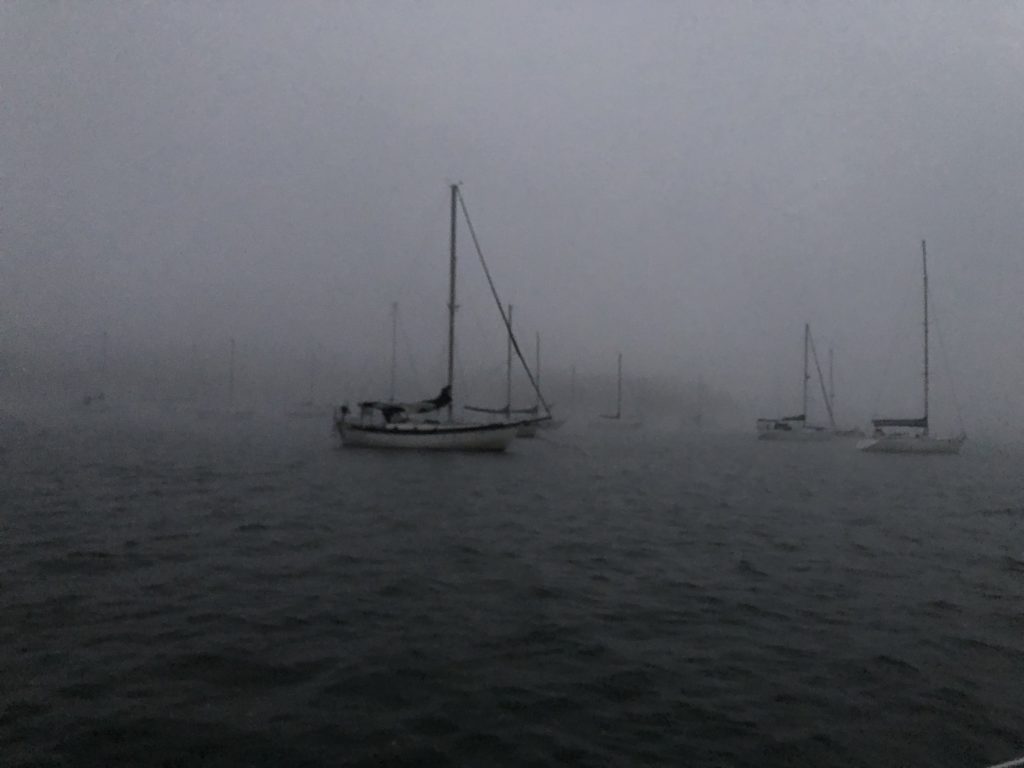
Awake ~0630. Slept well. Snug in the second cabin. Fog surrounds us, though can still see shore and nearby vessels.

Coffee & Oatmeal. David awake ~0700.

The weather prediction for Wednesday has eased up a bit.

Anchored for lunch in Kingsland Bay. Practiced anchoring. Bit of a trick lee-cocking but we got it right, 10′ depth 1730. Sailed to Westport. We tacked south all day. After departing Kingsland Bay, steered west of Diamond Island, looked forever for the buoy marking Fields Bay. Took a look at Barn Rock Harbor but found it too cozy. Then sailed over to Basin Harbor and considered mooring there, but at it was only mid-afternoon we decided to sail over to Westport [read La Morte D’Arthur] where we decided to tie up for the night

The second day was our first day of really sailing. We listened to the weather forecast. We plotted basic courses on the chart. We chose multiple destinations, unsure how far we’d get. We sailed.

We would return to some of these places. Much of the first few days were simply getting familiar with the area, as well as gauging how far and how fast we could sail.

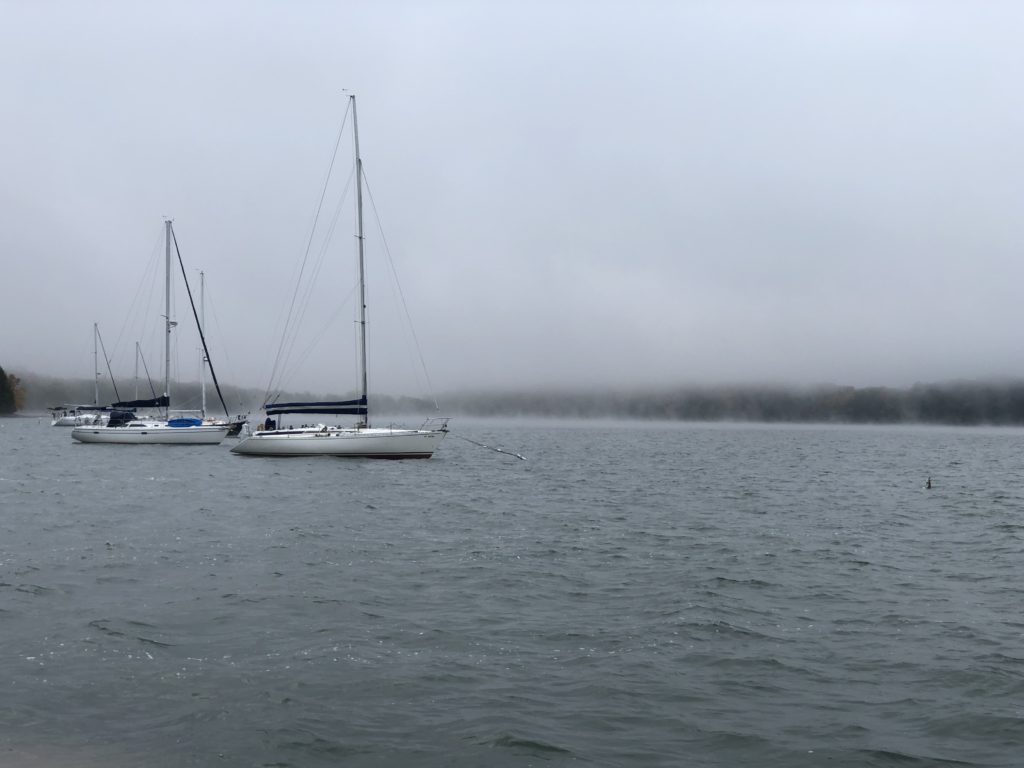
It was foggy in the morning, but but the time we were done with breakfast, it was already burning off to become a beautiful day.
Cruising Lake Champlain, October 2020
Early Morning.
Cruising Lake Champlain, October 2020
In the Marina.

The ship itself proved quite comfortable. In our trial run we’d slept forward, in the V-berth, but I found it a bit high to climb in and out of. We used that for storage and stayed in the side cabin.
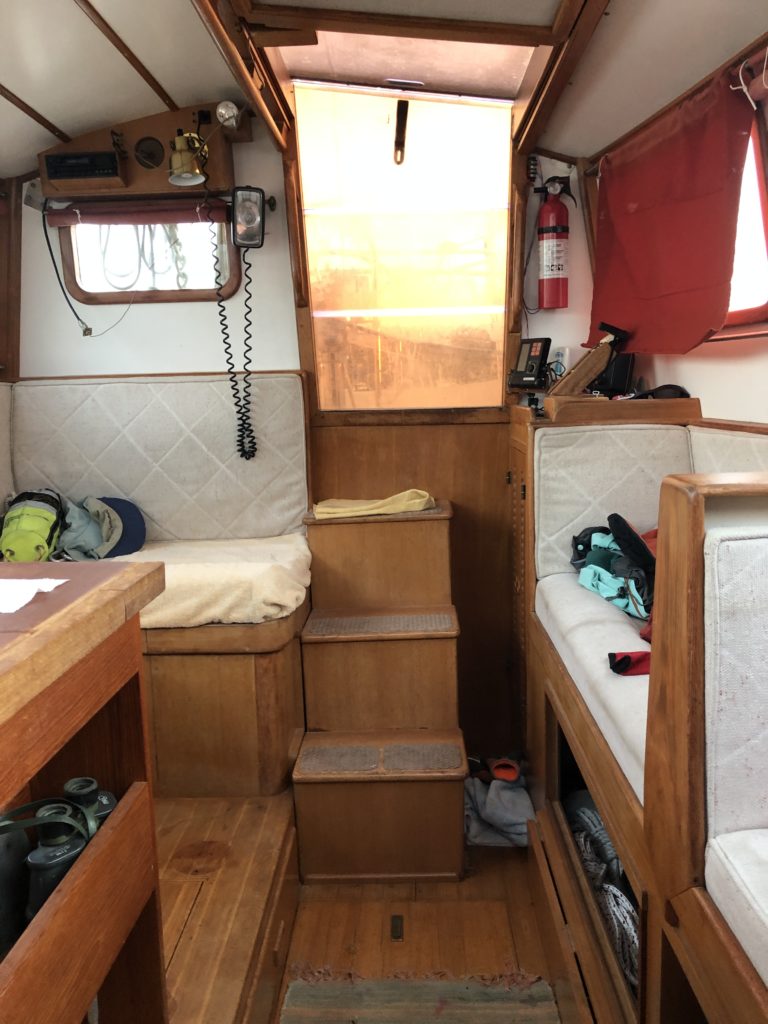
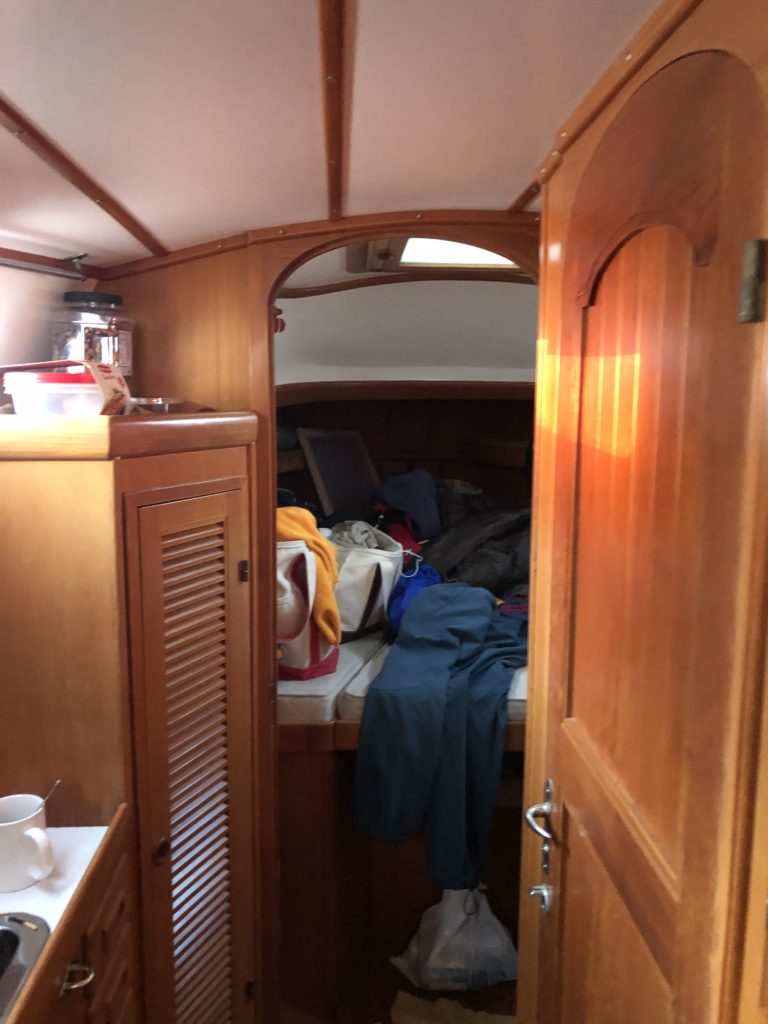
Cruising Lake Champlain, October 2020
Looking Aft.
Cruising Lake Champlain, October 2020
The V-Berth

We had been a bit concerned about heat. The ship has a propane heater, which proved brilliant at providing nighttime warmth. We also learned that the sun would heat the cabin up quickly, once it was up.
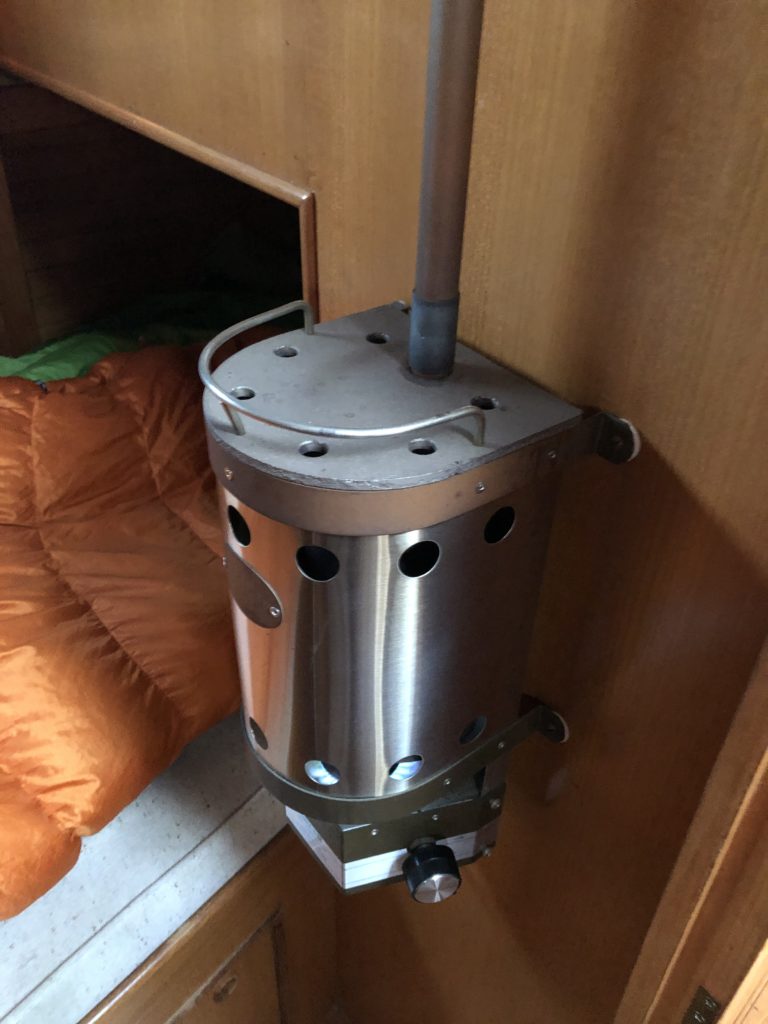
The Heater.
Heater.

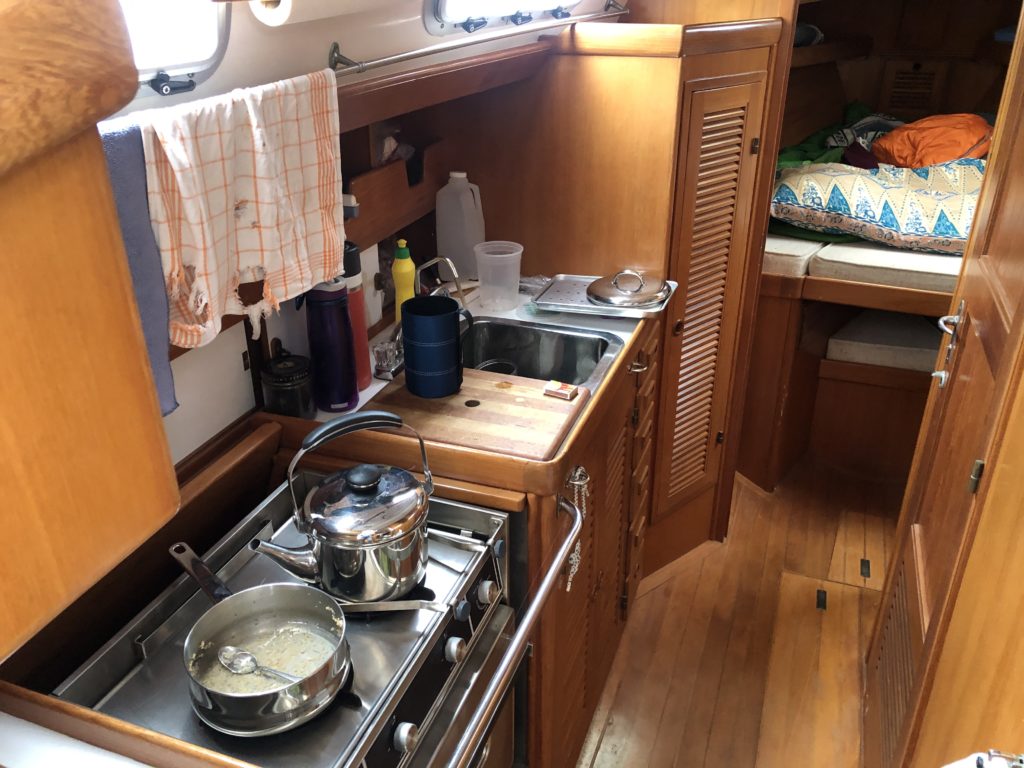
The galley proved more than adequate as well. The ship has an icebox built in, meaning it wasn’t refrigerated but, with some ice in, would keep things cool quite a while. The two-burner range worked, but the oven not so much; to my amusement the entire apparatus is mounted on a pivot, so it can swing with the ship. I didn’t cook on the go, but there were one or two rolly mornings where it was tempting to let it roll freely.
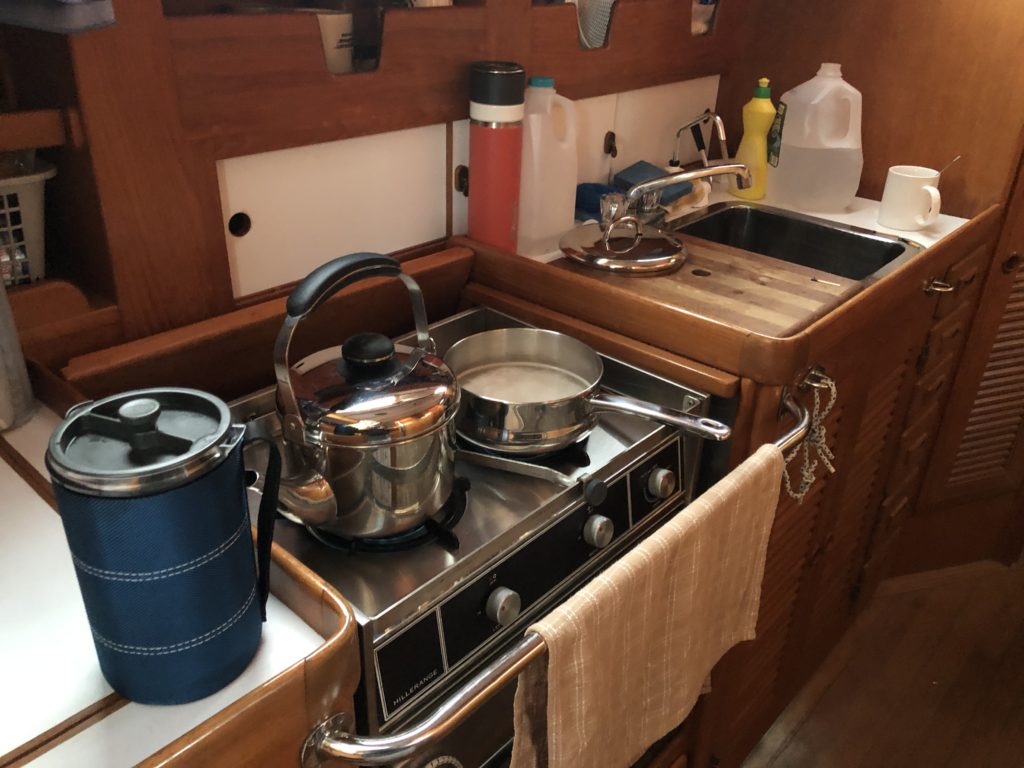
Cruising Lake Champlain, October 2020
Preparing Breakfast.

Breakfast was mostly oatmeal and fruit, though we did do pancakes a couple of days. Coffee was a must.

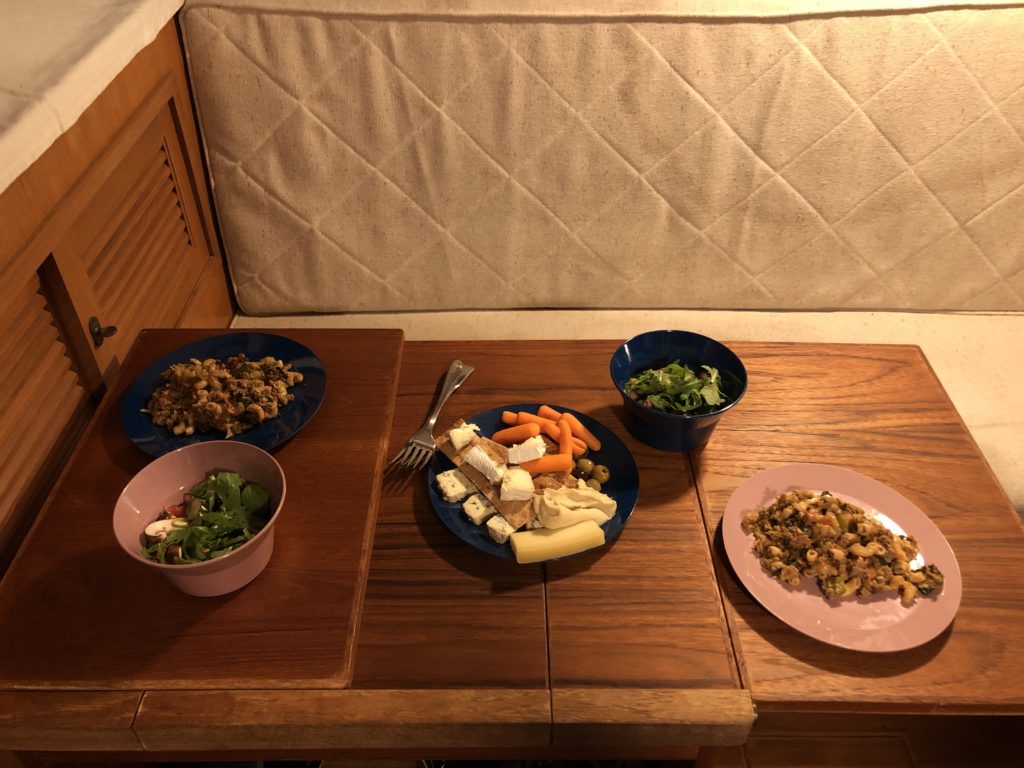
We didn’t have lunch so much as a snack plate – something we could either sit down to, or take turns snacking while we were sailing. Dinner was only put on once the boat was settled in for the night.

Day 3
Cruising Lake Champlain, October 2020

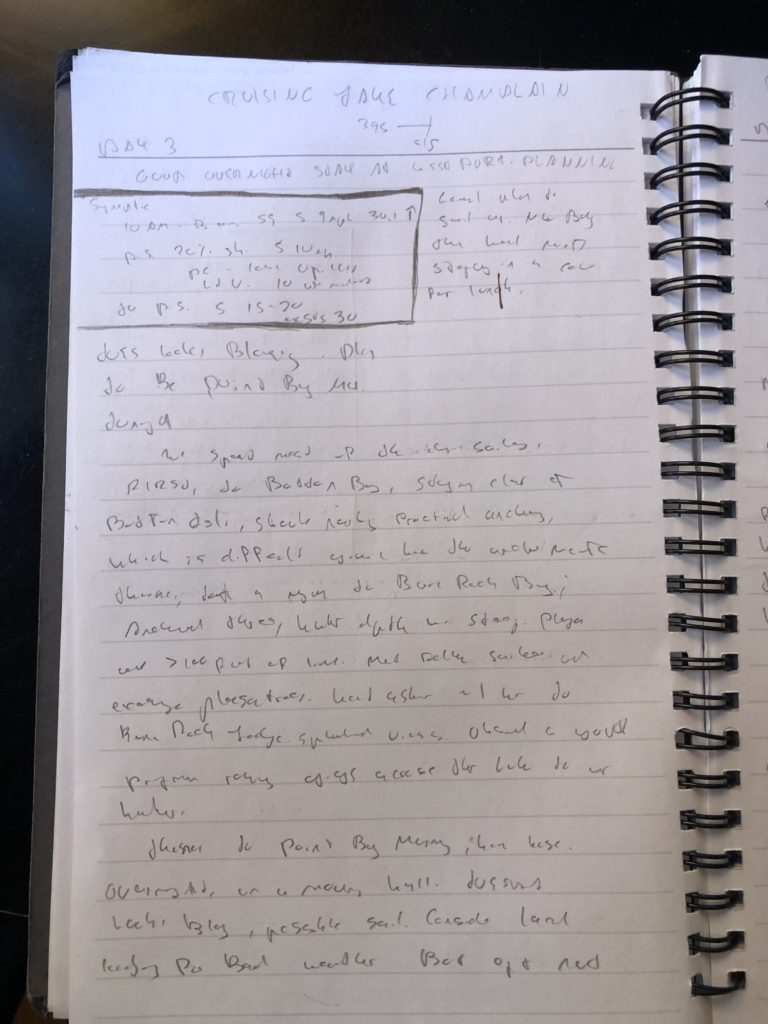
Good overnight stay at Westport. Planning. general Plan to sail ar Northwest Bay, then head north, stopping in cove for lunch.

Tuesday looks blowy. Plan to be Point Bay Marina tonight.

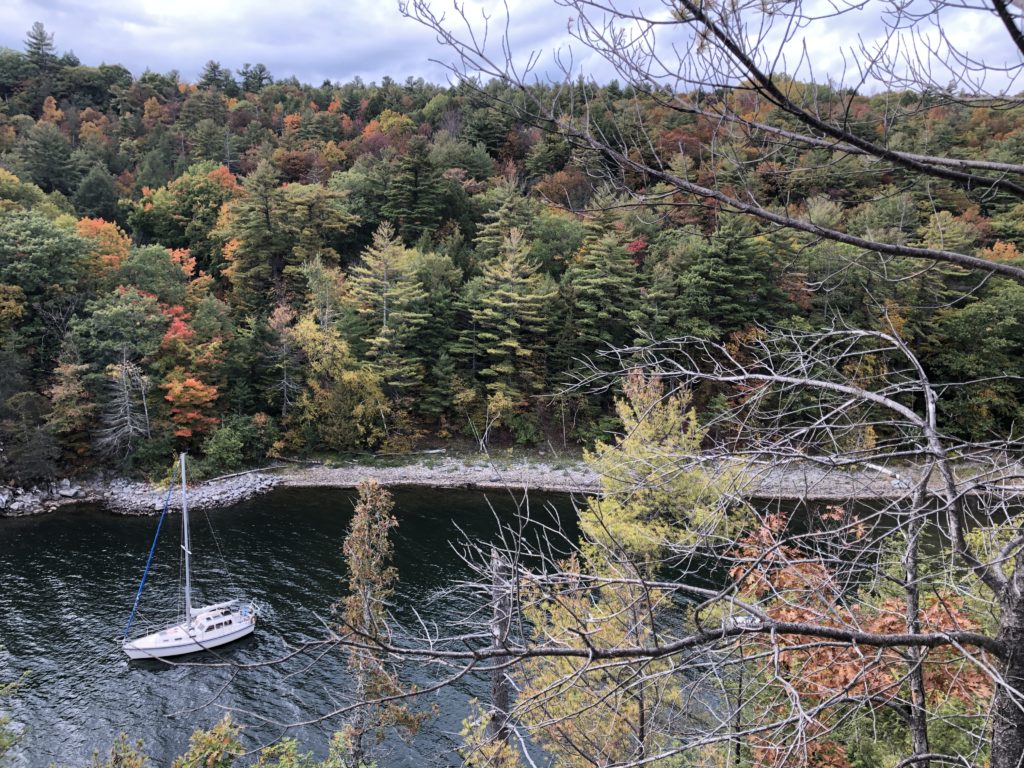
We spent most of the day sailing. First, to Button Bay, staying clear of Button Island […] practiced anchoring, which is difficult given how the anchor mounts. Then, kept a course to Barn Rock Bay [Harbor]. Anchored there, harbor depth was steep. Played out >100 feet of line. Met fellow sailor and exchanged pleasantries. Went ashore ~1 hour to Barn Rock Ledge, splendid views. There is a youth program rowing gigs across the lake to our harbor.

Thence to Point Bay Marina […]. Overnight, on a mooring ball. Tuesday looks blowy, possible sail. Consider land lodging for bad weather. But optimistic not.

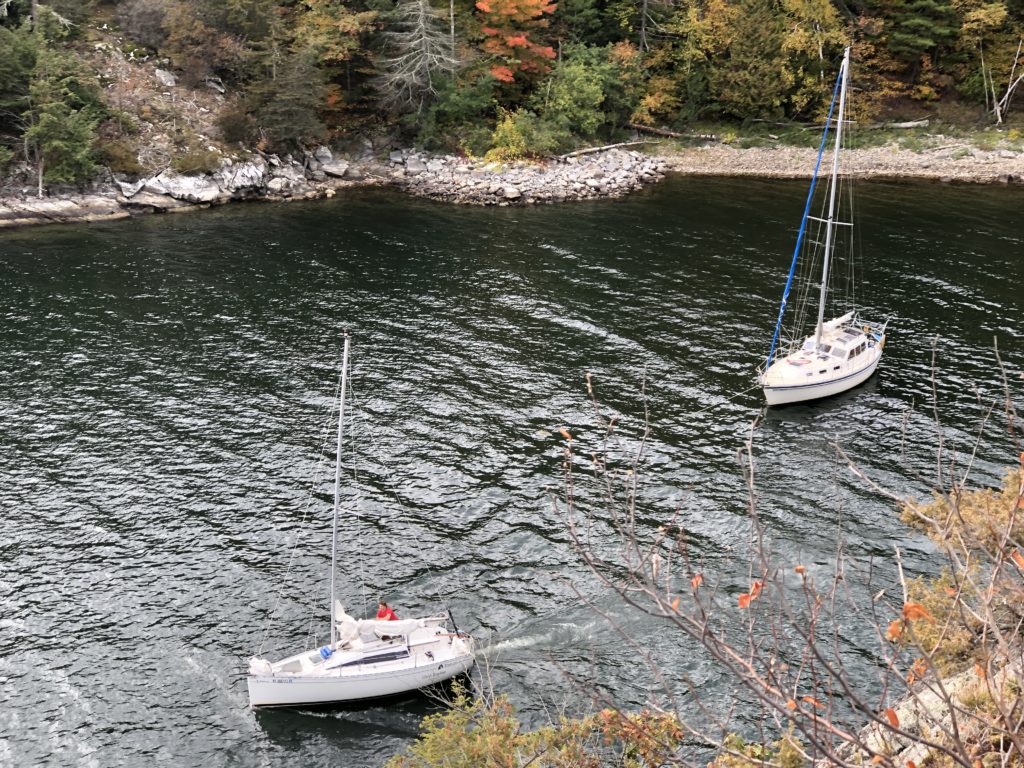
Barn Rock was great. It was simply daunting, because it is a small cove with a very steep dropoff. There’s a narrow window between too-deep and too-shallow. In hindsight we could have anchored farther in, but we didn’t want to cramp our neighbor.
Cruising Lake Champlain, October 2020
Our neighbor departs.
Cruising Lake Champlain, October 2020
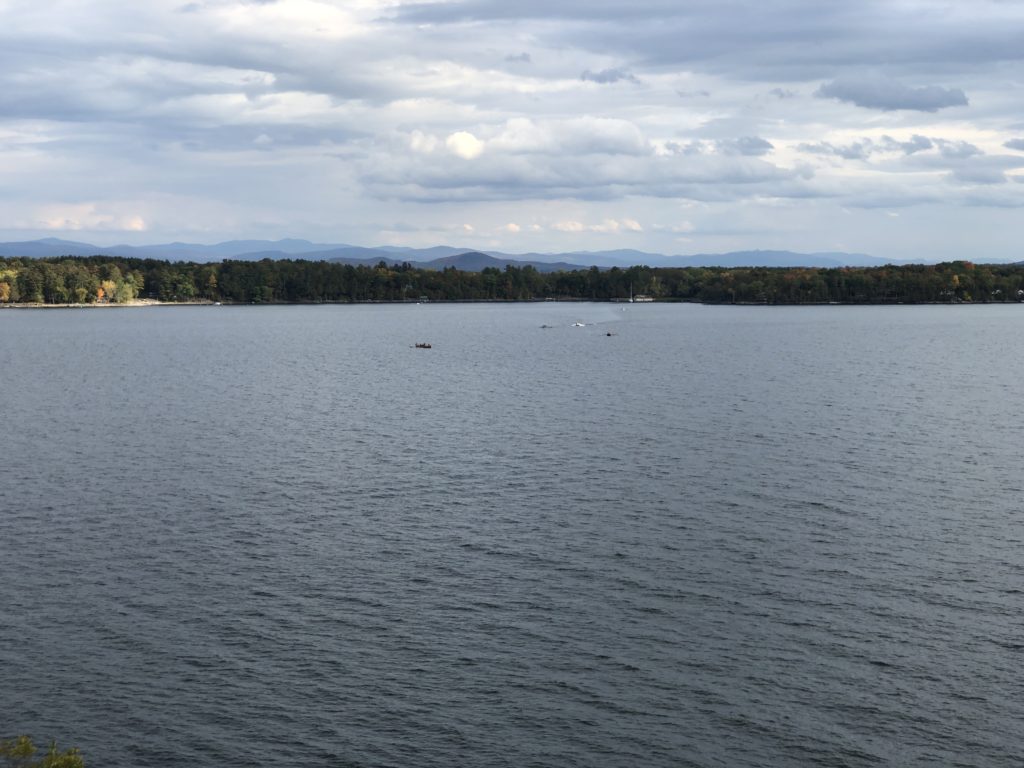
Kids Rowing.

We could hear them from almost a mile away – the sound of kids, rowing hard in a race across the lake. By the time we climbed down and were sailing again, they were rowing back, and we steered around them.
Cruising Lake Champlain, October 2020
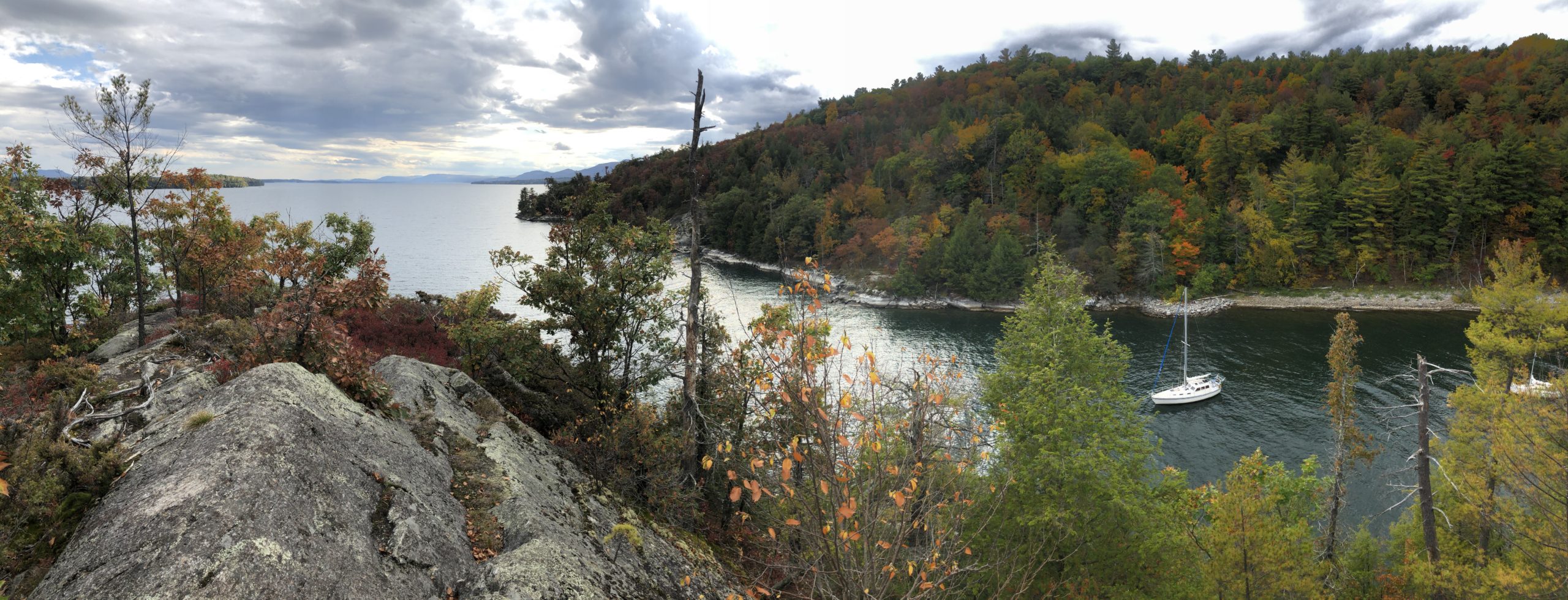
A View From Barn Rock.

The weather was predicted to be formidable Tuesday (Day 4) and possibly thunderstorms on Wednesday, so we set out to “home base” of Point Bay Marina. As I recall though, after consulting with the owner and looking at the wind, we opted to stay in Kingsland Bay, south and facing north across Town Farm Bay to see “home base”.
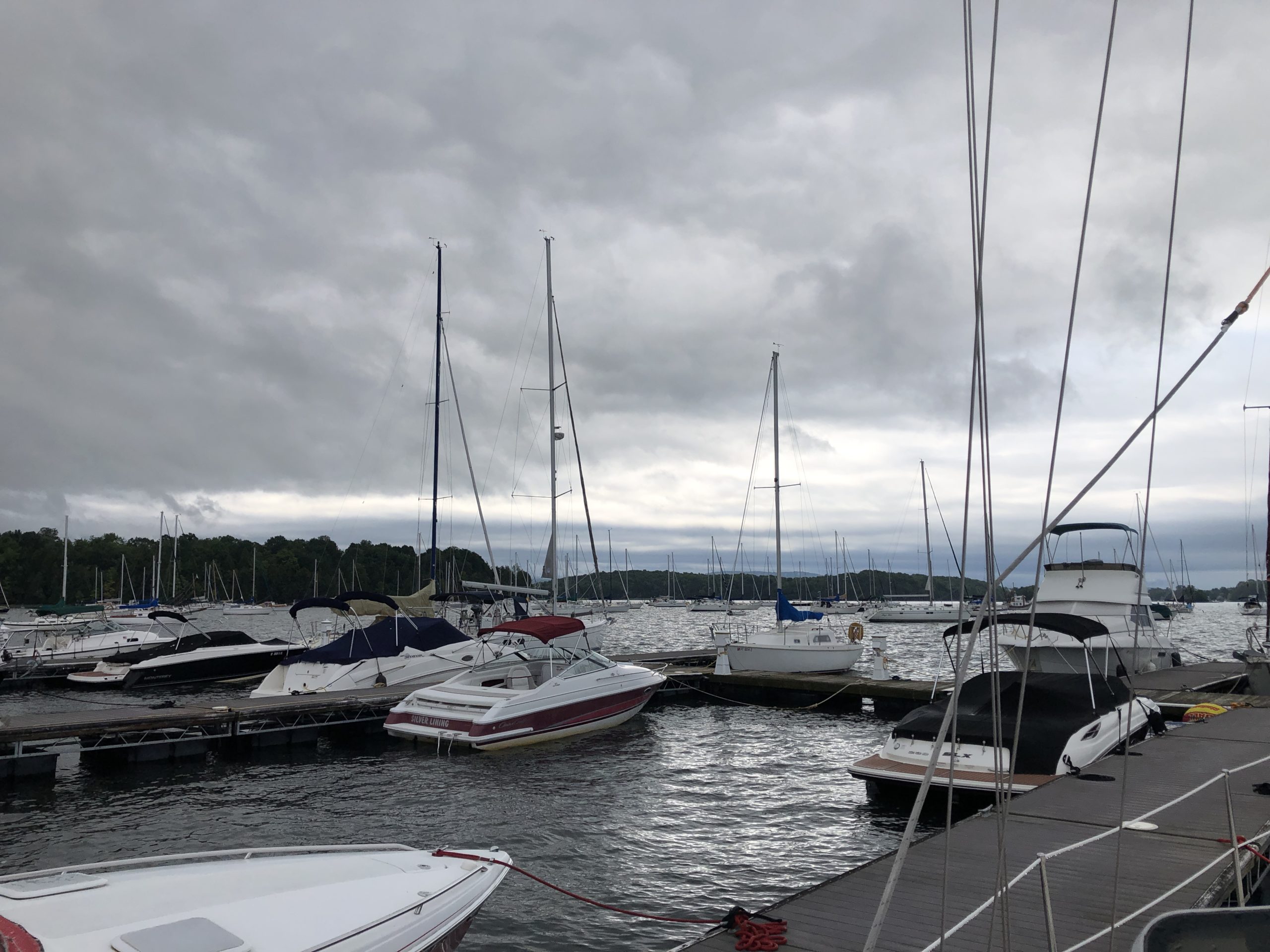
A Short Sail

You can hear the wind. Not just the wind in the air, rustling trees, rattling lines. Inside, whether a boat or a building, the wind might be imperceptible, until you look outside and see its effect on the world around you.

Yet inside, you can still hear the wind, howling from across the lake, pushing the boat to strain audibly against the lines that hold her to the dock. The wind might push the boat against the dock, creaking against the fenders. Howling, mighty, the wind reminds you of its power, even fully inside the harbor.

David and I were aboard the Wind Rose, a Vancouver 32 closed-cockpit sailboat his parents own, on Lake Champlain. We were trying out living and sailing on the boat over a long weekend. I’m happy to say it was a success, and we hope for a longer journey aboard her soon.

After a Friday evening sail with his parents, who showed us the ropes, as it were, we slept and ate aboard the vessel. This came about in part because so many of the travel restrictions due to Covid require quarantine; here, we were able to minimally quarantine while still having a bit of a holiday.

The Closed Cockpit
The Closed Cockpit.
The Galley
The Galley.
Dinner Aboard the Wind Rose
Dinner.

David has taken me sailing a few times on smaller boats. There was a 24-foot boat we rented for a day in Florida; we’ve been out once or twice on a friend’s boat, recently sold; my paddling club has a sunfish, and most recently he’s been part-owner in a 23-foot Oday kept in Piermont, New York, near the Tappan Zee. Mostly, I steer, or work the jib when we tack.

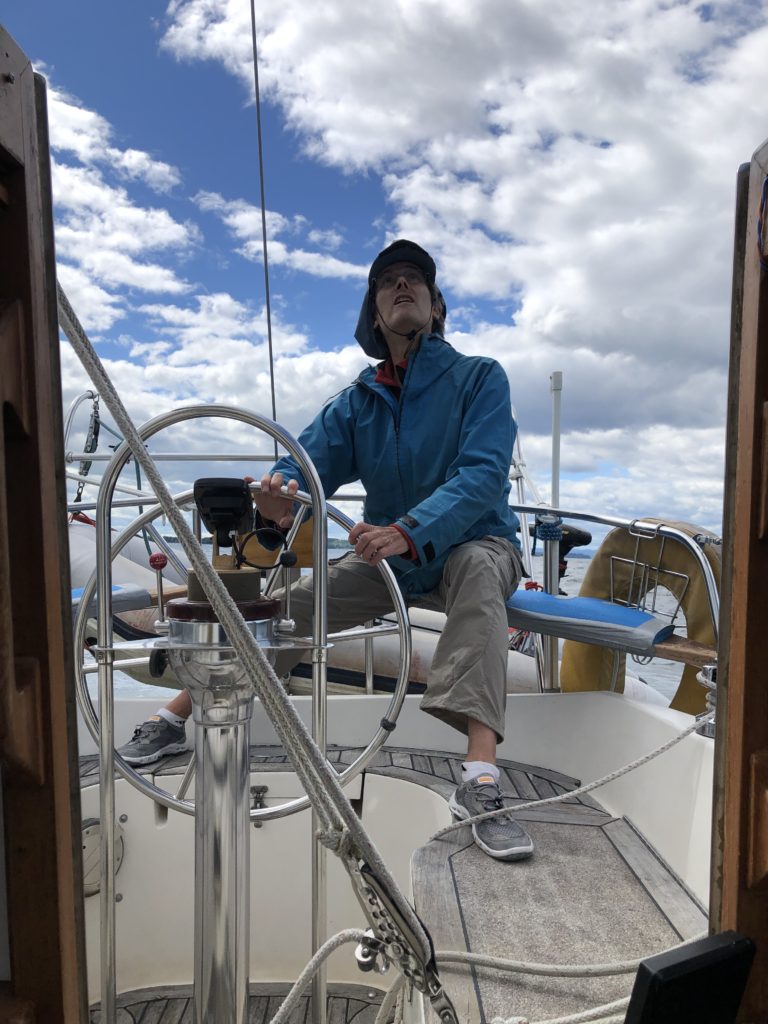
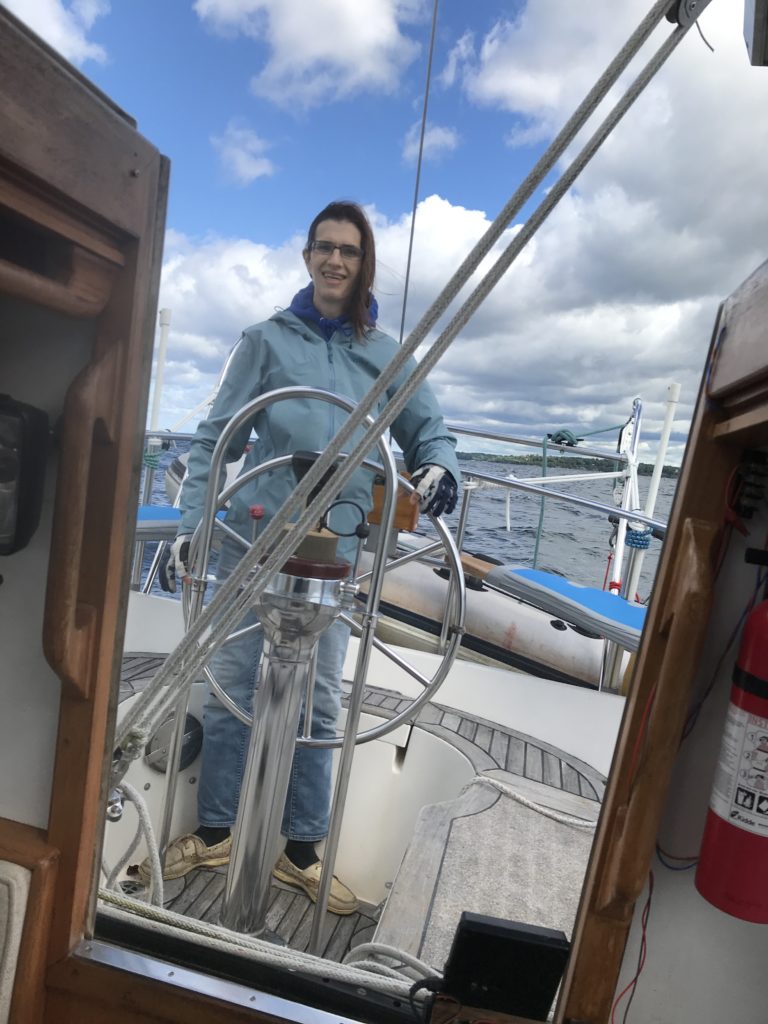
This was my first experience using a wheel for the helm; everything else has had a tiller. That took a bit of getting used to. Gaining a feel for how far to turn the wheel to change course or hold a course took a bit of practice. Additionally, while we did most of the driving from the open cockpit in the back, we made sure to try steering from the closed cockpit position, which offered less visibility in exchange for a bit more shelter from the wind. That was a novel experience.

The Wind Rose is also by far the largest vessel we’ve sailed. At thirty-two feet overall, she was steady and more reassuring in bigger waves. Fortunately, her size belies her handling; she turns very quickly, and in the world of sailing, and handled well both jib-only as well as main-only.

Day 1

Day 1 - Sailing August 2020

SATURDAY AUGUST 29

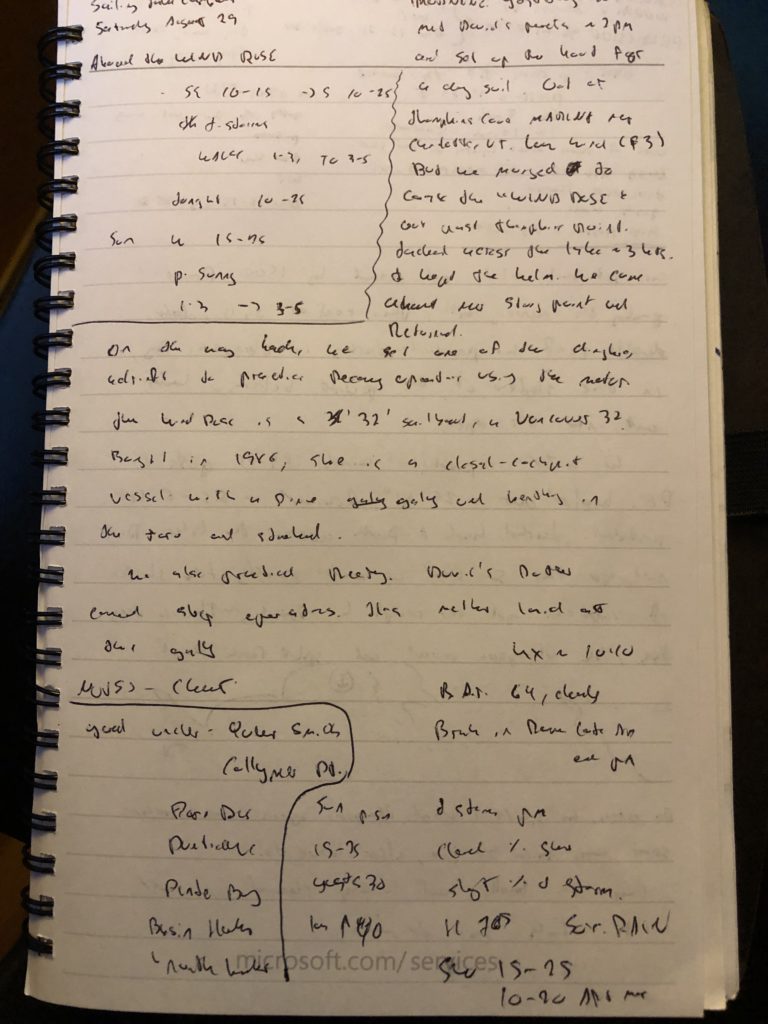
SE 10-15 growing to S 10-25; chance of thunderstorms.

Yesterday we met with David’s parents ~2PM and set up the boat for a day sail out of Thompsons Cove Marina, near Charlotte, VT. Low wind (F3), but we managed to coax he Wind Rose out past Thompsons Point. Tacked across the lake ~3 hours. I kept the helm. We came about to Split Rock Point and returned. On the way back, we set one of the two dinghies adrift to practice recovery operations using he motor. The Wind Rose is a 32 foot sailboat, a Vancouver 32. Built in 1986, she is a closed-cockpit vessel with a fine galley, and berthing in the fore and starboard. We practiced reefing. David’s father commanded ship operations. His mother laid out the galley operations. We were given a list of potential destinations to sail should conditions prove charitable.

Unfortunately, our sailing plans were curtailed by the weather. High winds predominated, in the F5-F6 category, gusts to F7 (16-25 mph, gusting to 30). Thunderstorms were predicted Saturday. Coupled with this being the first time David would be sailing the Wind Rose, and our limited area knowledge, we stayed in Saturday, although by the end it was evident that the worst of the conditions had passed to the east.

We pored over the weather all weekend: the synoptic over the radio, radar maps and raw data on our phones. How strong would the wind be? From which direction? What about wave height? Lake Champlain is notorious for winds running north and south, the long, relatively skinny lake offering plenty of fetch for the wind to grab the surface of the water and push it into mighty waves.

Ultimately we stayed in, reading, talking, learning how the boat’s systems worked. The galley proved quite usable, with a built-in icebox, propane cooking range, and tanks for water and fuel.

Day 2

Day 2 - Sailing August 2020

SUNDAY AUGUST 30

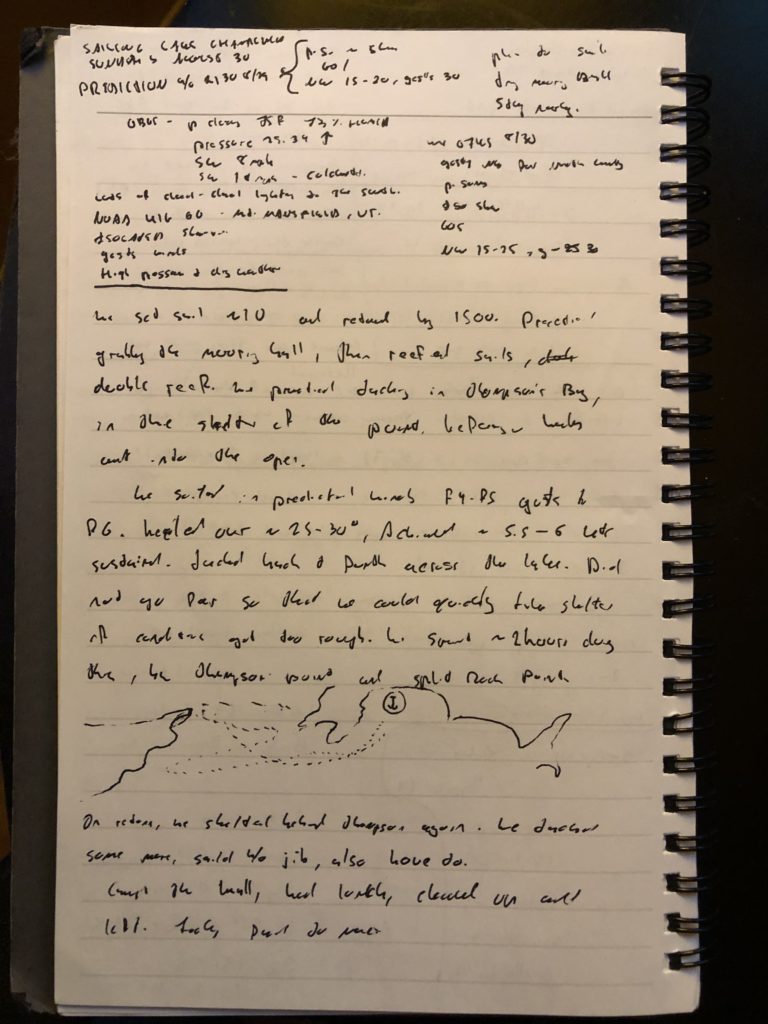
Isolated showers, gusts of wind. High pressure system and dry weather coming in from the west. P cloudy 75 F, pressure 29.34 and climbing. Winds NW 15-20, gusts to 30.

We set sail ~10 and returned by 1500. Practiced grabbing the mooring ball, then reefed sails, double reef. We practiced tacking in Thompsons Bay, in the shelter of the point before heading out into the open. We sailed in predicted winds of F4-F5, gusts to F6. Heeled over 20-30 degrees (?), achieved 5.5 to 6 kts sustained. Tacked back and forth across the lake. Did not go far so that we could quickly take shelter if conditions got too rough. Spent ~2 hours doing this, between Thomspons Point and Split Rock Point. On return, we sheltered behind Thompsons again. We tacked some more, sailed without jib, also hove to. Caught the ball, had lunch, cleaned up and left. Looking forward to next.

Day 3

https://www.smugmug.com/app/organize/Non-Kayaking/2020/Sailing-Lake-Champlain-Sept-2020/i-MTxtNjF

Sunday was our big sail. We were underway by 10, and returned a bit before 3. The first thing we did after leaving the slip was to practice grabbing the mooring ball and tying up, which was easier than anticipated. We then tacked back and forth in the shelter of Thompsons Point; with the wind from the northwest, the point protected us from the brunt of the wind while we got a feel for the boat’s handling, and our ability to handle her. We could see bigger water out past the point.

Eventually we set out, and oh my did we catch some wind. We heeled over and our speed ramped up considerably; we touched seven knots but were generally cruising in the five to six knot range. We did not go far; our thinking was that we wanted to be able to quickly duck back behind the point if conditions became too much. Essentially, we tacked back and forth across the lake.

David at the Helm
Helmsman.
Julie at the Helm
Helmslady.

While it was exciting, I have to admit that after a while I was a bit queasy, and didn’t want to prepare lunch while slapping bow against the waves, which were solidly in the two-foot range. We pulled in behind the point and compared strategies of vessels heading out; one was under full sail, another was jib only. We later saw a motor boat being towed back by the marina’s crane rig.

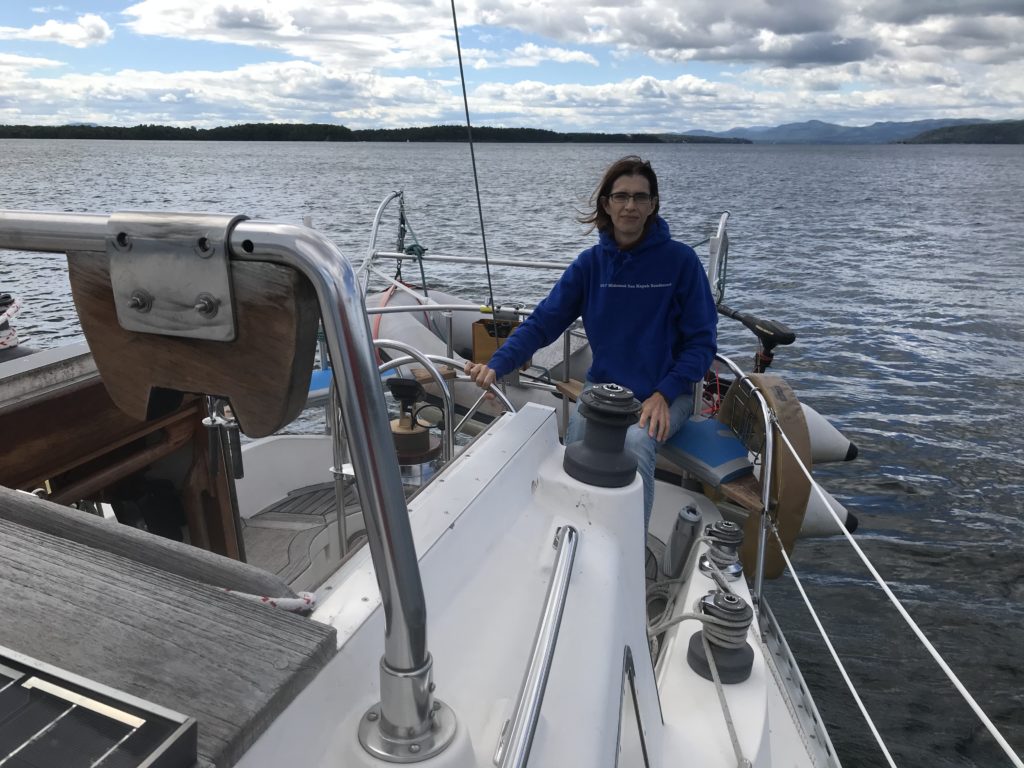
Steering
Relaxed Steering.

When we decided to try and heave too, it turned out his parents were on shore, watching, and apparently we didn’t look too shabby in our efforts. Stopped, barely moving sideways, we took a much-needed break.

When we were done, we started the long process to break things down. Caught the ball, lowered the sails, cleaned the berths, head, and galley, gathered our belongings. We left her ship-shape, and took the dinghy back to shore.

A Different Kind of Freedom

My COVID Journals.

The numbers have come down, in the northeastern United States at least. Numbers are going up in the south, out west, in Texas. Coronavirus and COVID-19 aren’t going away anytime soon, but life in New York is almost normal again.

This was not the case three months ago. By mid-March, our local political leaders were starting to try to do something, anything, often contradicting each other and postponing vital decisions. We were told to stay home except for essential tasks, and in short order, various employers started work-from-home plans where possible.

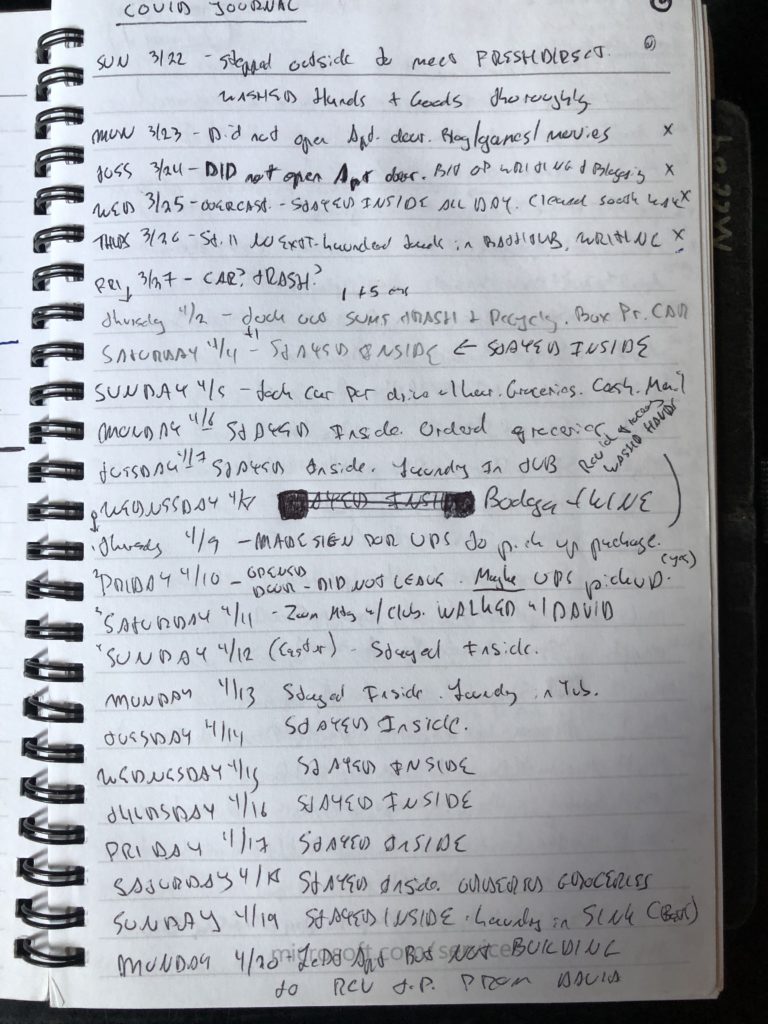
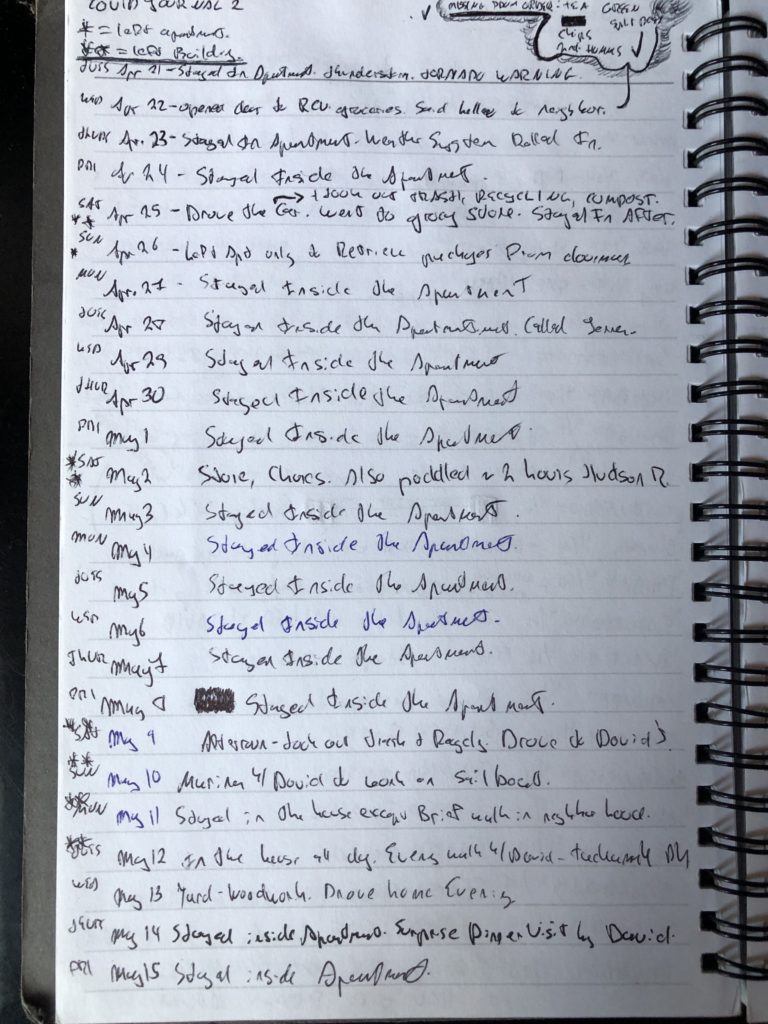
I’m not going to look up the details of what decisions occurred when, or what the body count was week-on-week, day-on-day. I started keeping a diary, partly to keep myself sane. When every day is in the same 500 square-foot apartment, and more and more people are dying daily, it’s good to have a hobby.


In late March I seem to have been playing it by ear. Would I go out? Would I need to? What was my normal routine? Yet by early April I was writing “Stayed Inside” a lot.

COVID Journal 01
COVID Journal 01

There were some challenges early on. David and I talked about whether to visit one another and we decided not to, partly because he’s old enough to be (in the knowledge of that time at least) in a vulnerable group, and I was safer staying at home while he was out in the open for work. I also started a new job and got to witness the company figuring out how to do all the normal hiring things, like paperwork and delivering a new laptop – when I couldn’t go in to the office.

On April 5 I took my car for a drive around Manhattan. I don’t believe cars should sit idle too long, and it had been a couple of weeks since I drove.

On April 11 my paddling club had a virtual meeting using Zoom. After that, David stopped by, and we went for a walk. We both wore masks, I wore gloves, and we met in the garage, where he dropped off his bike.

On April 20, he dropped off some toilet paper for me, having bought a large quantity, on his way to work. I didn’t leave the building; I met him at the entrance.

By late April, I’d adjusted to a new routine. I would stay inside for a week at a time, and save my outdoor requirements for a single day. There are a lot of “Stayed Inside the Apartment” entries.

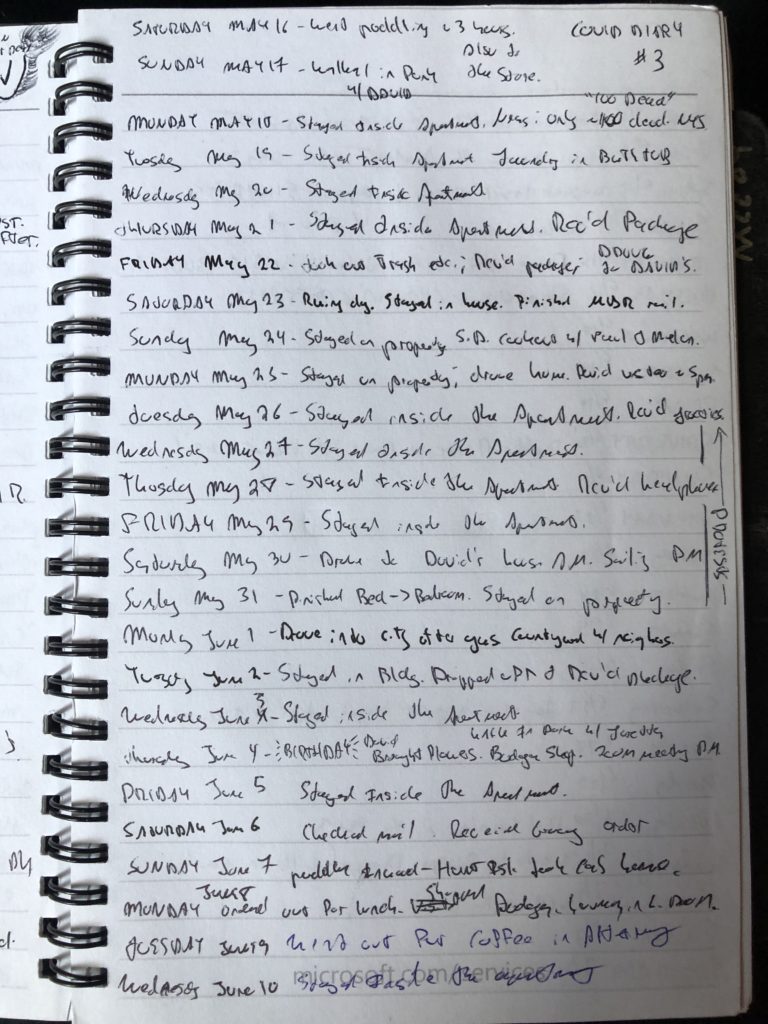
COVID Journal 02
COVID Journal 02

By mid-May, however, I was starting to venture outside more. On May 9 I drove to David’s and spent the better part of the weekend there. Later in the week, he had some downtime at work and was able to sneak in a dinner visit to my place.

By that point, the numbers were beginning to decline.

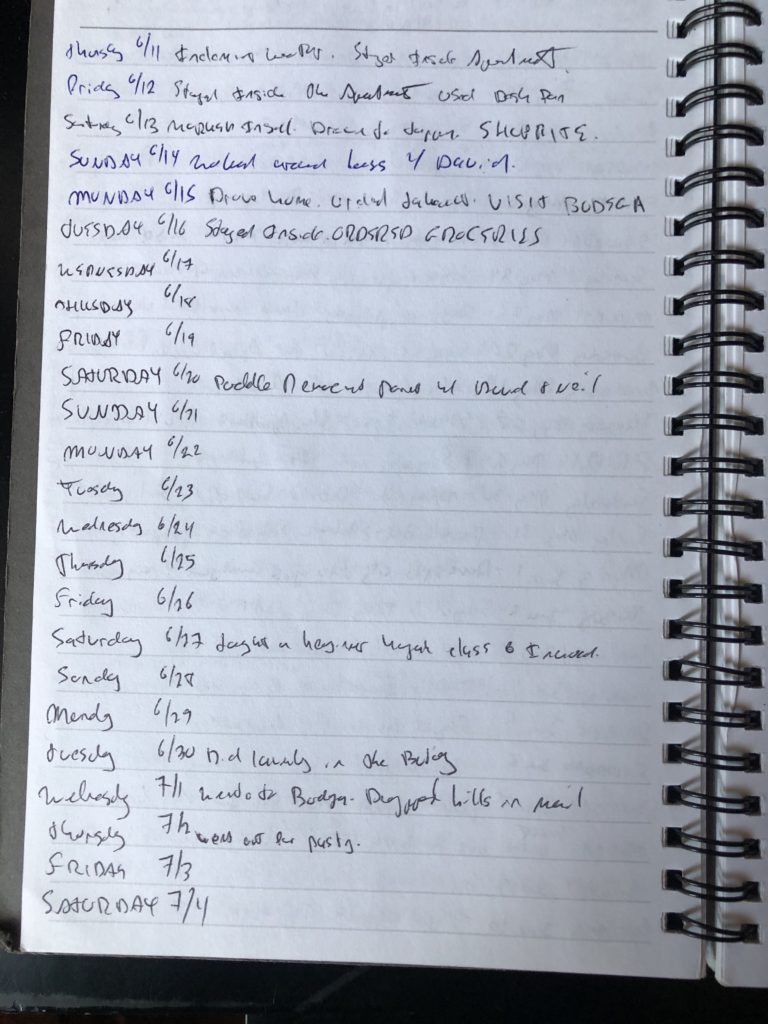
COVID Journal 03
COVID Journal 03

In early May I went kayaking a couple of times. My club had worked out some rules for keeping the total number of people at the boathouse low, as well as cleaning equipment. All the same I was very paranoid. Once, I walked home in my drysuit, wearing nitrile gloves, even though it was nearly eighty degrees and sunny.

Besides paddling, I ventured out more and more in general. My neighbors had a get-together in the courtyard. I met up with a friend for a walk. I was more willing to go to the store.

I still stayed inside a lot.

COVID Journal 04
COVID Journal 04

For the past six weeks, life has gotten progressively more “normal”, with frequent reminders of how not-normal things are. I’ve gone up to David’s house a few weekends, and in the suburbs, we can walk around in the yard without a mask. We went out for walks in parks, we even got to a point where, as you can see, I lost track of time – what did I do which day? Did I stay inside? Did I go to the store? The new normal set in. Whatever I did, it was “normal”.

I know I went to a suburban grocery store for the first time. Mask on, basket, sanitizer, do my shopping, stand in a well-spaced line after negotiating the one-way aisles. I’ve taken a first aid course in a state park – a small class, masks on, distancing as much as possible. I’ve developed a fatalistic streak even. I advocate masks and distancing and minimizing time away from home, but when things need to be done, they be done.

With takeout, and grocery orders, and occasional walks to get coffee or bodega runs . . . this is the new normal. We watch and wait to see if the numbers go up, or down, locally, nationally, globally. We silently judge people for wearing masks, or not wearing masks; for opening too soon or overreacting. That’s new normal too.

Wearing a mask is the simplest thing one can do. It’s a kindness to others; it protects oneself too.It’s frustrating, it’s silly, it muffles out voices, but makes a difference. Places where people wear masks have lowered their infection rates.

We can argue about whose fault it is, or how we should spend money to address the problem, but most importantly we have to address the problem. Official guidelines in the US are being treated as optional; speed limits where there is no enforcement. There is not enough testing, and therefore data, to make the kind of fine-tuned decisions that everyone wants. Too many politicians want to be the cool parent who lets their kids run free, only to find the have to be the responsible parent when they come back from spring break with a highly contagious respiratory illness.

The numbers are going up. Various states are rolling back their opening plans. I don’t plan to start another COVID journal. I hope I don’t have to. Nonetheless, July 4 or thereabouts marked a different sort of Independence Day.

Portal al Verano

Memorial Day Weekend: now with more memorial.

Here is the current state of affairs, as we walk over Memorial Day weekend here in the United States, into the summer.

In New York State, the daily death rate due to Coronivirus is reported to have fallen below 100. While terrible, that is amazing compared to the peak near 800 just a few weeks ago.

The state has also announced criteria for regional emergence from “New York on Pause”, and some parts of the state are reopening for business. New York City, however, is at least a month away from being able to re-open. Also while the state is allowing beaches to open, the city is not.

Farther afield, various states have lifted various restrictions on activity, and everyone is eying the effects. Meanwhile, the cumulative death toll due to Coronavirus is approaching 100,000 for the nation.


Over the past couple of weeks I’ve experienced a change in general emotional state. It’s a strange thing to remember how one felt just a short while ago, in contrast to the present.

I remember the end of March and early April, a period I generally refer to as, “when the city was on fire”, when every day brought new developments, new highs in infection rates and body counts, along with grim anecdata like refrigerated trucks being used as makeshift morgues and a Navy ship being brought in as a hospital. Death was right outside my window, right outside my door. Death touched every doorknob, every handle, every package, the slightest piece of mail.

I washed every grocery, and would toss my keys into a sink filled with soapy water when returning from outside. If I drove my car, I kept my mask on in the car. I stayed inside my apartment for over a week at a time, FaceTiming with David, using Teams with my co-workers, and Zoom with my club. It was a state of terror I hadn’t felt since the days immediately after 9/11.

Now, however, I’ve grown more lax. More data leads to changes in behavior. Supposedly surfaces are a less potent vector than other peoples’ exhalations. I still stay in my apartment during the week but have ventured out on weekends, either to David’s house or to walk in the park with him, to go to the grocery store or, in a couple of cases, to go kayaking at my club’s boathouse.

Three weeks ago I still felt like an astronaut; nowadays, more like a warm-water scuba diver. Some assembly is still required, but less than before, and it’s more routine.

Talking with others, taking in the news and the comments and the opinions all around, there seems to be an overall feeling of having shifted into a new sense of what is normal; whereas in the beginning there was a bit of a lark, ha ha we’re going into quarantine, oh my working from home is a zany new concept, look at me I’m baking with all this time on my hands. Now, there is experience on the one hand and a track record on the other.

We’re all experienced with whatever changes in our lives we’ve had to make. The novel is no longer new; it’s routine. For myself, I was already working from home before the pandemic occurred, and the only real changes have been 1) not going out for a daily constitutional and 2) not kayaking nearly as much.

The track record of governments and employers has come under scrutiny, and while it’s easy to forgive mistakes at the beginning (even if it’s debatable “when” this all began), three months since documented arrival of the virus in the United States and its subsequent spread, there is plenty of blame to go around.

Were controls put in place for people returning from abroad? Were necessary medical supplies procured or ordered? Were restrictions enacted wisely, and were they too soon or too late? What about economic adjustments for the thousands of businesses and millions of workers thrown out of work?

Also, not to forget, this is an election year, and America is less than six months away from its quadrennial decision about who gets to lead the country.

Summer is here, and the weather is nice. The world we live in today is not the world we will live in tomorrow; it certainly is not the world we lived in very recently. Things are better, but not good; improved, but disaster looms right around the corner.

That is the state of affairs as we pass through this gateway to summer.

A Walk in the Parks

An outing during the pandemic.

David and I saw each other in person last Saturday, the day before Easter, for the first time in at least three weeks. Work assigned him the week off – something kinda normal, not virus-related – and he needed to drop the truck off at work, with a plan to bike home.

I met him at the garage entrance for my building. We put his bike next to my car, and he put on some warmer layers and walking shoes. We were both wearing masks; I was also wearing gloves, and offered a pair to him. Fully sorted, we walked up to Fort Tryon Park.

This was a variation of my ongoing dilemma: do I invite someone in to my apartment, potentially violating the sanctity of cleanliness, or do I meet them outside, exposing myself to contamination? I know on the one hand that I am overreacting to the possibility of contagion, but on the other hand – the virus causes a terrible illness, and there is a non-zero chance of contracting it with every exposure to the outside world.

Well, I wanted to see my boyfriend, and at this point, there were some risks I was willing to take.

Walking along, we learned a new normal of monitoring spacing between us and Others; silently judging groups that spread out in a wide line, like volunteers looking for a missing person in a field, or groups of children or young people, randomly veering in and out of the flight paths of others. Some parents admonished their children to stay near. Some work masks, and others did not.

In the park itself, we felt things were a bit crowded on what previously might have been a normal day. We walked through the flower garden and quickly ventured down to one of the overlooks, gazing at the bridge and the Palisades across the water. It was a beautiful day, nary a cloud in the sky, bright with the promise of spring.

We continued on, following a path I don’t believe I’ve ever walked, taking the opportunity to explore as well as avoid the more commonly used paths. Eventually we connected back to the main route and went up some stairs to the Stan Michels Promenade, where we sat on a bench and David had the lunch I’d made for him – three-bean chili served over rice and eggplant, in a thermos jar.

We compared notes on making the chili, since we’ve both given it a shot. We also talked about roasting vegetables, and listened to music coming from a boombox not far away. I danced a bit, posing more than dancing.

On we went, until we decided it was more crowded than we cared for, and we walked back towards my neighborhood. Along the way, I wanted to stop at my local grocery store, and as we walked up the sidewalk from the east, the sun in our eyes, I turned into the store and there was a woman gatekeeping there.

We hadn’t realized there was a line, snaking back in the opposite direction, to the west. A well-spaced, orderly line of people wearing masks, under the scaffolding for some building work being done next door. I apologized; I felt like a jerk. Across the street we were able to discern the line for another grocery store.

Because of social distancing, it’s hard to make out the lines. They look like a series of people waiting for a ride pickup.

On we went, defaulting to my original plan of stopping at the Korean bodega. Here, there were two men standing outside, separate from one another, but they were not a line. I went inside and was able to get the things that were missing from my grocery order earlier this week, plus some additional items I figured I might need sooner rather than later. Korean bodega for the win.

We wanted to keep walking, so we proceeded to the bottom of the hill and walked over the pedestrian overpass to the bike path along the Henry Hudson Parkway. Usually I take this route walking or riding to the boathouse, but today we turned south and proceeded down the switchback that leads to the shoreline and the Little Red Lighthouse. All the while, still wearing our masks.

We passed some young men working out together, and a couple of skateboarders were at the top of the hill waiting for traffic to slow enough that they could ride down. We saw equipment at the base of the bridge tower, presumably related to the refurbishment project high above.

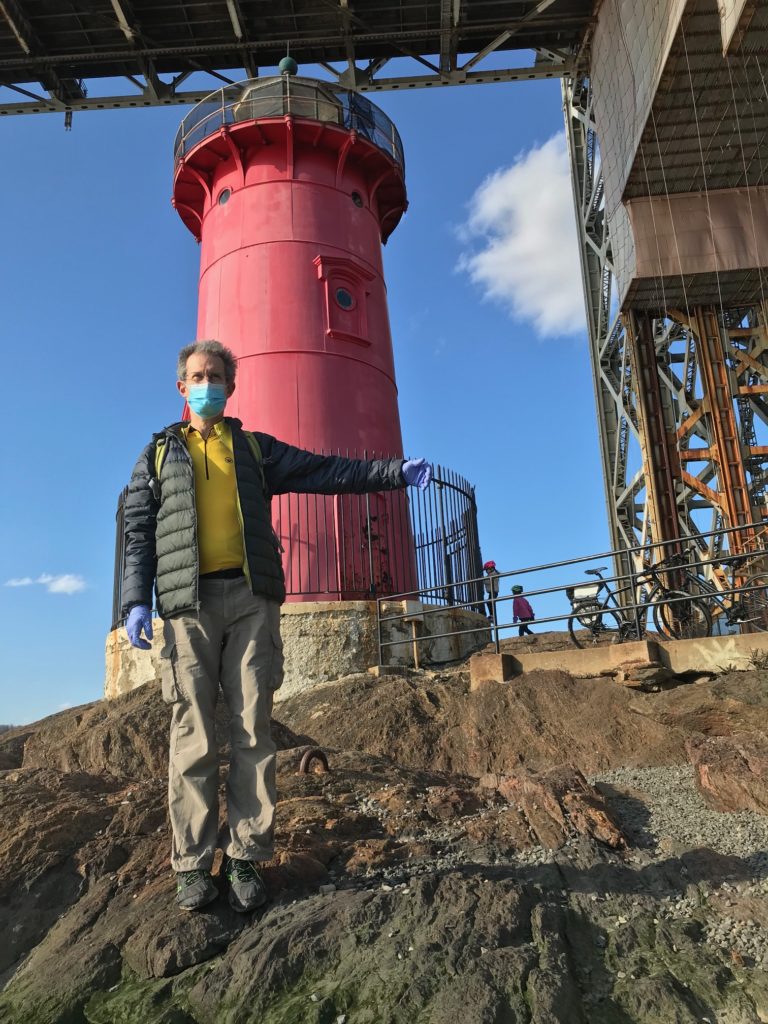
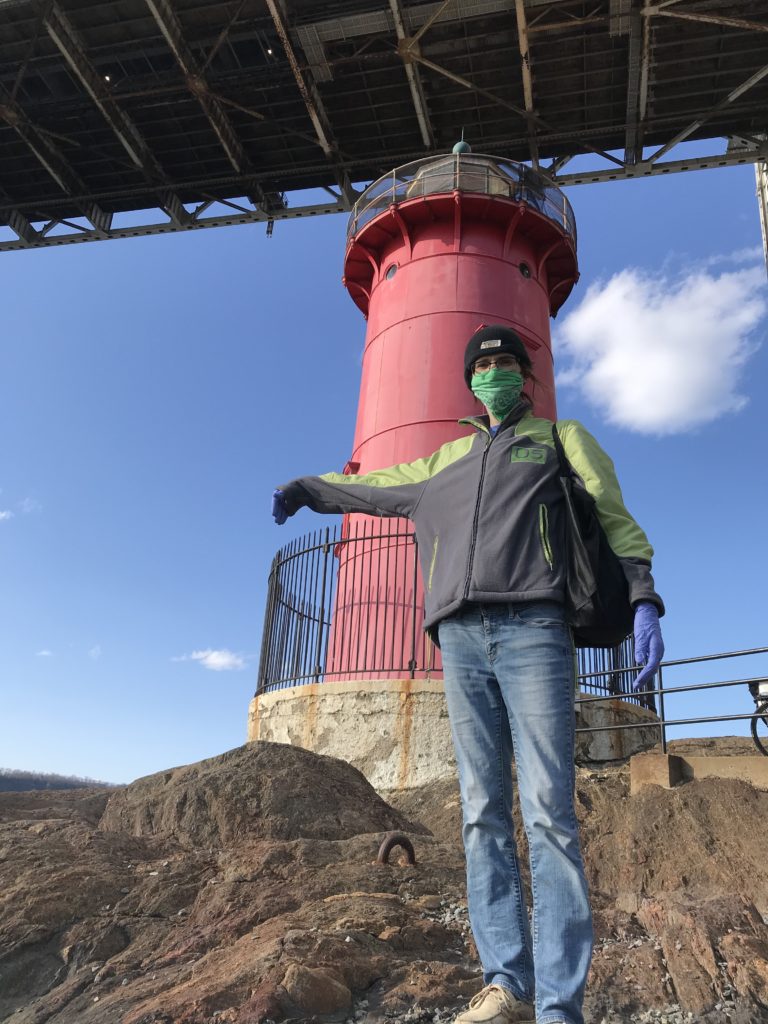
At the Little Red Lighthouse, the tide was low and we clambored down to take some pictures of each other in front of the lighthouse. We made light of the requirement for social distancing, staging each other in poses implying the presence of the other.

Coupling-David
David.
Coupling-Julie
Julie.

By then, the evening hours were creeping in, and David would still need to bike home, preferably in daylight. We made our way uphill, retracing our steps, across the overpass and to the garage, where the beginning occurred in reverse: he took off layers down to his biking clothes, put on his cycling shoes, and everything left went into his backpack. We said goodbye, both noting it was a special afternoon.

I picked up a package from my doorman, and once in my apartment followed my usual protocol: coat and outer layers, as well as shoes and socks, removed in the entrance; mask removed, keys and wallet dropped on the floor for later cleaning; gloves peeled off, followed by a thorough soapy washing of hands, arms, and face.

That was our afternoon together.

Food Under Orders

David reports that at the Northvale Shop Rite, they were only allowing fifty customers in at a time and, after eyeing the length, he and his friend drove to Stop & Shop, where there was no line. He lives near the state line between New York and New Jersey, and basically Shop Rite is in New Jersey and Stop & Shop is in New York, so whether this is a difference in states or stores, we’re not sure.

I have heard from other people in both states of lines at stores, a similar symptom with a very different cause as often compared to lines in the Soviet Union. There is plenty of food, though some things run out quickly. The challenge is that they want to keep people as far apart as possible.

At the Stop & Shop, aisles were designated one-way; like streets, presumably to help people avoid running into each other with cross traffic. One imagines a lengthy assembly line where the worker moves along the tracks, collecting their required parts for final assembly at home. Everyone wears masks.

Contrast all of this with my own experience in Manhattan. I have long used a grocery delivery service, one that until recently was excellent. They still are, but if you go to their website they basically advise to check delivery availability first, and nothing is available for at least a week.

My local “posh” grocer has had a delivery service for a while, and I’ve used it twice now. They’re not really that posh; they have some fancy things, but the non-fancy things are reasonably priced. The first time I ordered delivery, they delivered to the apartment in the other building, which is an easy mistake to make. Yesterday they dropped off my delivery in the right place, and early to boot.

In both cases though, my orders were missing items because they’re run out. There are methods they use to put in substitutes, but I expect they have their limits.

This leads to my chief conundrum: do I venture outside to seek these items on my own, or forgo them until the next time I need to order groceries?

I generally settle for the latter but two days ago, I realized I’d forgotten to order hummus, and it was too late to add hummus to the order, and I knew I would want hummus, so I put on my coat and shoes and extra layer of pants, and my mask and a scarf and gloves, and I walked up to the Korean bodega, and I bought not only hummus but some produce that the posh story had been empty of, and some chocolate, and some Omega-3 nut mix for snacking on. Oh and I picked up six bottles of wine from the wine store because I like them and want them to stay in business.

If only I’d known then what wouldn’t show up, I’d have gotten that. This leads me to realize I need to be more systematic about my grocery shopping. In the past, if I ran short of anything, my worst case was some inconvenience in having to ugh put on shoes and coat and walk five minutes up the hill, buy that thing, and walk five minutes back down.

Now, to do so means breaking a streak of staying in home. It means following my meager protocol of excursions, summarized more or less as:

  1. There is a “dirty” coat that stays near the door and is not hung with other coats.
  2. I wear gloves and a mask. A hat or scarf as well to cover my head.
  3. I wear shoes that are easy to don and doff.
  4. When I return, pants and socks stay in the hot zone.
  5. Goods stay in the decontamination zone. Anything that requires refrigeration gets cleaned and stowed within an hour or two, but everything else stays in the hot zone.
  6. Eventually items in the hot zone get either 1) washed in soapy water or 2) stowed once whatever material they are has been inside long enough for the virus to no longer be a threat.

It’s exhausting just thinking about it.

On the other hand, I’ve bought and cooked and frozen so much food that I really have run out of room and containers. I may not always be able to have what I want, but I have enough food that if I had to, yeah I could stay inside for two weeks.

And that, thankfully, is more than a lot of people can say. So, no complaints.

Touch

I count in my head the number of touches I need to accomplish anything outside of my apartment.

  1. the door to the laundry room, coming and going, washing and drying: four.
  2. to the grocery store: the two doors for my building, coming and going (4), the basket (1-ish?). Minimizing the handling of goods: five minimum, but not accounting for proximity to people in the aisles.
  3. going for a walk: the four for my building door as above, although if I’m lucky I can draft on the doors that use mechanical assistance to stay open longer while still maintaining social distance.
  4. to the garage below my building: the breezeway door, the door at the top of the stairwell, the door at the bottom of the stairwell. I debate whether it’s better to touch or hip-bump the first of those, which has a horizontal press-bar to open from the inside. In any case, yikes, that’s six touches just to go to the car.

And so it goes. As of March 20, we’ve not been ordered locked down, or quarantined, or “shelter in place”, in either the Empire State of New York or the great city of New York, but I have essentially been practicing that. I was already working from home before the outbreak occurred, so it’s been easy for me to simply stay inside as much as possible.

That said – when our mayor, who resisted closing public schools and was still going to the gym hours before a ban on that went into effect, said that New Yorkers might want to plan to shelter in place, that was the one moment of true panic I had. What groceries did I have on hand? Would there be a run at the market as nine million people across five boroughs rushed to stock up? Should I get in my car and evacuate to the suburbs, where my significant other has a house?

I decided to stay, mostly on two key assumptions. One is that, despite living in an apartment building in one of the largest cities in the world, I am alone in my apartment, as isolated as a person can get. The other is that, while David and I were planning to spend next week together, which we both have off, it’s not clear whether I’d be able to come back home afterwards, and the nature of his job is such that he is out and around people constantly.

Even at that, the job has changed just in the past couple of days. He works in television news, driving the truck, shooting and editing video, then transmitting it back to the station. They stopped having reporters do “man on the street” interviews, since that inherently breaks social distancing, and recently, he’s not been driving with reporters – alone in a truck.

A shared truck, mind you, though even that appears to be about to change.

This was the hardest decision of all. I was looking forward to a long week with my loved one, neither of us having to go to work, spending time with each other, and maybe getting some work done ’round the house. Even here I counted touches: the keypad on the lock, and visits to the grocery stores there.

It’s clear we’re in a different world now, and it’s one that will continue, in varying degrees, for months to come.

Coronavirus and COVID19

It’s Thursday, March 12, the day after the President announced that the US was banning flights by non-citizens from Europe, except the UK, for thirty days.

David called me last night to say he was working at the station and about to watch Fearless Leader. When I called, since it’s our usual talk-time, he asked if I was watching. Why would I be watching? Anything important that comes out of that man’s mouth, I can read a day later in a reputable news outlet.

“You should watch,” he said.

I’d missed the part about the travel ban at the top. I watched as the most deadpan, first-pass script-reading session proceeded apace. I had questions, but it would take a while to process. A great economy. Virus doesn’t stand a chance. It was clear what the priorities in this speech were.


David had been considering a ski holiday in Europe. Every year, he takes some kind of exotic ski trip, and most years in the past five, it’s been to Austria or Switzerland. Far from civilization, atop the peaks and glaciers of the Alps, he’s with a small group skiing from hut to hut for about a week. We had been worried about airports, but the majority of his time would be away from crowds.

There was a really good trip in the Alps shaping up, as well as some alternates in Norway. First he had to confirm getting the time off, which he did, but by that point the virus had spread to Italy, and we were wondering if or when it would get to Austria. That was perhaps two weeks ago, and if last week was a search of flights, this week was, the Austria trip was outright cancelled by the organizers, and now the entire continent was mooted.

We were both considering domestic travel, but at this point we would rule out airplanes. A driving holiday is about the most we would expect.


I already have one friend who’s holed up with his wife in a cabin in the Catskills, large quantities of dried foods (rice, legumes) handy, in a remote area where they can ride out the worst. His advice, only half-joking, mirrors two others I’ve heard from: go get the virus now. Get sick now, before the hospitals are overwhelmed. Get it, get through it, be done with it.

This sounds bonkers to me, at first. I understand the logic – embrace the inevitable – but that wouldn’t work for anyone who’s caring for others, especially the vulnerable. I would go further to say it’s almost a grasp at having control: I will choose the time of the battle, even if I can only choose to make it sooner rather than later.

In the meantime, the rapid escalation in the past forty-eight hours has me, for the first time, worried. Maybe I should be stockpiling food, and cleaning supplies, and deciding where I want to live in the event that I can’t leave for a few weeks.


For several months I have been one of those “work from home” people. It’s a topic deserving of its own post sometime, but suffice it to say, it’s been an adjustment. Now, however, it’s all over the news: companies are telling employees to work from home if at all possible.

The emails started last week, maybe the week before. I work for a consultancy, which is in turn owned by a larger consultancy, and between the two I get staffed at other companies, so I have been receiving all sorts of internal emails. We’ve gone from “no unnecessary international travel” to “we’re not sure how to handle the ban that was launched last night”, along with “Campus X is closed”, and of course helpful reminders on how to use technology to work remotely.

On the other hand, my more left-wing acquaintances have been reminding everyone on social media that not everyone has this choice to make. People who must be present – cab drivers, construction workers, store employees, and certainly doctors and pharmacists – can’t exactly do their jobs remotely. Many of these same people won’t have the safety nets that us office drones have, either: savings and other emergency funds to dig into if things get really bad. Furthermore, despite precautions, they’re inherently at greater risk than someone who is single and could, if she wanted to, stay in her apartment for days at a time.

The above all bears repeating even if you’re not a lefty-wing person.

Today, I had my first cancellation of a call due to “dealing with coronavirus” by a customer. I’ve previously had chats with others in the idle moments before a call properly starts – the small talk while we wait for others to join. It doesn’t feel like small talk anymore.

Part of adjusting to a work-from-home job was recognizing that I needed to keep some sort of schedule that isn’t driven by my calendar, and to get outside and go for a walk. At least twice a day I go for a short walk in my neighborhood, and I frequently put off little errands to ensure I have something to do each day: drop off sweaters for mending, pick up some salsa, go get a fancy coffee (Wednesdays, an almond milk turmeric chai latte).

But now I wonder, do I need to go to those places? Even doing laundry in my building, I wonder how many other people have touched the handle to the laundry room, how many have opened and closed the washer and dryer machines? Even the gym – I’ve decided not to go for a while, even though I’d like to work out more. Despite precautions, I’m not going to avoid thinking about the worst.

And yes, I am washing my hands thoroughly.


The latest – as of about 1430 Eastern, Thursday March 12 – in New York is that gatherings of more than five hundred people are now prohibited; New Jersey is capping gatherings at two hundred and fifty. This of course affects Broadway shows, as well as concerts and sports events. Some NYC public schools are closing as well; the challenge there is that public schools are often the front end of social services, so closing them affects far more than education: they are where many children get food, medical services, and counseling. The Mets (Museum, Opera) will be closing as well.

That is all there is to say about that.

Forties on 181

. . .the cars stand out on their own, irrespective of plot.

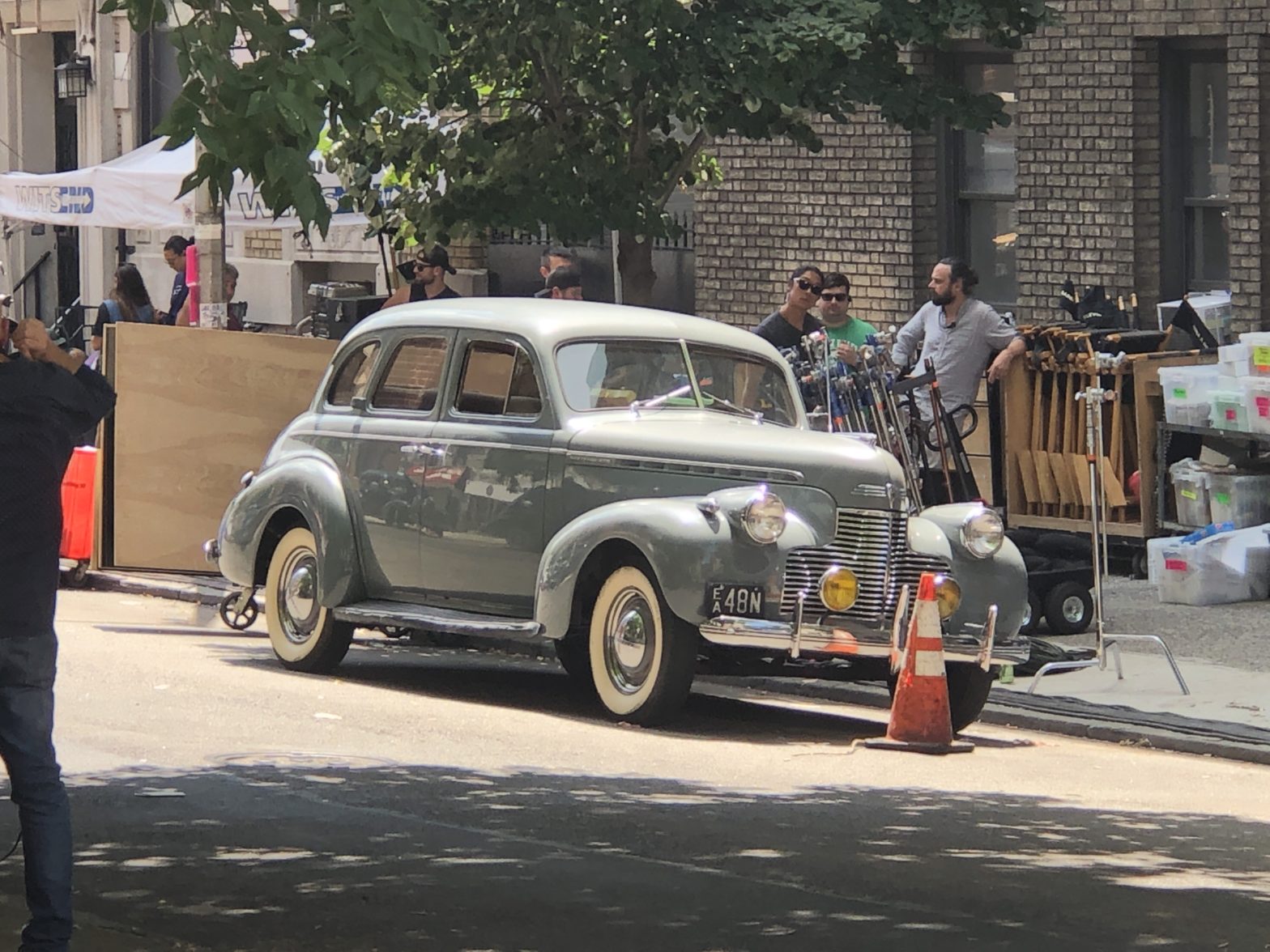
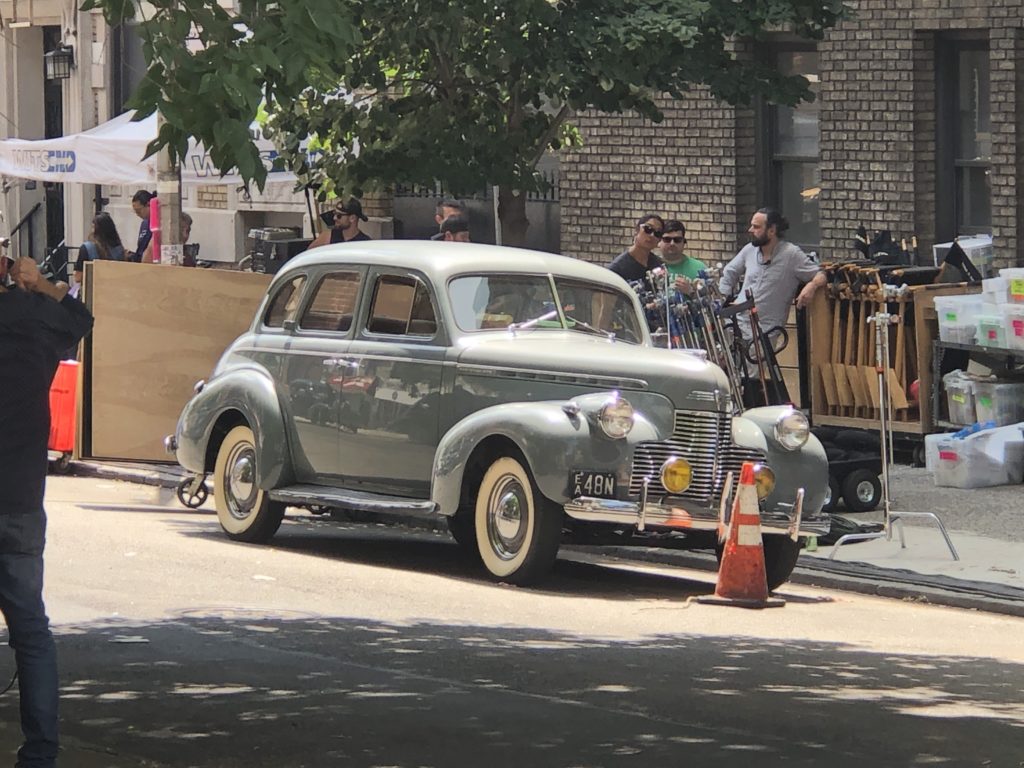
A recent film shoot brought an array of interesting, old-timey cars. There was a similar yet smaller array a few months ago, for what I later learned was a shoot for a film version of Philip Roth’s The Plot Against America, which is set in the early 1940s, in an alternate history wherein Charles Lindbergh defeats Franklin Delano Roosevelt for President, largely on an isolationist and anti-semitic campaign platform.

While that sounds bleak, the cars stand out on their own, irrespective of plot.

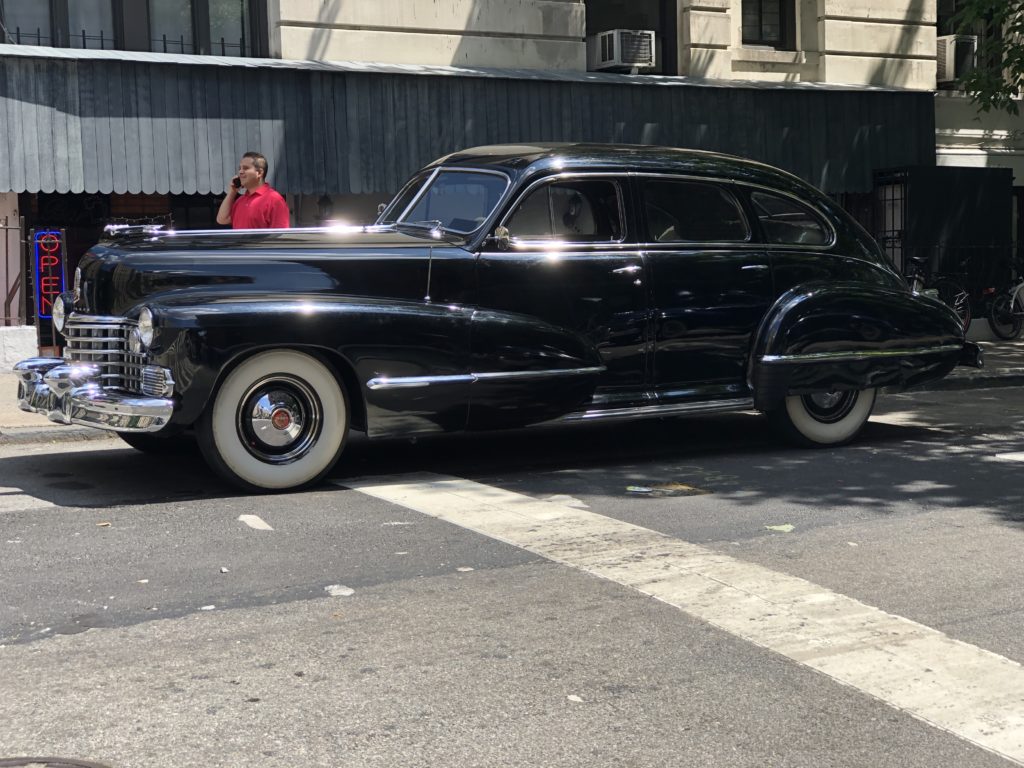
It’s the Caddy that really caught my eye. That thing was a beaut.

Cadillac
Black Cadillac, Film Shoot. July 2019

“Long, black Cadillac,” indeed.

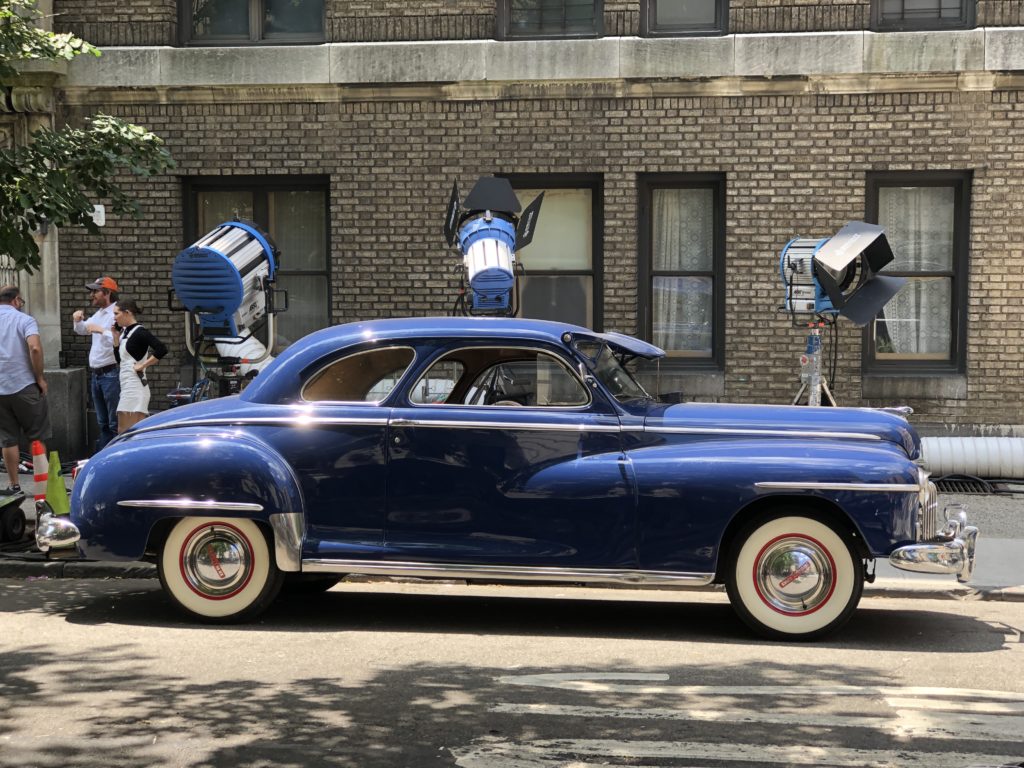
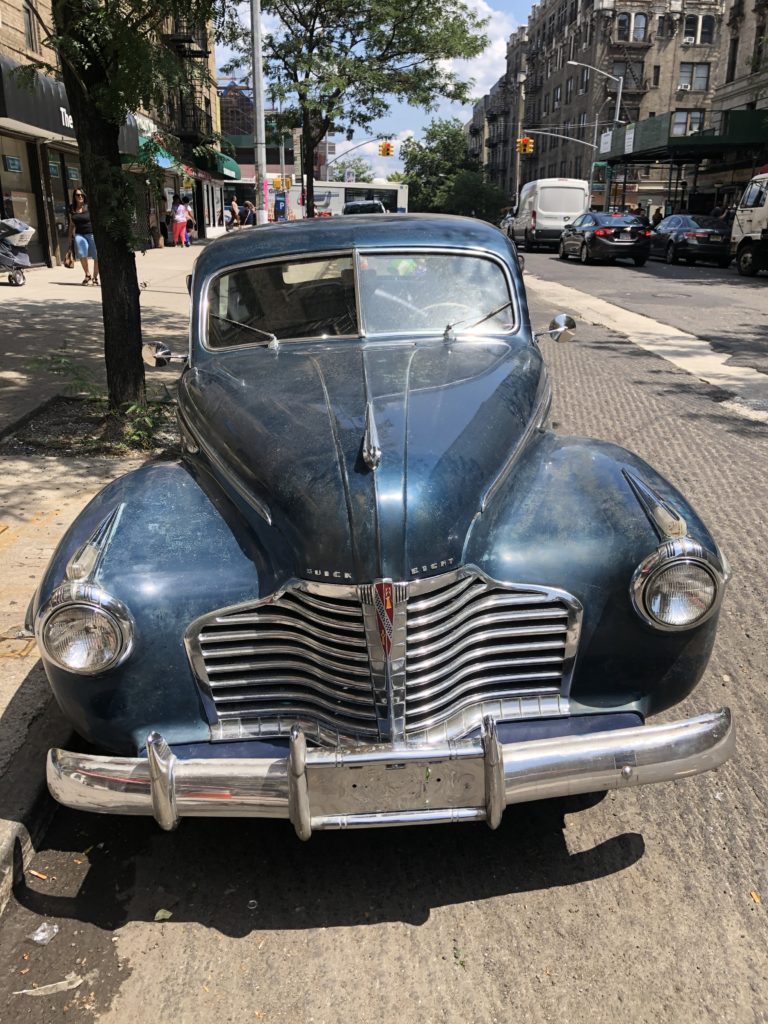
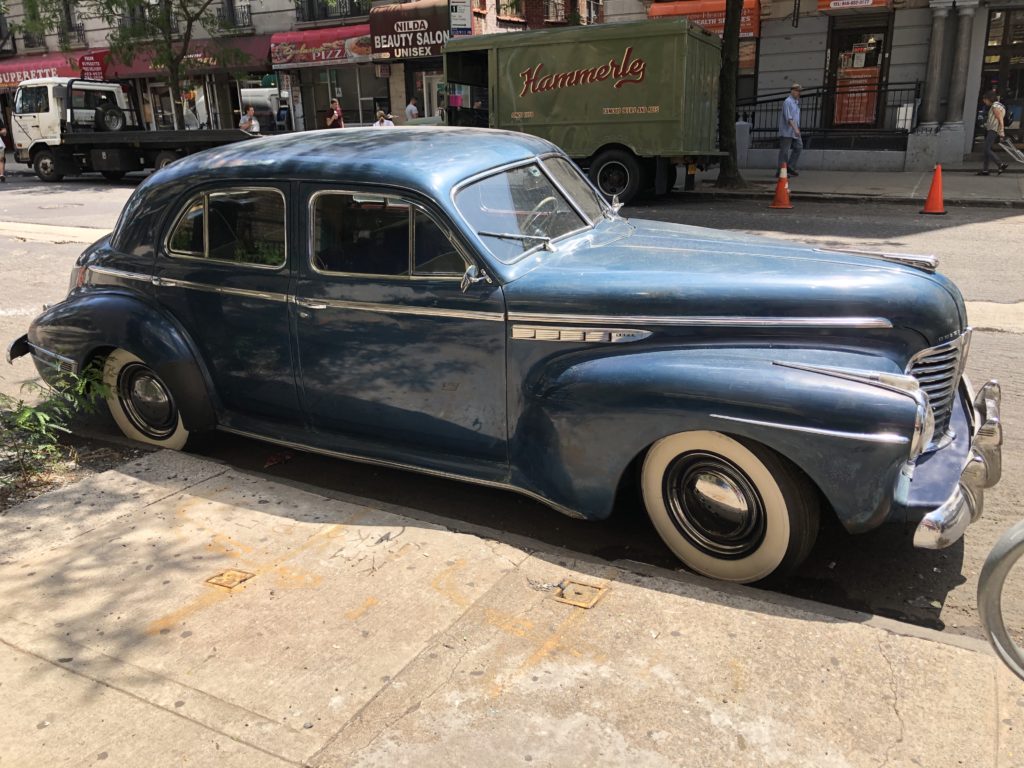
While the Dodge was equally gorgeous, I was able to get closer to a Buick Eight, not quite as shiny, but seemingly all the more lovable for it.

Buick Eight
Buick Eight. Film Shoot. July 2019

Look at that grille!

Buick Eight
Buick Eight. Film Shoot. July 2019

And now, the interior:

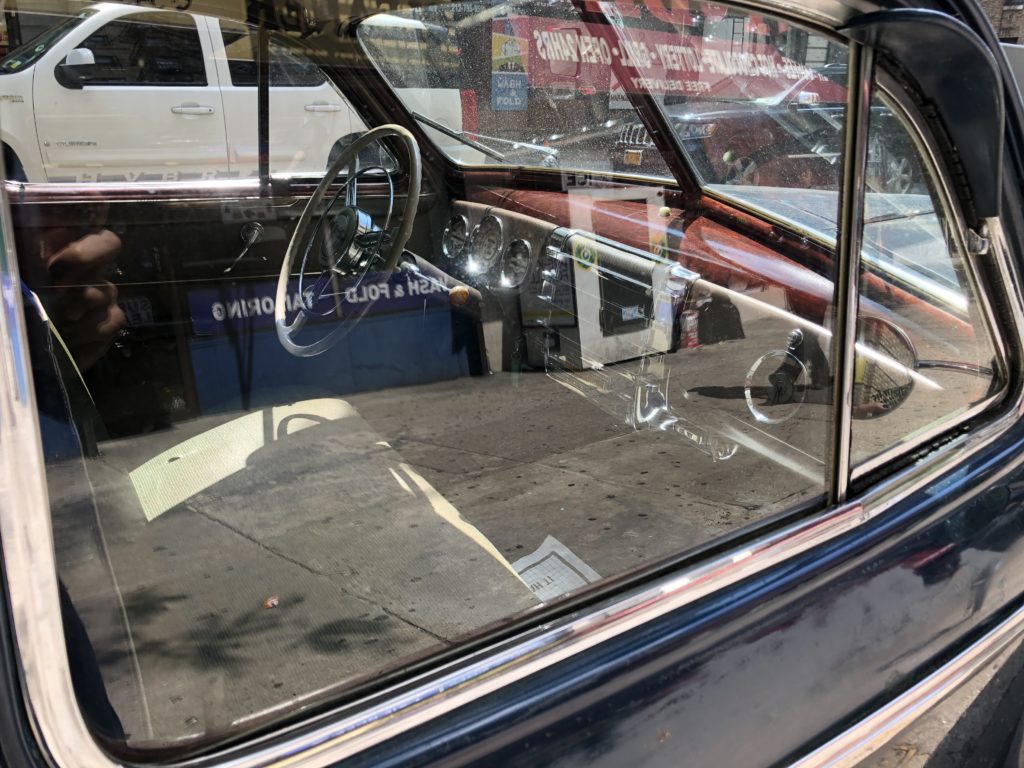
Buick Eight (interior)
Buick Eight (interior). Film Shoot. July 2019

Back to a time of bench seats and solenoid buttons. I had to wonder, what would people then make today of our touchscreens for everything from music to phone calls to navigation?

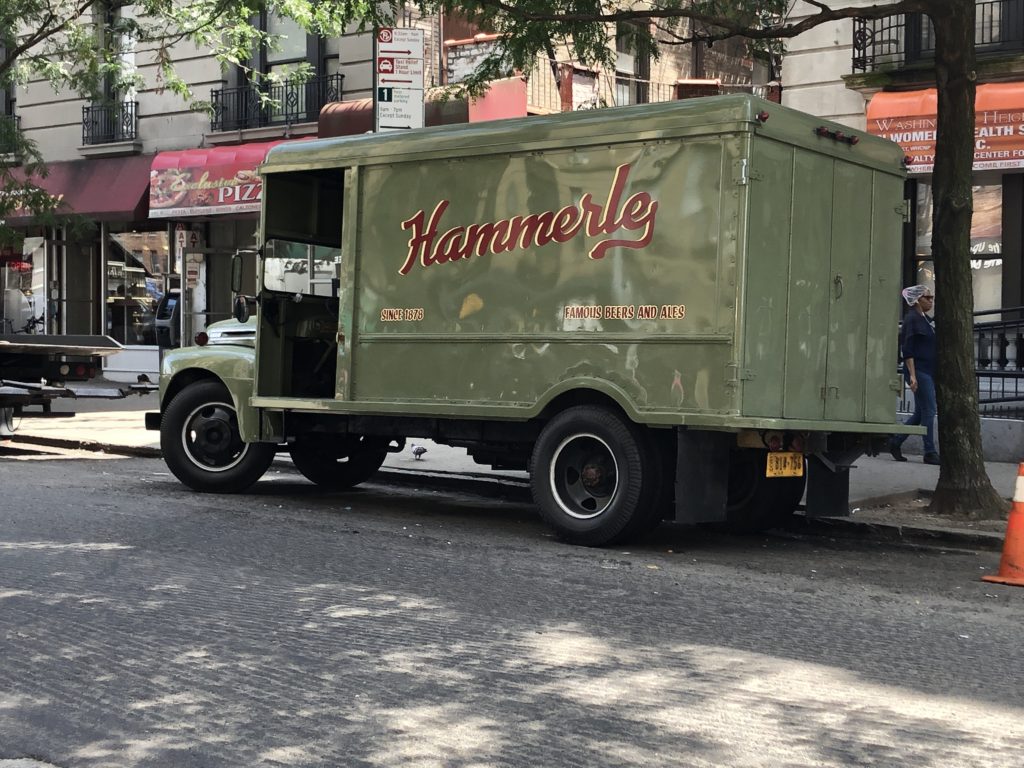
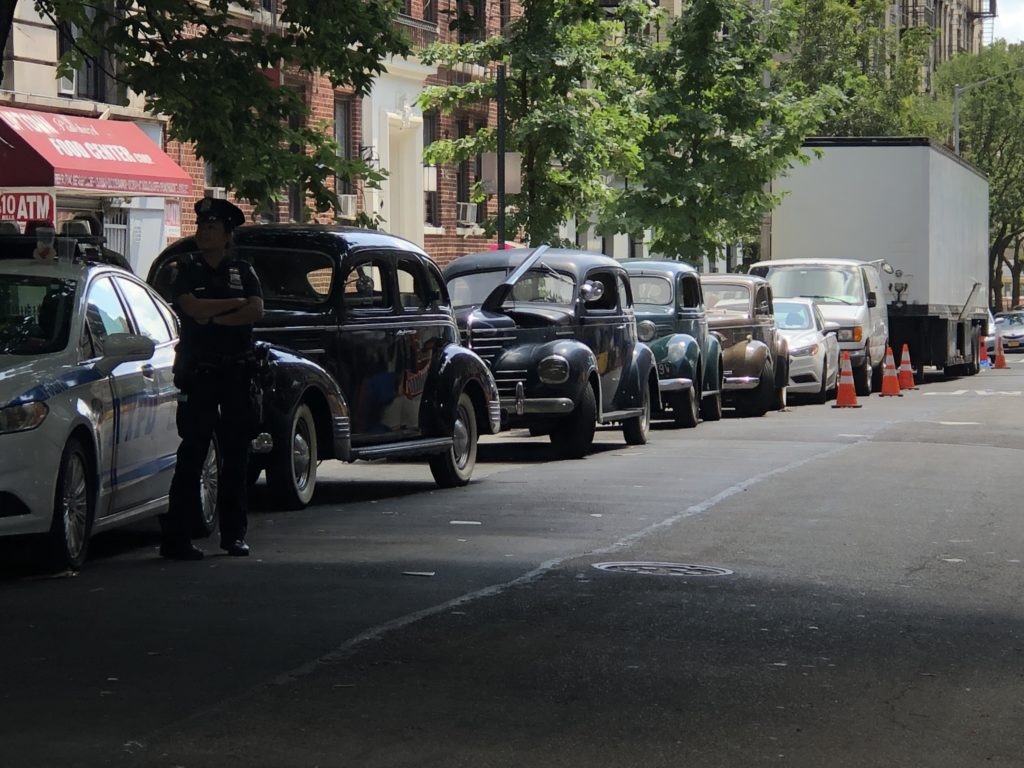
There were some more cars staged down the block. Here’s the rest.

Old Cars
Old Cars. Film Shoot. July 2019