“Madame, I have seen you in the garden, every morning. What grows?”
The musician was soothing in his query, a man long able to put at ease the subjects of his interrogations.
“Ah, the garden, I have put in a row of carrots, another of beets, another of radishes, and yet another of….rocket?”
“Arugula, we say.”
“Arugula,” said Madame. And behind those posts, some onions, and to the side, seed potatoes.”
“I see,” said the musician. “There is some green blooming.”
“Yes!” Madame’s excitement knew no bounds. “The radishes have come up the most, the arugula next, and now we are starting to see the blooms of the beets. The root vegetables, they are taking longer.”
“I am looking forward to them. How long, do you suppose?”
“To eat? A month. Perhaps a little sooner for the radishes and carrots. The will need to be moved further apart, but not yet.”
Coffee should be worshipped like a god or, perhaps more apt, a benign spirit. It brings conscientiousness, awareness; it enhances thinking. We are but simple clay until the oil of the bean is imbibed, bestowing human awareness upon us.
The bad weather done, we set out for one more proper journey before ending our adventure.
We would leave our strange marina and head south, where the lake narrows to a near canal; not quite to Ticonderoga, but halfway there and then back again. We would shelter again from the wind, enjoy another brief hike, and end with a final tour before tucking in one final night.
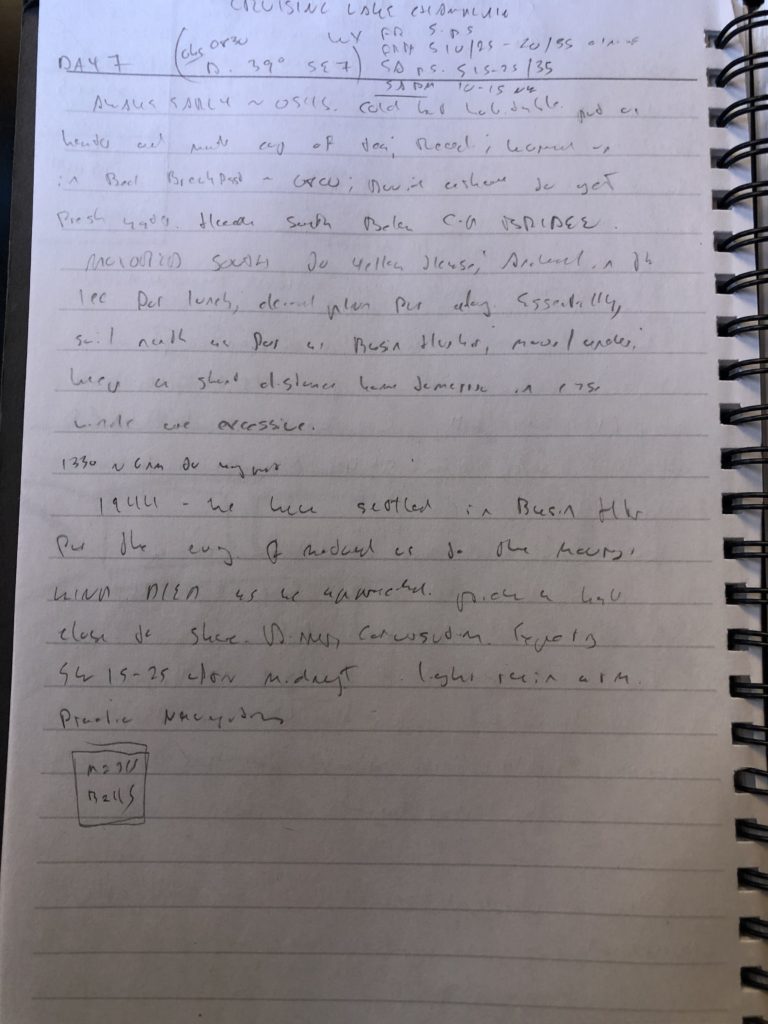
Day 7
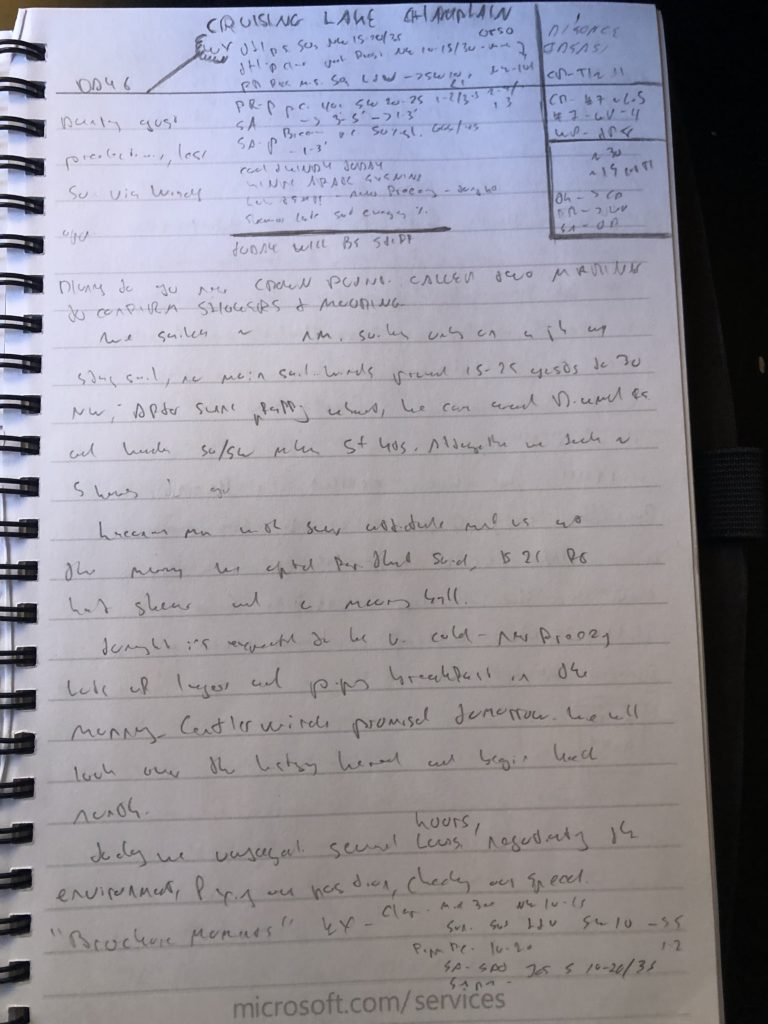
Awake Early ~0545. Cold but habitable. Put on heater and made cup of tea; read; warmed up in bed. Breakfast – 0800; David ashore to get fresh water. Heading south below C.P. Bridge
Motored south to “yellow house” [on chart]. Anchored in lee for lunch, decided plan for day. Essentially, sail north as far as Basin Harbor […] and keep a short distance home tomorrow in case winds are excessive.
1330 ~ 6nm to waypoint
1944 – We have settled in Basin Harbor for evening. I motored us to the mooring ball. Wind died as we approached. Picked[ed] a ball close to shore. Dinner & conversation. Expecting SW 15-25 mph after midnight. Light rain AM. Practiced Navigation.
It seemed more eventful at the time. As the lake narrows, so does the navigable channel, and we found ourselves taking more care to range our distance from shore and use buoys to gauge our position. In most outdoor activities, the mind can wander alongside the mind across the horizon; in nautical adventures, that which isn’t seen can be more consequential than that which is.
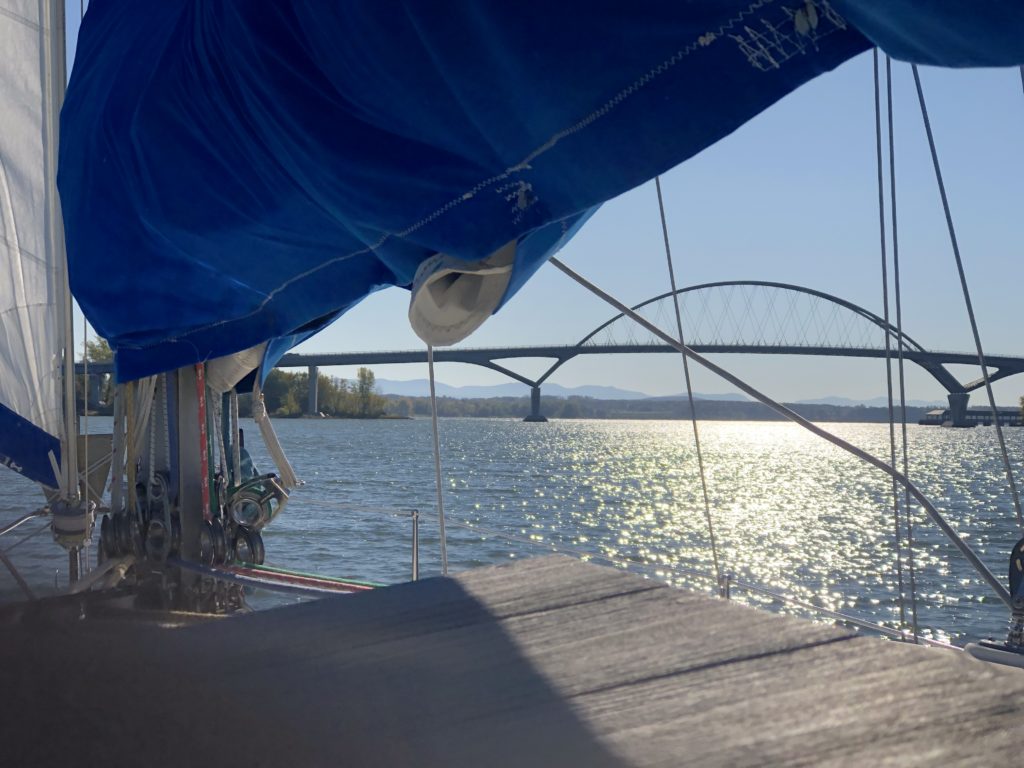
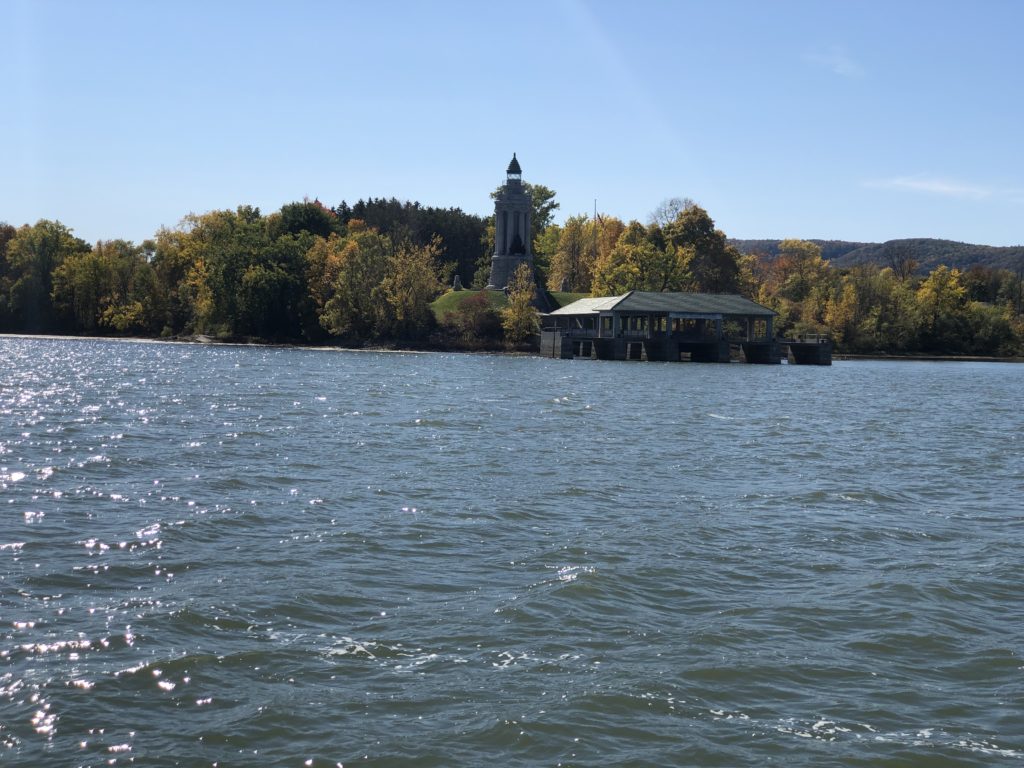
So we went, under the Lake Champlain Bridge, and past the monument to Samuel de Champlain.
Lake Champlain Bridge.Samuel de Champlain Monument.At the Helm.
Day 8
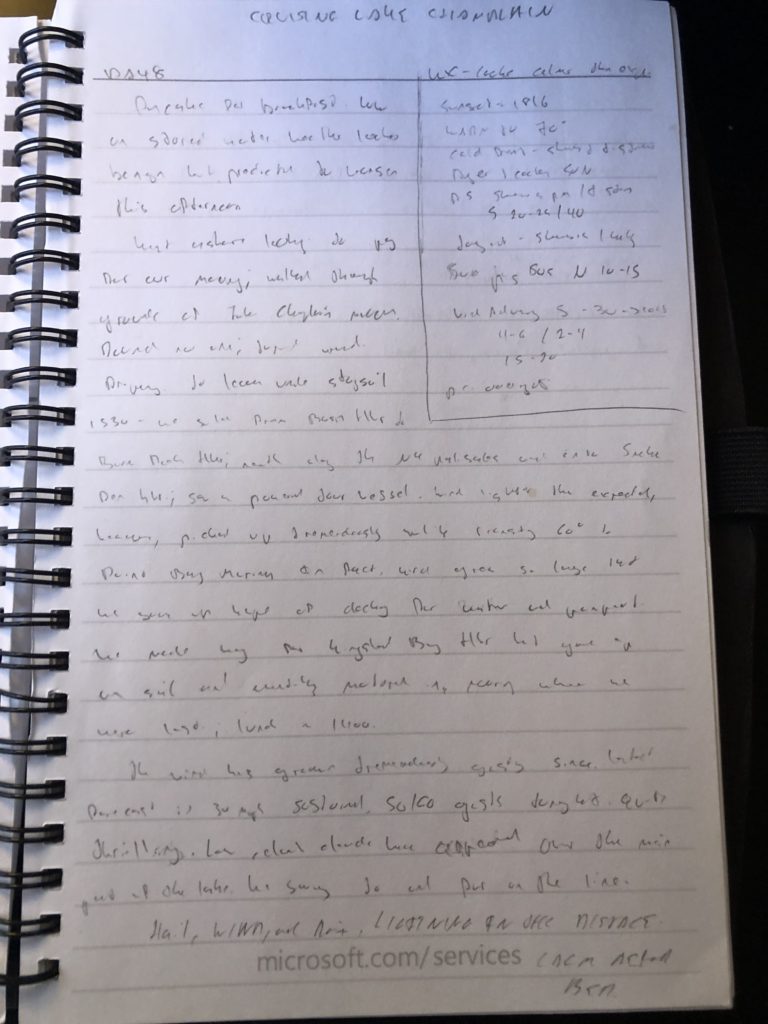
Pancakes for breakfast. Low on stored water. Weather looks benign but predicted to worsen this afternoon.
Went ashore looking to pay for our mooring; walked through grounds of Lake Champlain museum. Found no one; turned around.
Trying to learn under stay sail.
1530 – we sailed from Basin Harbor to Barn Rock Harbor; north to New York Palisades and into Snake Den Harbor; saw a powered touring vessel. Winds lighter than expected […] picked up tremendously while crossing 60 degrees to Point Bay Marina. In fact, wind grew so great that we gave up and [wound up] motoring in, near where we were last, lunch at 1400.
The wind has grown tremendously gusty since. Lake forecast is 30 mph sustained, 50/60 gusts tonight. Quite thrilling. Low, dark clouds have appeared over the main part of the lake. We swung to and fro on the line.
Hail, wind, and raining; lightning in the distance. Calm before bed.
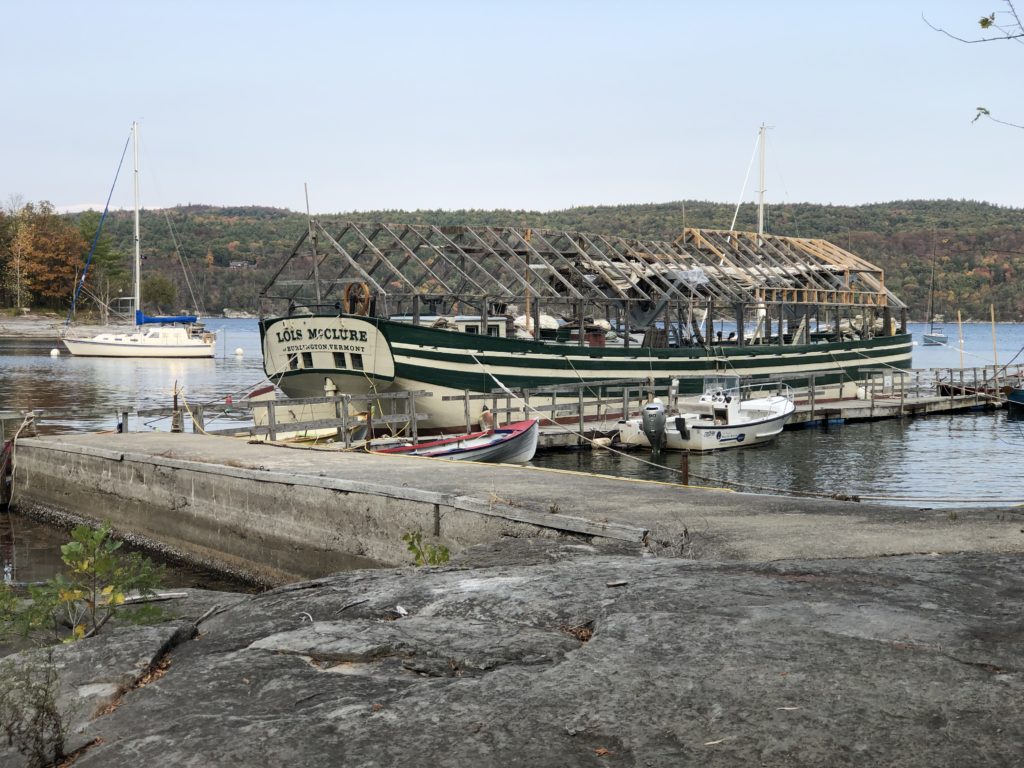
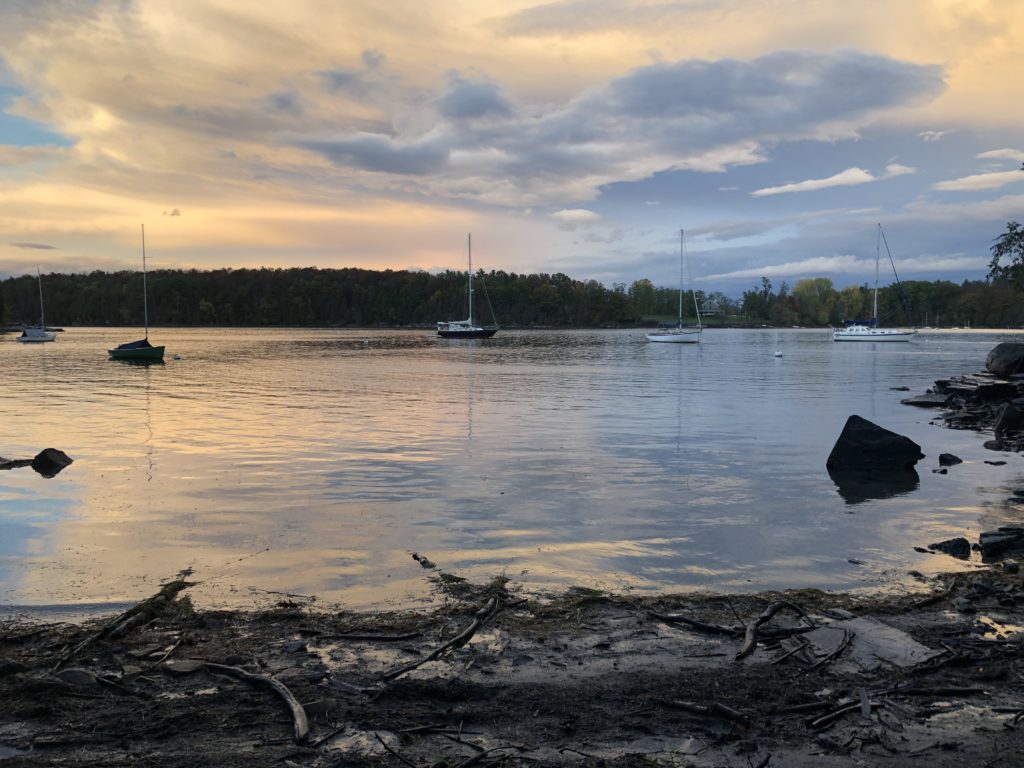
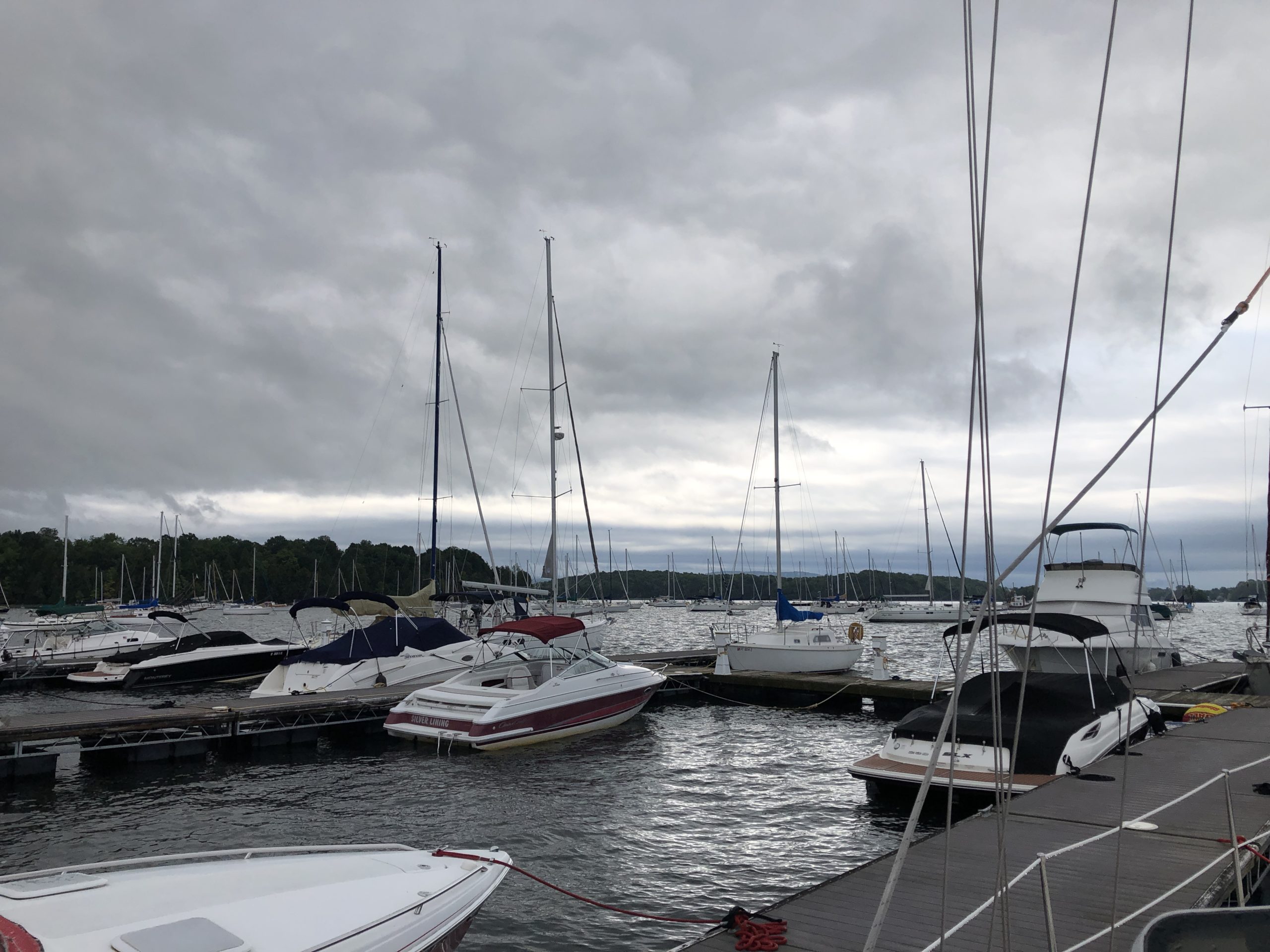
We had stayed in Basin Harbor, rather the north cove of it. It’s a cove used by the Lake Champlain museum, and we took the dinghy to a long slip where a replica sailing barge was tied up. We also recognized some of the boats we’d seen the young people rowing a few days earlier.
Basin Harbor.
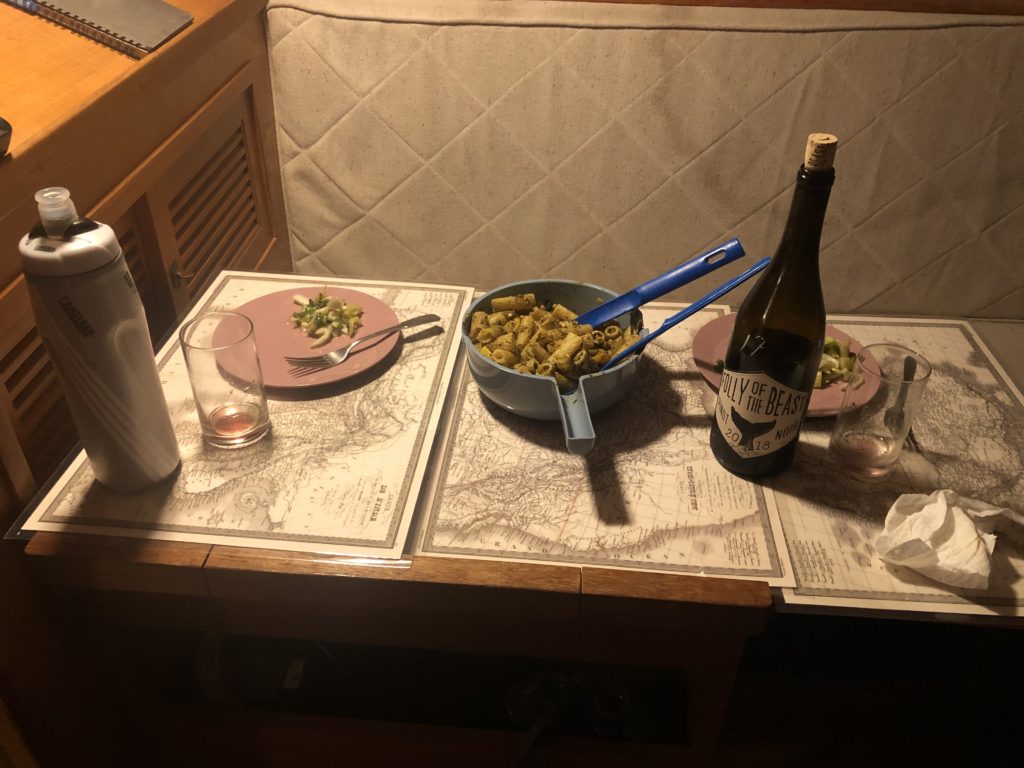
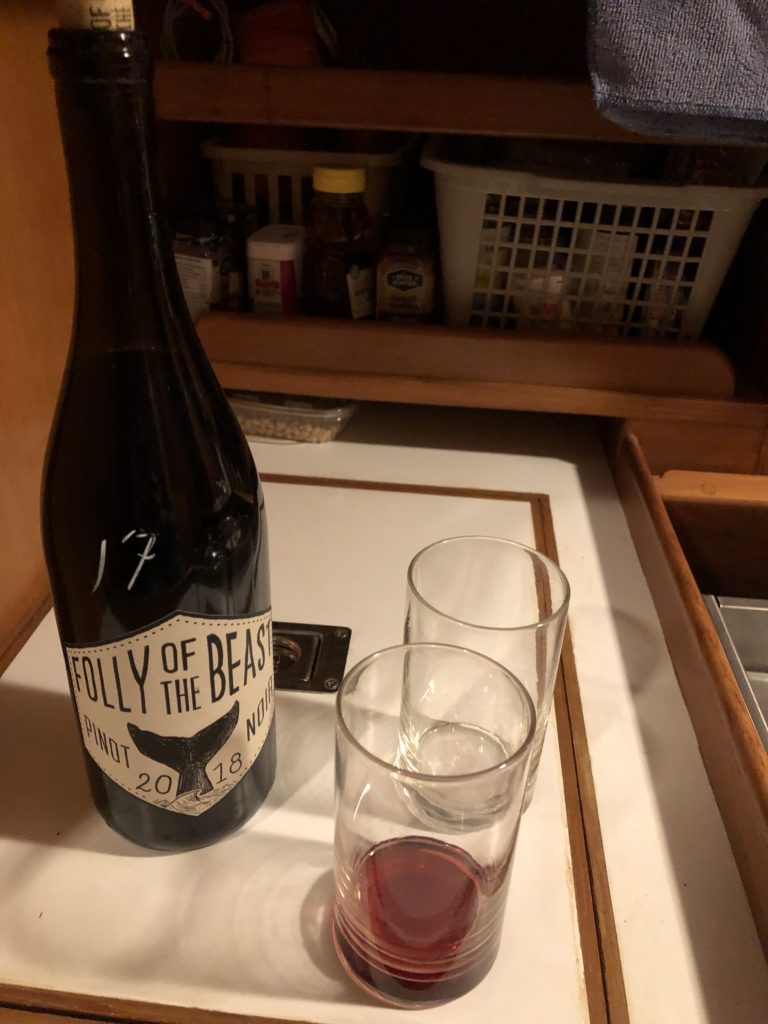
We spent the night on the boat, finishing off our thematically-appropriate wine.
Pasta with sauteed squash.In Basin Harbor.
The next day we thought we ought to see about paying for our stay. There were no responses by radio or phone, so we took that as an excuse to head ashore, and wandered a bit through the museum grounds.
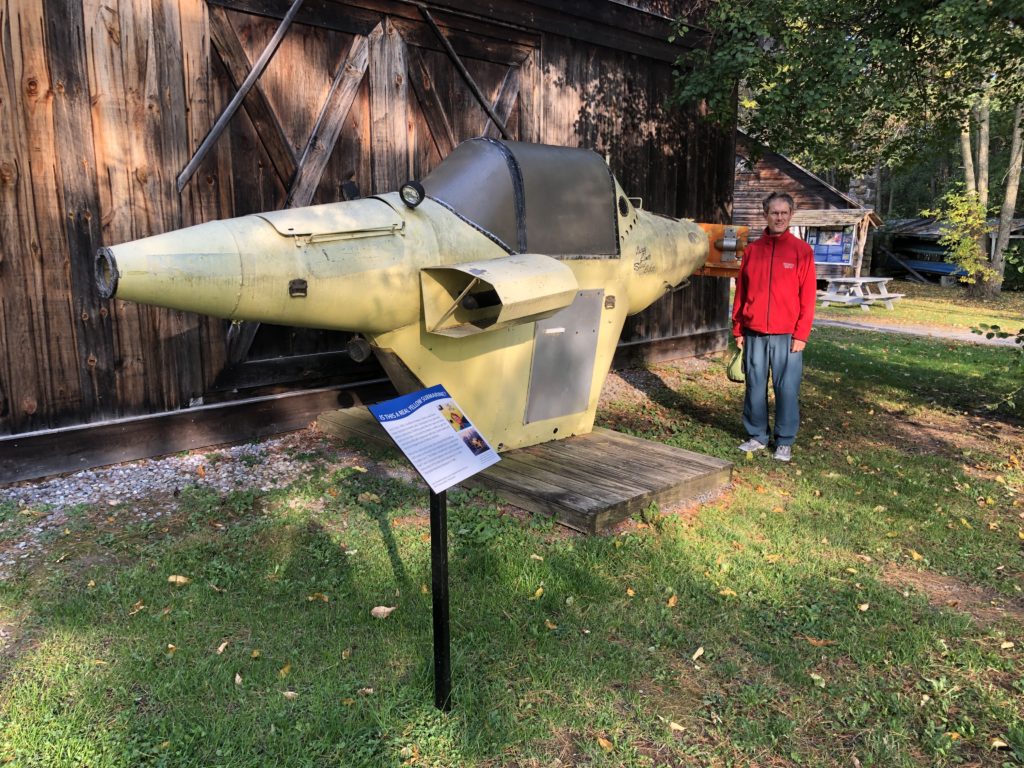
At the Lake Champlain Maritime Museum.
The above was essentially an underwater motorcycle, and not a true submarine; the pilot would wear scuba gear and ride along inside. Notably, it had to be licensed both by the Coast Guard and the Vermont Department of Motor Vehicles.
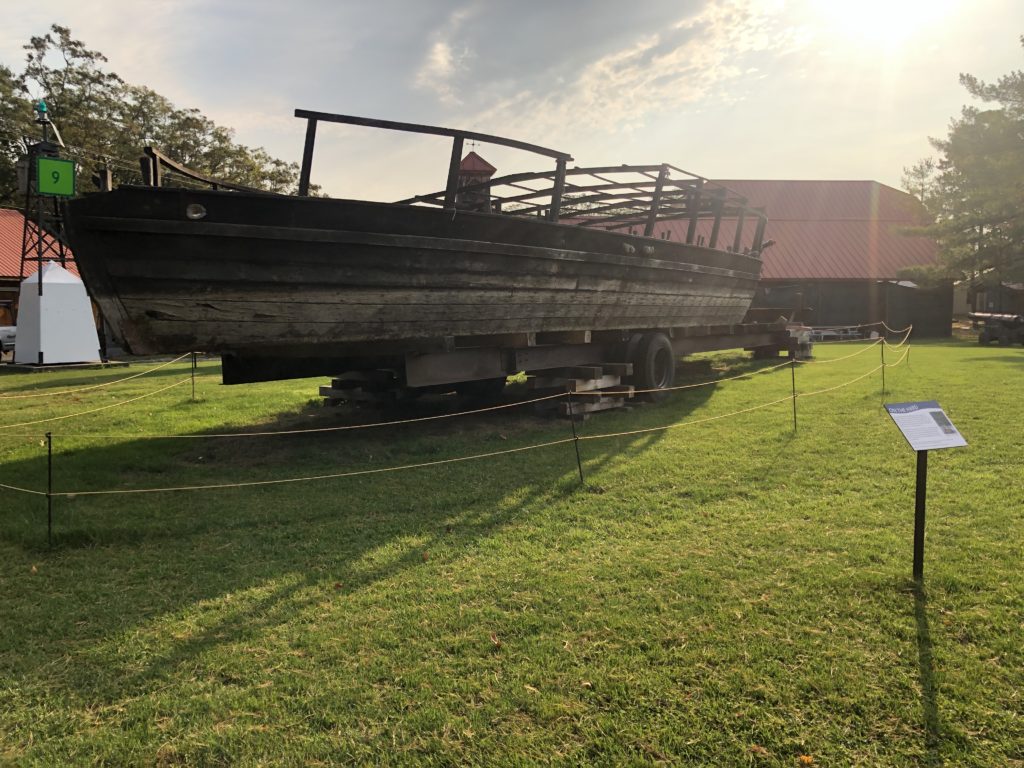
What’s pictured below, in addition to the replica sailing barge, harks back to Lake Champlain’s nautical history. For a long time, sailing barges were how goods were transported from the north to the south, and once the canal was built, the same vessels could trade down the Hudson all the way to New York. However, Lake Champlain’s nautical history also extends to the Revolutionary War period.
Benedict Arnold is remembered in American history as a traitor; an officer in the military who dared betray the United States and join the British. Before that, however, he was a pretty good commander, at one point giving the British the slip following a naval battle on the lake before sailing to Button Bay, where he escaped thereon by foot. The museum has a replica of that ship, and presently it’s being worked on.
Arnold’s Replica.
In any case, after our stay in Basin Harbor, we sailed some familiar territory again, to Barn Rock Harbor, then north along the western edge of the lake. We planned to take a bit of a detour into Converse Bay, but the winds grew strong and we decided to head to Kingsland Bay for one last sleep. We ended up spending up a ridiculous amount of tacking and, after we had enough data to work out our average speed, decided to motor in rather than spend another two or three hours negotiating with the environment.
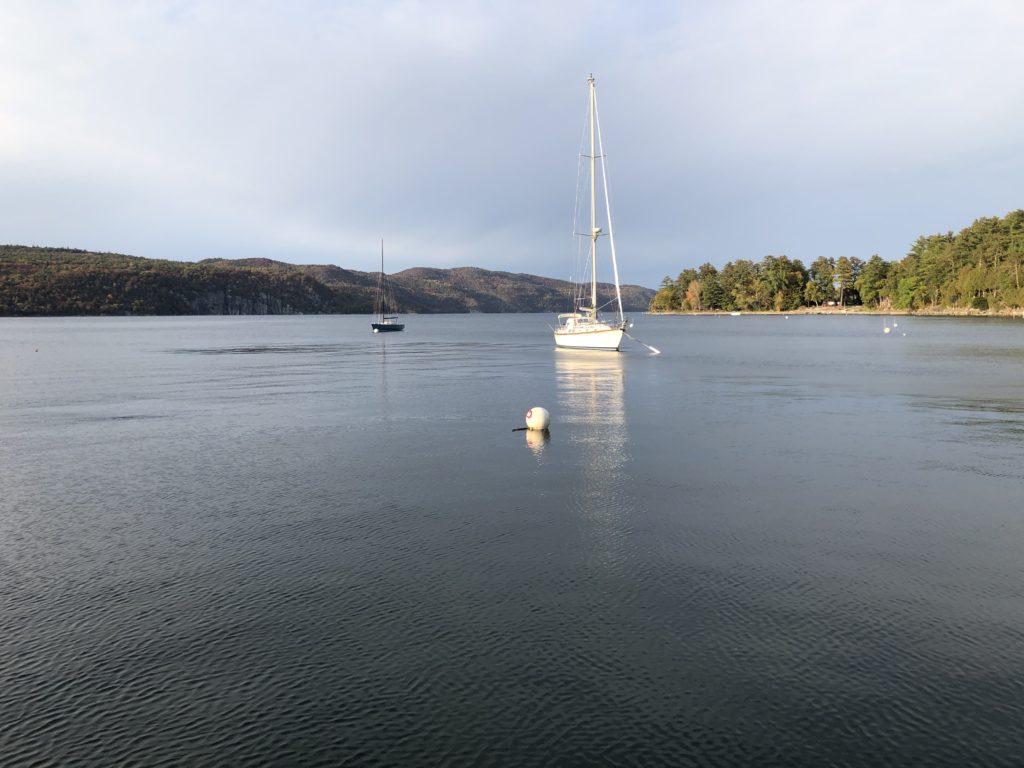
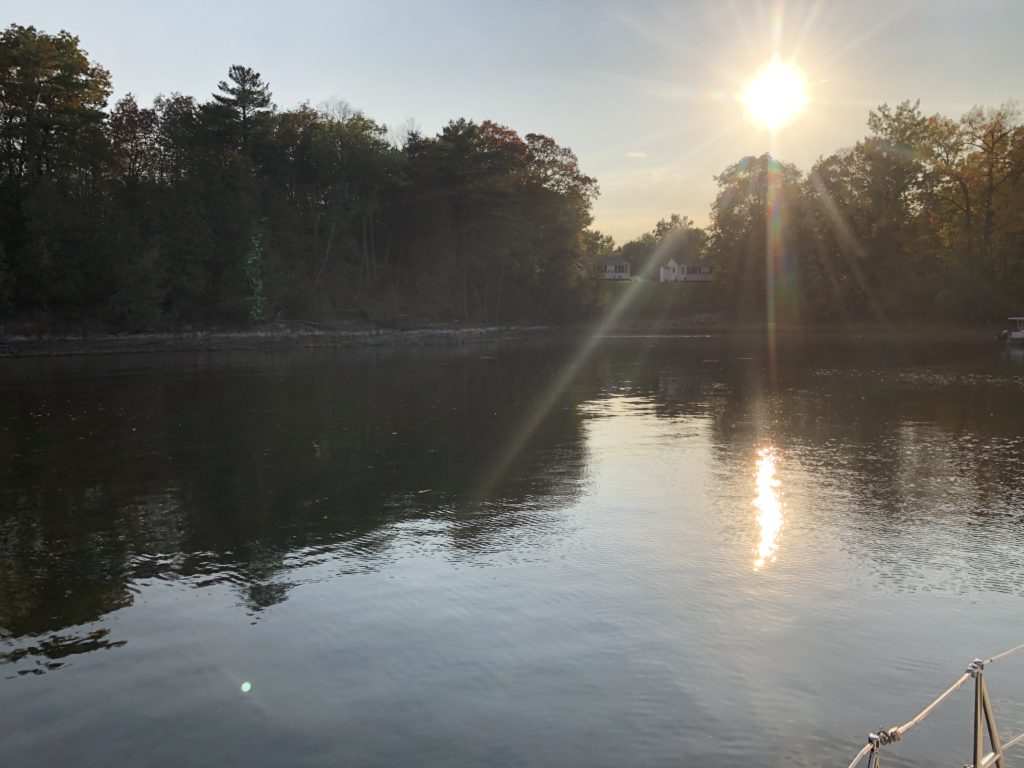
A Clear Morning.In Kingsland Bay.
Day 9
Day 9.
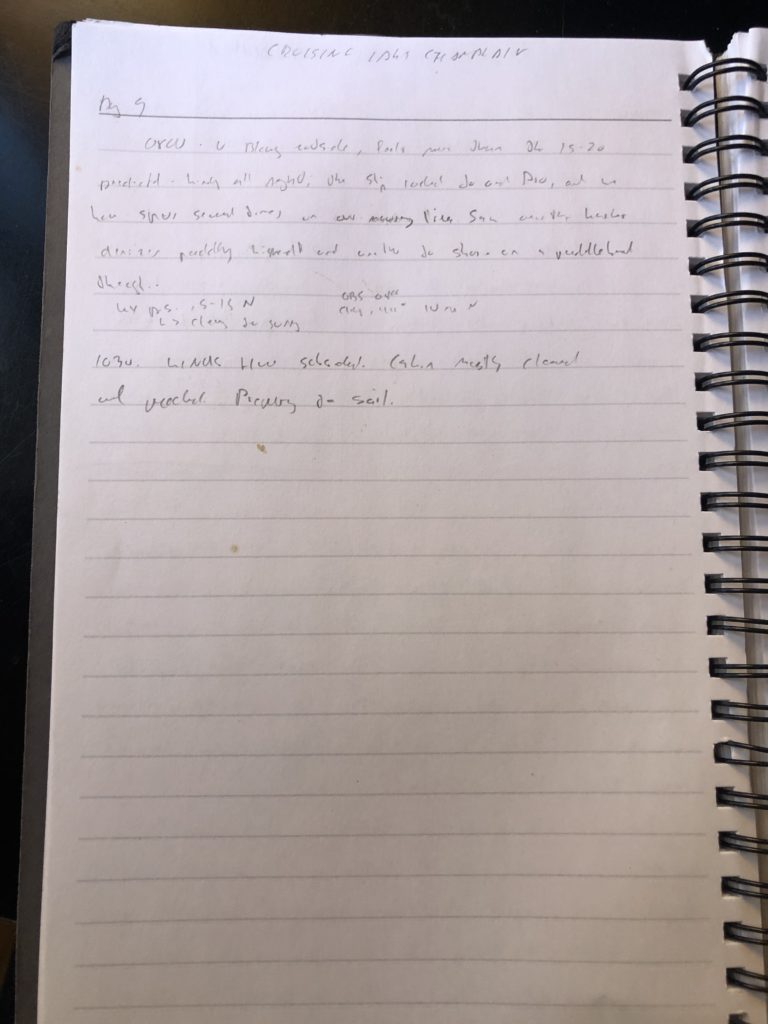
0800. V blowy outside, feels more than just the 15-20 predicted. Windy all night, the ship rolled to and fro, and we have spun several times on our mooring line. Saw another harbor denizen paddle himself and another to shore on a paddleboard though.
1030. Winds have subsided. Cabin mats cleaned and […]. Preparing to sail.
Our last day was a short one. Unfortunately, it was some of the best weather we had, so we succumbed to temptation for one more sail, and arrived back at home port an hour later than we’d planned. We’d been in touch with the ship’s owners and they were there to meet up; we unloaded at a slip, and then hurriedly finished closing up the ship before saying our final goodbyes and heading back home.
Lake Champlain is a beautiful place. Having camped there via kayak, and now lived and sailed there, I can say it is at once welcoming yet capable of great wrath and surprise. It is not a place to take lightly, but it is greatly rewarding for those who dare to trespass on its ripples.
Having settled into the boat and properly cruised a bit, we meant to sail more, but were confronted with an ugly forecast directly in the middle of our journey. We added some ice to the cooler and set out north, initially with the idea of sheltering in our home port, but opted instead to harbor in Kingsland Bay to shelter from the southerly wind.
Over the next day we would spent some time ashore, hiking some pretty trails; we also witnessed some very inhospitable weather, and imagined, and in some cases could glimpse, how rough the sea proper would have been. We had planned for the possibility of weather days with gear for inclement hikes, warm tea, and plenty of reading material: various material on iPad and Kindle, Jennifer Egan’s Manhattan Beach, and a rather thick biography of James Madison, America’s fourth President.
After the weather, we sailed south, to Crown Point; along the way we stayed at a marina; we braved a cold night and ventured towards the canals, but only so far before turning back north.
Day 4
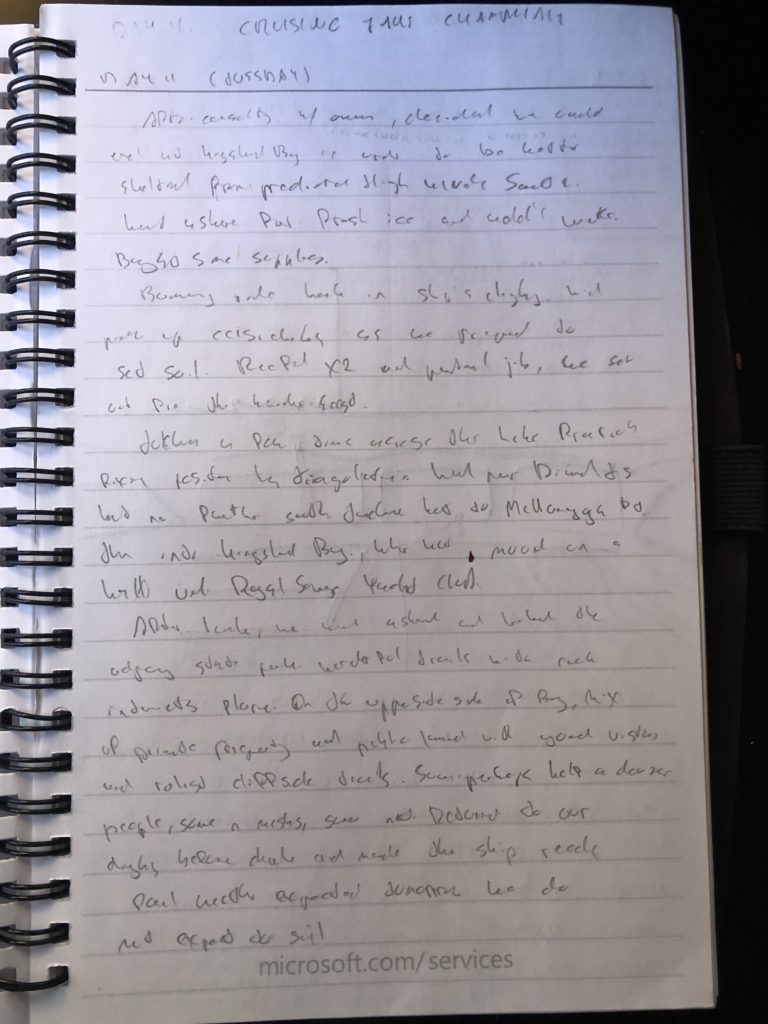
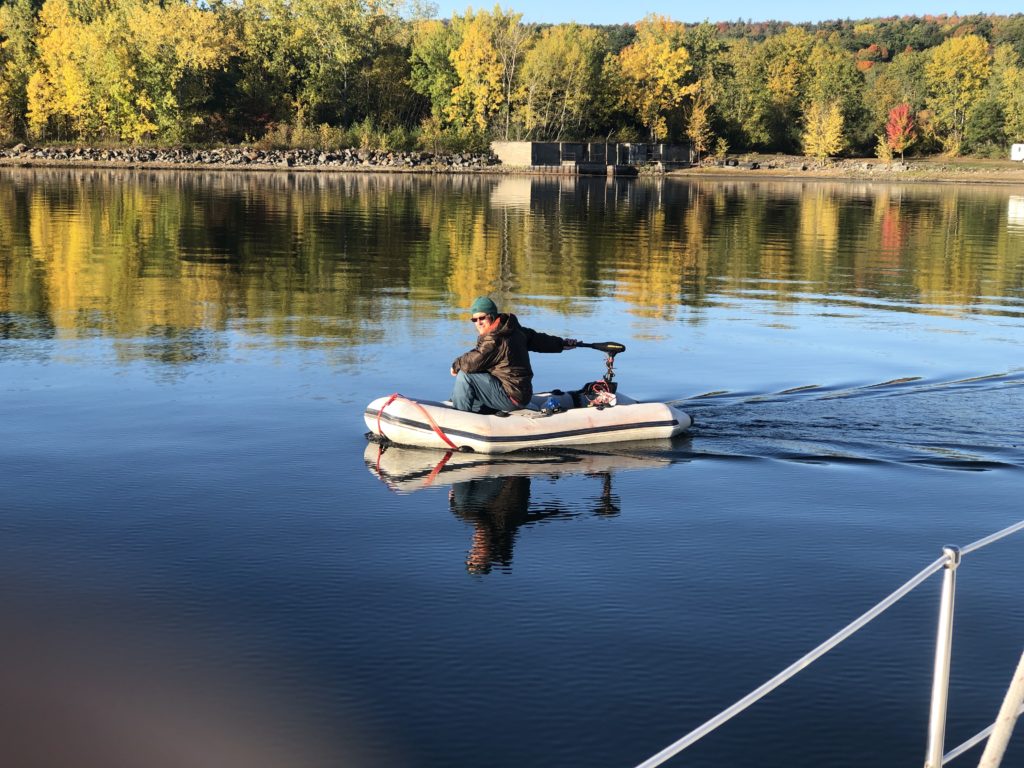
After consulting with owner, decided we would […] at Kingsland Bay in order to be better sheltered from predicted high winds from south. Head ashore for fresh ice and add’l water. Bought some supplies. Bouncy ride back in ship’s dinghy. Wind picked up considerably as we prepared to set sail. Double-reefed and partial jib, we set out heading east.
Taken a few ranges across the harbor. Practiced fixing position and triangulation. Headed near Diamond but no farther south, then to Mcullough Point, then into Kingsland Bay, where we moored on a ball under Royal Savage Yacht Club [banner].
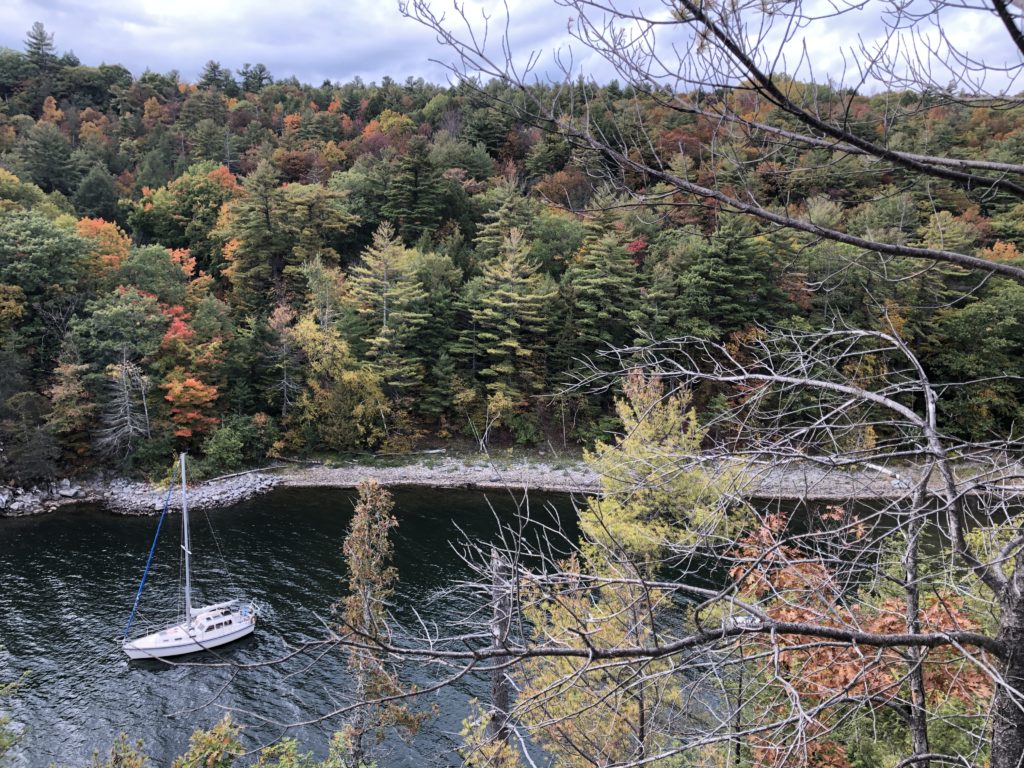
After lunch, we went ashore and hiked the adjoining state park. Wonderful trails with rich and interesting flora. On the opposite side of the bay, mix of private property and public land with good vistas and robust cliffside trails. Saw perhaps a dozen people, some in masks, some not. Returned to our dinghy before dark and made ship ready. Foul weather expected tomorrow. We do not expect to sail.
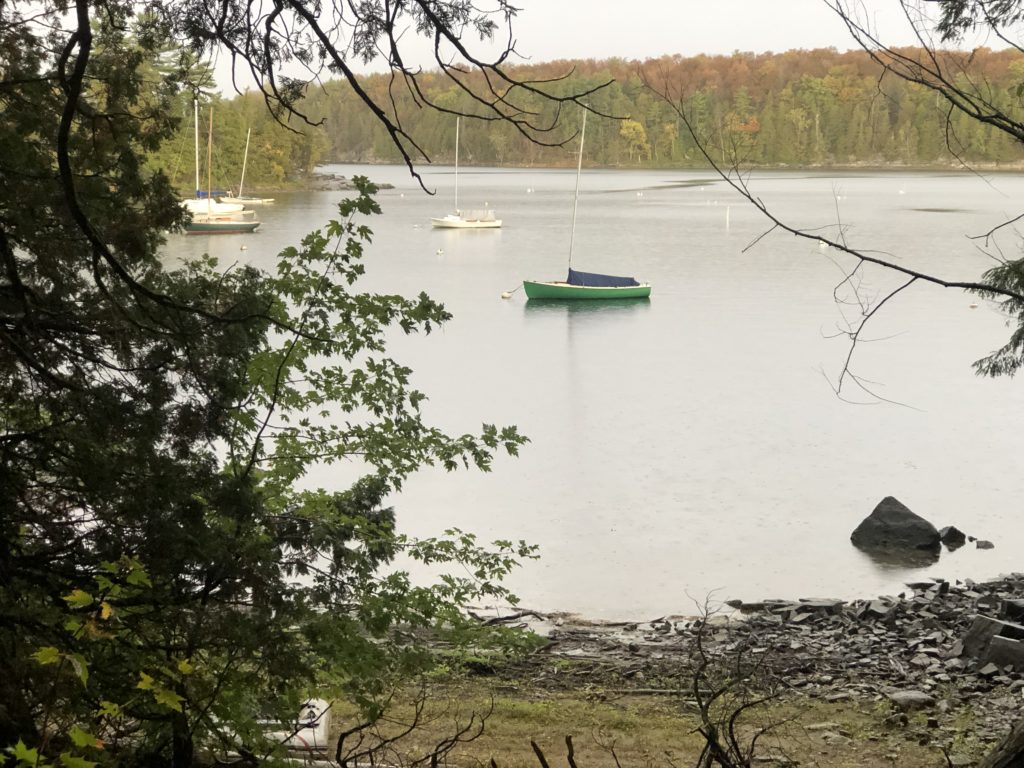
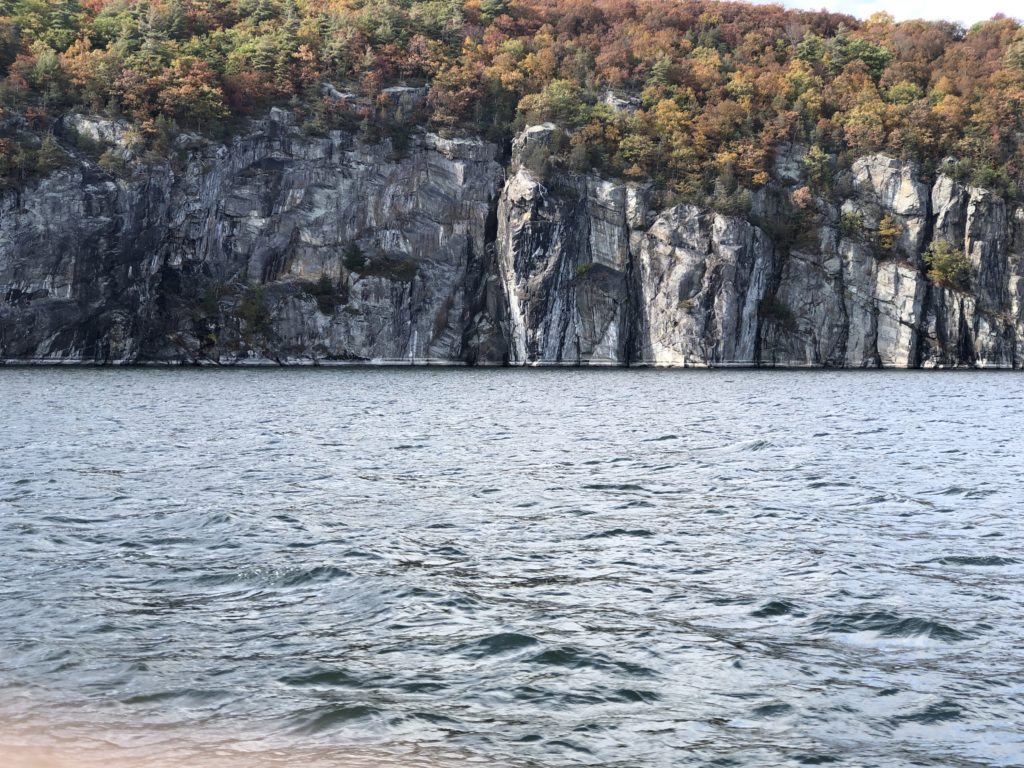
Our Green Friend.Under Way.The Palisades.
Day 5
This was our weather day. We stayed in Kingsland Bay and, for the most part, stayed on the boat. It was rainy and windy outside. We talked; listened to the radio, read, napped, and otherwise kept ourselves entertained.
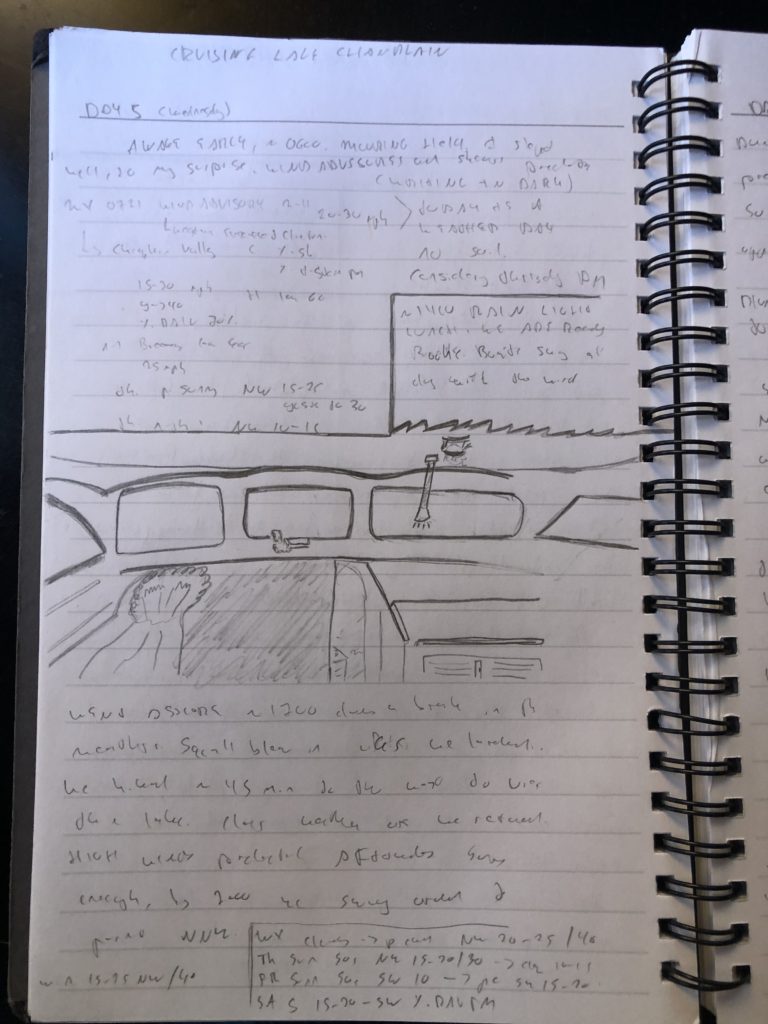
Awake early, ~0600. Mooring held, I slept well, to my surprise. Wind advisories [gibberish; I was writing in the dark].
Went ashore ~1700 during a break in the weather. Squall blew in as we landed. We hiked ~45 minutes to the west to view the lake. Clear weather as we returned. High wind predicted afterwards. Sure enough, by 2000 we swung around and pointed NNW.
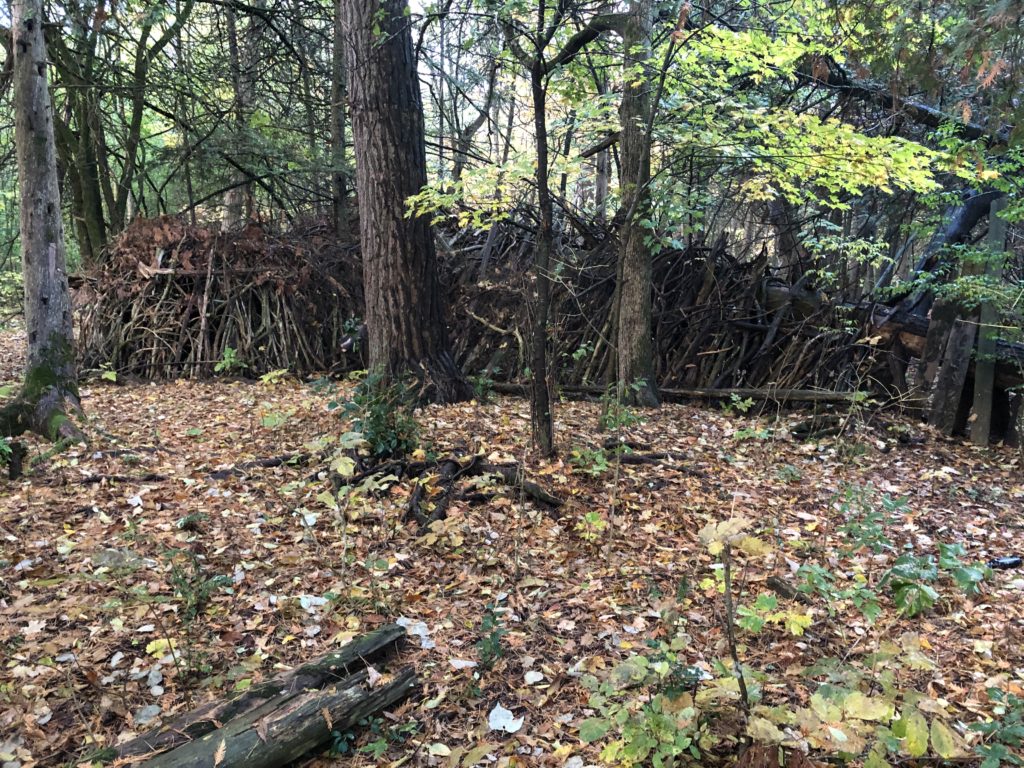
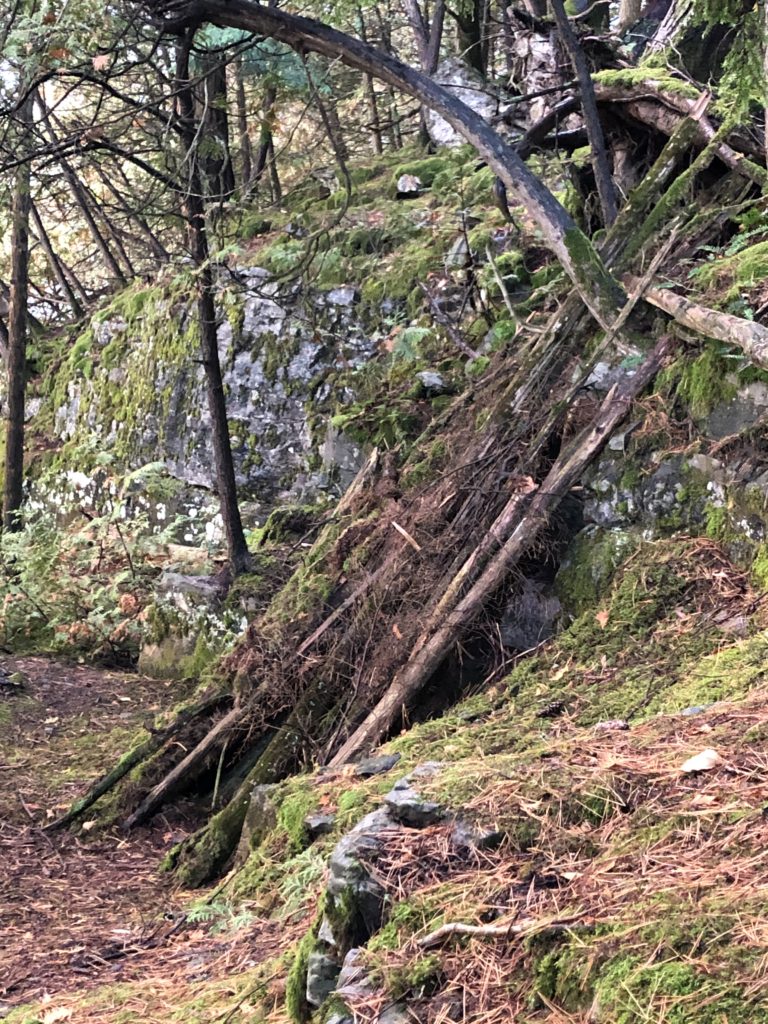
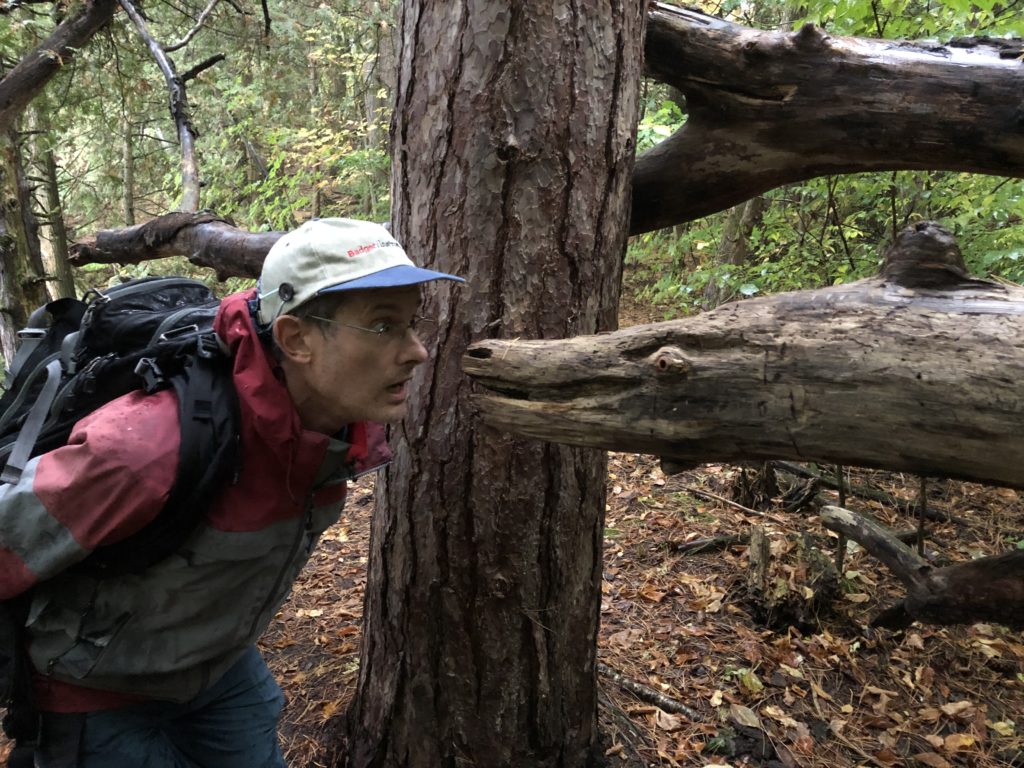
A Structure.A Hobbit Hut.A Wee Beastie.Thematically-Appropriate Wine.
Day 6
Planning to go to Crown Point. Called two marinas to confirm showers and mooring available.
We sailed [?] nautical miles. Sailing only on a jib and stay sail, no main sail. Winds predicted 15-25 gusts to 30 NW; After some pfaffing about, we came around Diamond Island and headed S/SW making 5+ kts. Altogether we took ~ 5 hours.
Laconic man with some attitude met us at the marina we opted for that [evening], $25 for the hot showers and a mooring ball.
Tonight is expected to be v. cold – near freezing. Lots of layers and piping breakfast in the morning. Gentler winds promised tomorrow. We will look over the […] and head north.
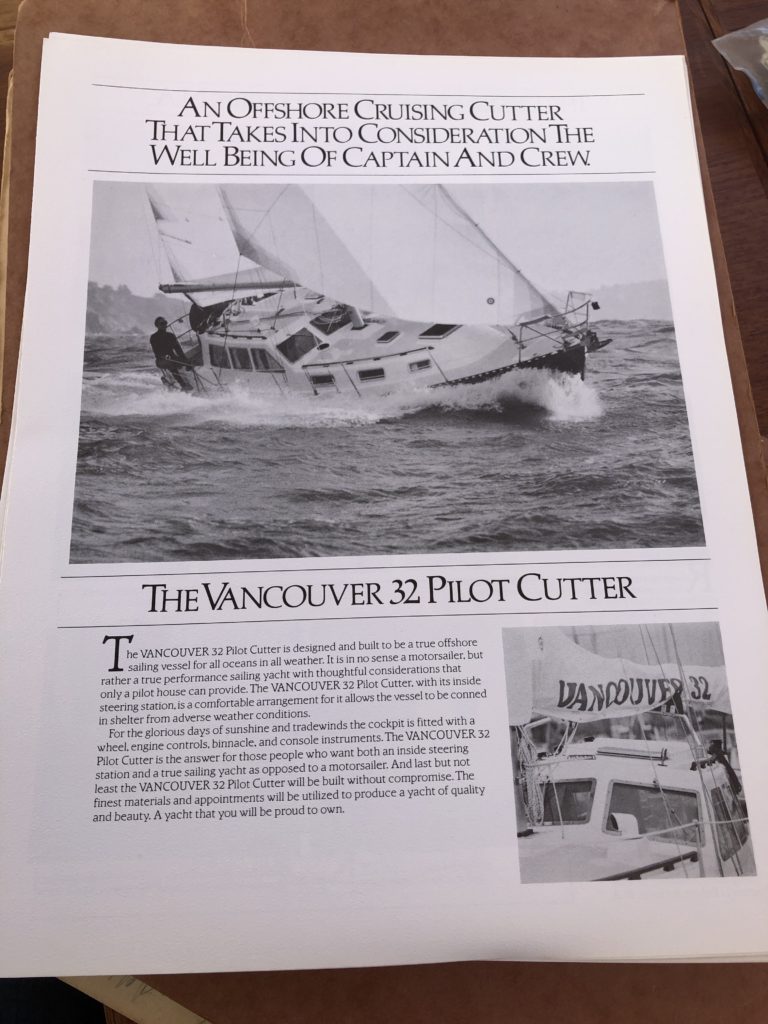
Today we voyaged several hours, negotiating the environment, fixing our position, checking our special “brochure moments”.
Ah yes, brochure moments. The moments we looked for the ship to be like the brochure.
The Brochure.
We never got quite that heeled over, but it was exciting at times.
The marina we chose was…strange. There was no overt hostility but neither was there the warm friendliness typical of most hospitality establishments. The cigarette dangling from a mouth at the fuel dock was a sign, albeit when no fueling was in progress.
This was our predicted cold night – down near freezing overnight. David and I had brought many layers, both clothes and blankets, and my number one mission the next day was to make coffee and start the heater.
Overall, it was not bad. In fact, the sun came out and in short order the next morning, the cabin was nearly warm. We still needed layers to be outside, but nothing unreasonable given the season. That was Day 7 though.
It was a surprising idea, even a worrisome one, proposed by David’s father: in order to have a vacation in Vermont, which at the time required New Yorkers to quarantine on visit, why not live and sail on the family sailboat?
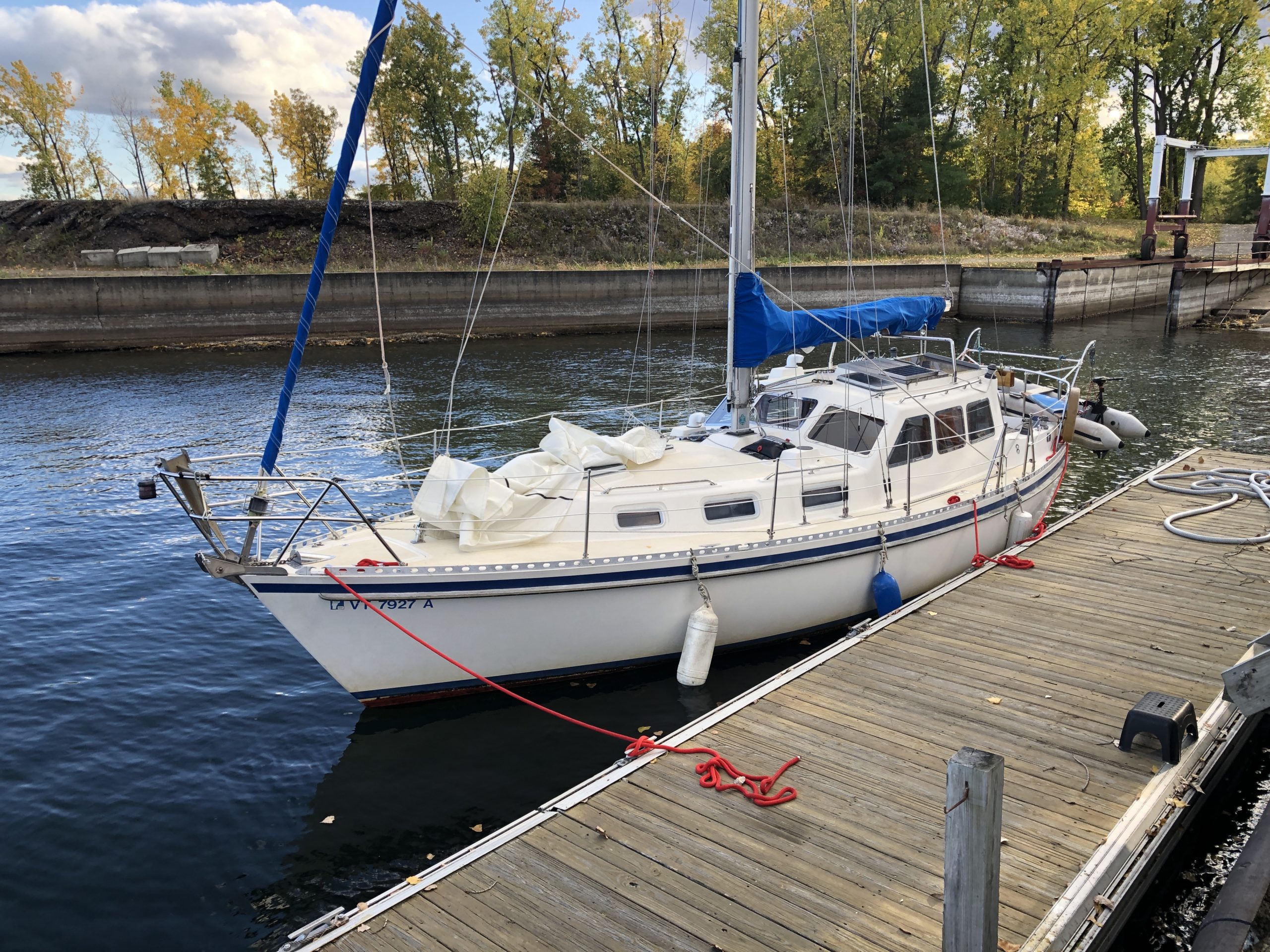
David has experience sailing, but nothing this big. He’s taken me out a few times on boats in the 23-26 foot range, as well as a sunfish, but nothing like this: a Vancouver 32 cutter with enclosed pilothouse. The Wind Rose is a fine ship, one that could comfortably sleep the two of us, with a two-range galley and inboard diesel motor.
It was really, really hard to say no, and after an initial trial weekend, we decided to give it a go.
We drove up in early October; by then, the lake water would be cooling and the air turning crisp. We were a little worried about overnight air temperatures, so we brought a lot of layers: blankets, clothes, extra jackets, wool socks. This was in addition to the food for galley cooking: breakfast, lunch, and dinner, as well as snacks. We also brought on potable water, because while the ship has water tanks suitable for rinsing dishes, the water tanks are thirty-five years old and, according to the owner, difficult to clean.
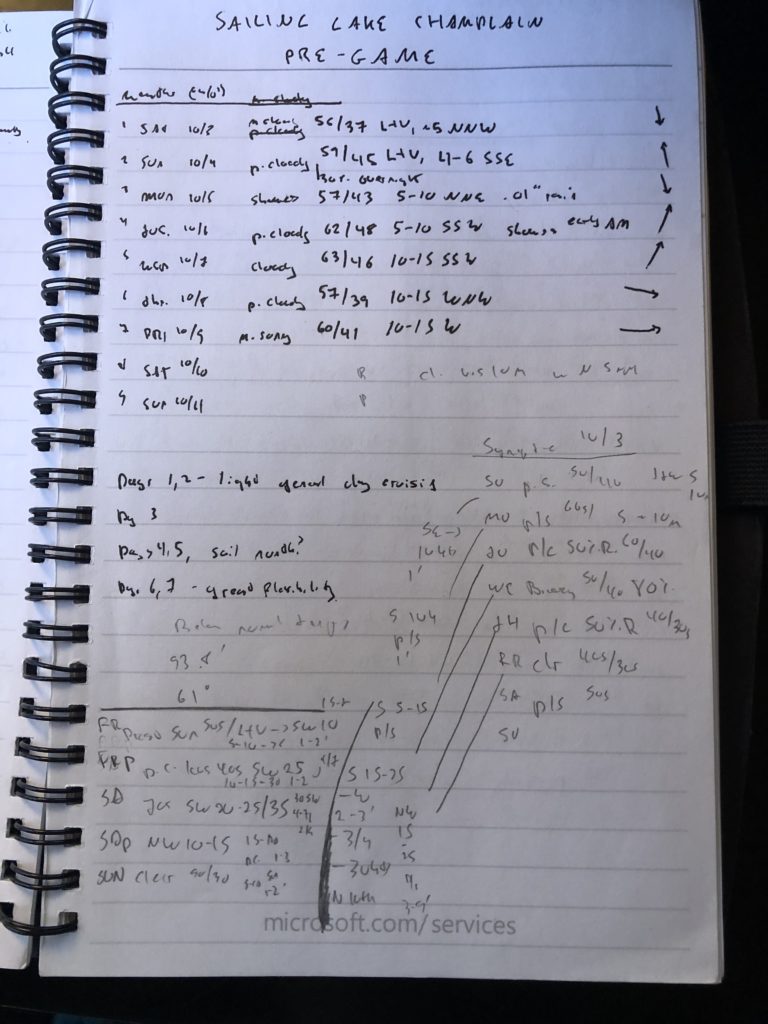
While it was a bit embarrassing how much stuff we had, we were fortunate to load up at a slip in the marina, a bit south of Burlington, Vermont. We had charts and some good anchorages marked on them. We took a look at the weather and went for a bit of a sail, before returning to the marina for our first overnight stay. We’d done some preliminary research.
Pre-Planning.
Overall, the forecast for wind kept us south. While we might have headed north, we wanted to take the first few days easy, and not get stuck too far away to come back without much effort.
We awoke early and had breakfast, then started determining our routine: listening to the weather forecast over the radio and determining our goals for the day.
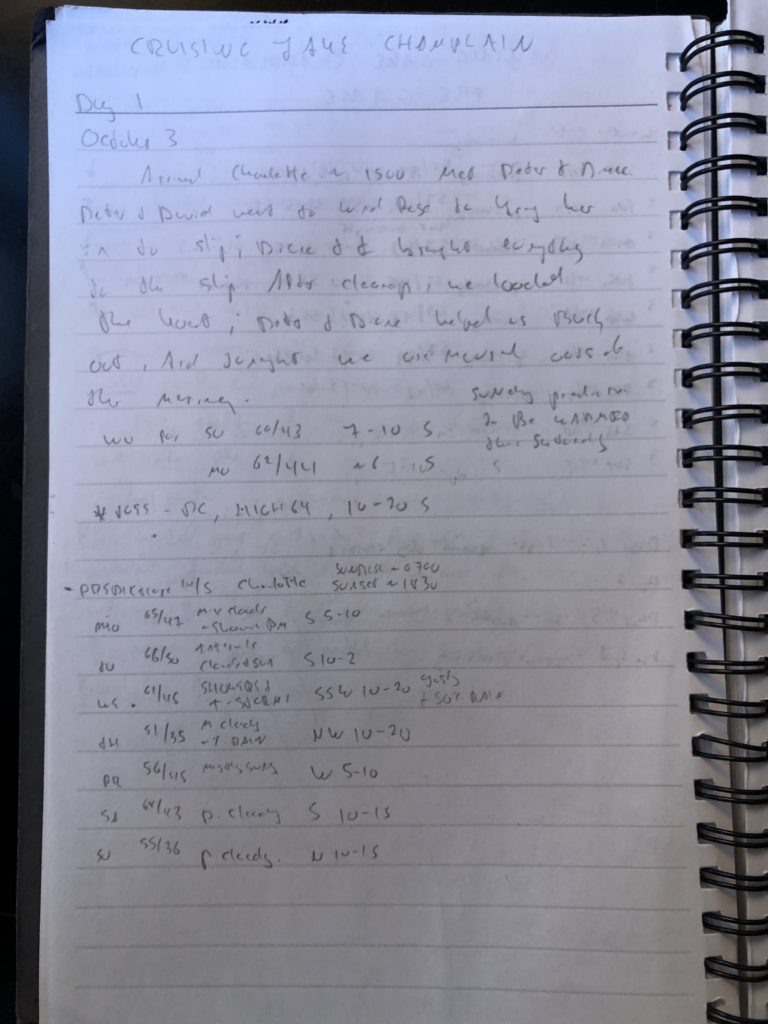
Day 1
Arrived Charlotte ~1500. Met P&D. P and David went to Wind Rose to bring her in to the slip; D and I brought everything to the slip. After cleanup, we loaded the boat; P&D helped us back out. And tonight we are moored outside the marina.
Essentially, we sailed for a couple of hours and came right back to the boat’s normal harbor, content to sleep aboard the vessel.
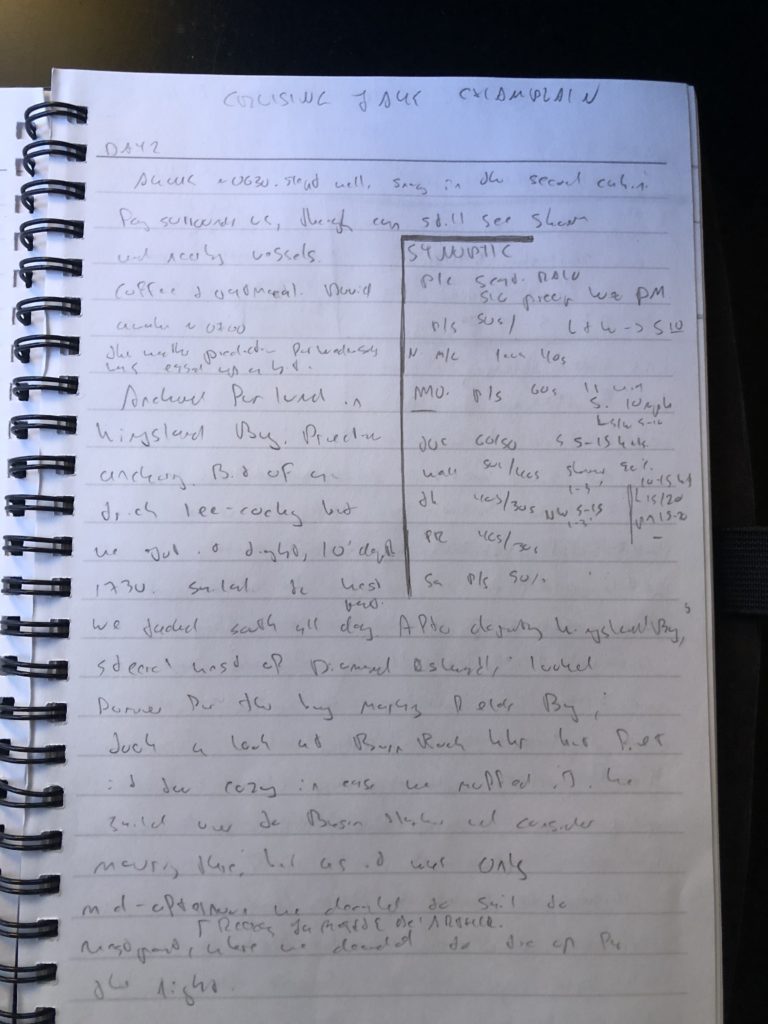
Day 2
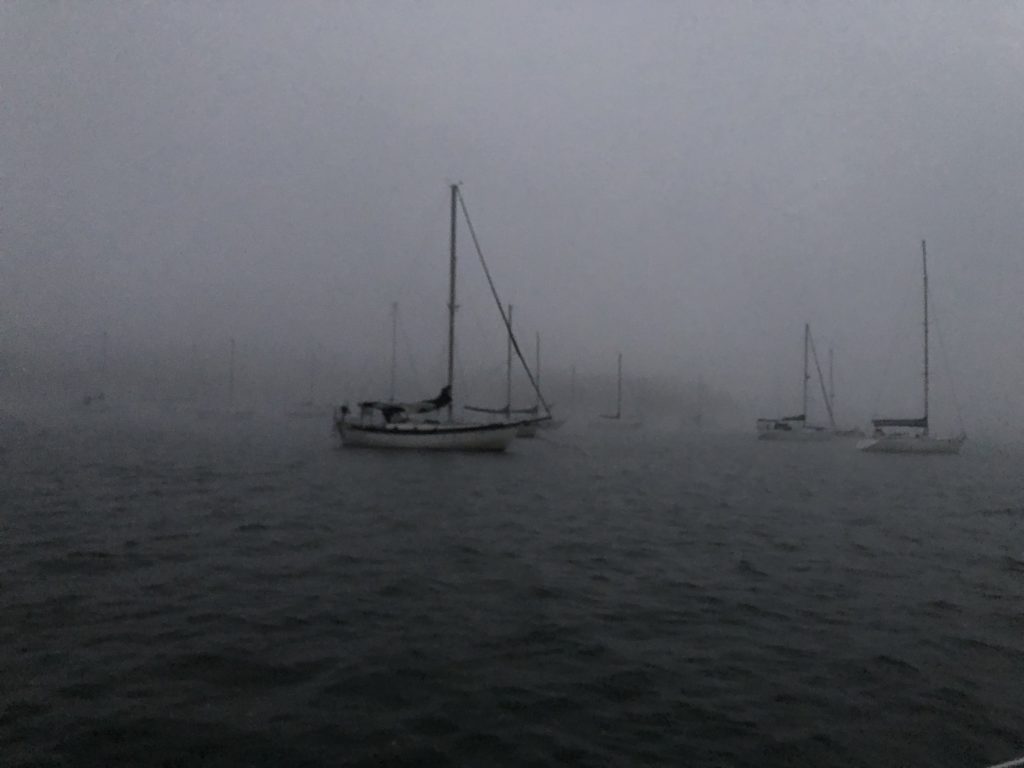
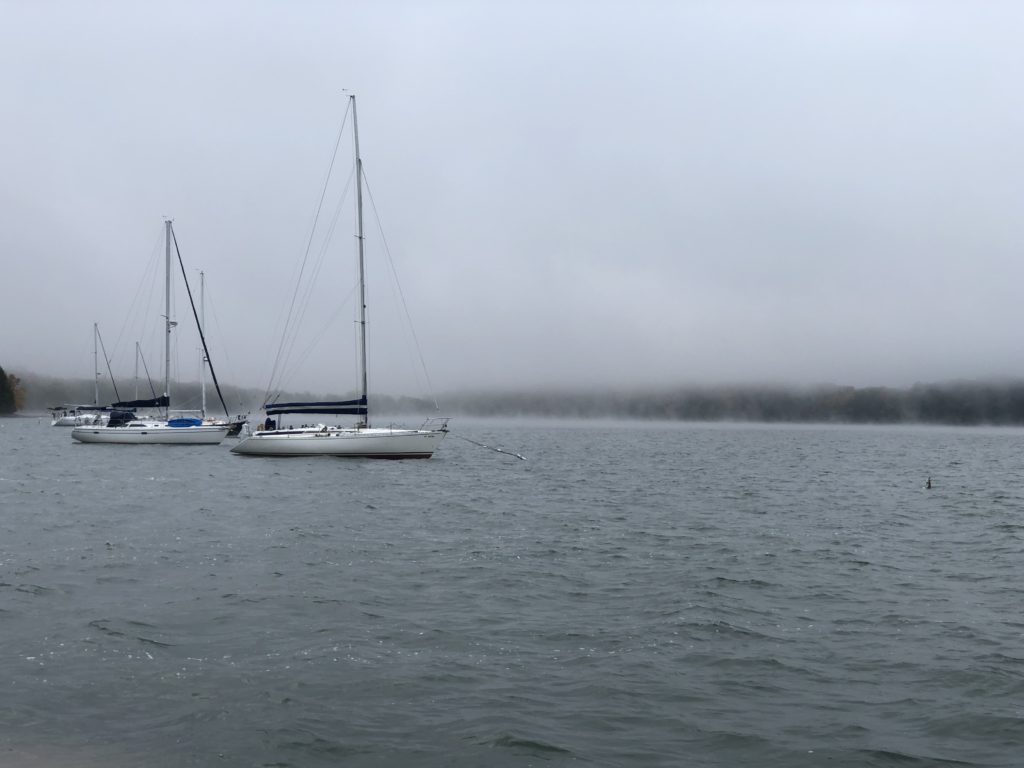
Awake ~0630. Slept well. Snug in the second cabin. Fog surrounds us, though can still see shore and nearby vessels.
Coffee & Oatmeal. David awake ~0700.
The weather prediction for Wednesday has eased up a bit.
Anchored for lunch in Kingsland Bay. Practiced anchoring. Bit of a trick lee-cocking but we got it right, 10′ depth 1730. Sailed to Westport. We tacked south all day. After departing Kingsland Bay, steered west of Diamond Island, looked forever for the buoy marking Fields Bay. Took a look at Barn Rock Harbor but found it too cozy. Then sailed over to Basin Harbor and considered mooring there, but at it was only mid-afternoon we decided to sail over to Westport [read La Morte D’Arthur] where we decided to tie up for the night
The second day was our first day of really sailing. We listened to the weather forecast. We plotted basic courses on the chart. We chose multiple destinations, unsure how far we’d get. We sailed.
We would return to some of these places. Much of the first few days were simply getting familiar with the area, as well as gauging how far and how fast we could sail.
It was foggy in the morning, but but the time we were done with breakfast, it was already burning off to become a beautiful day.
Early Morning.In the Marina.
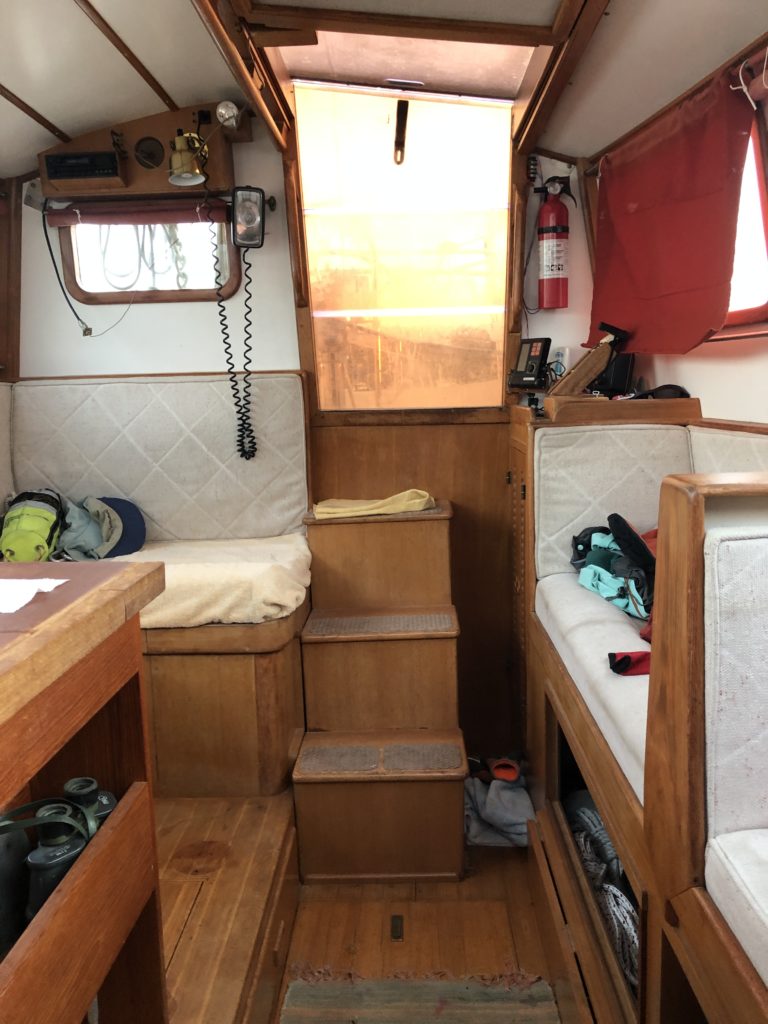
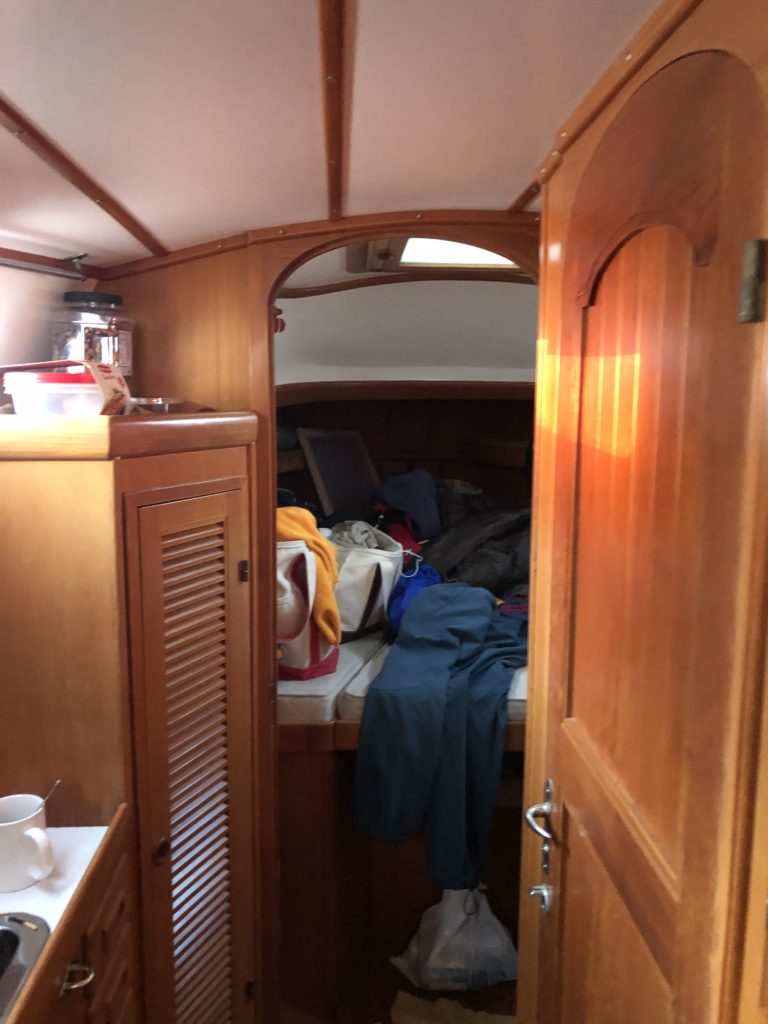
The ship itself proved quite comfortable. In our trial run we’d slept forward, in the V-berth, but I found it a bit high to climb in and out of. We used that for storage and stayed in the side cabin.
Looking Aft.The V-Berth
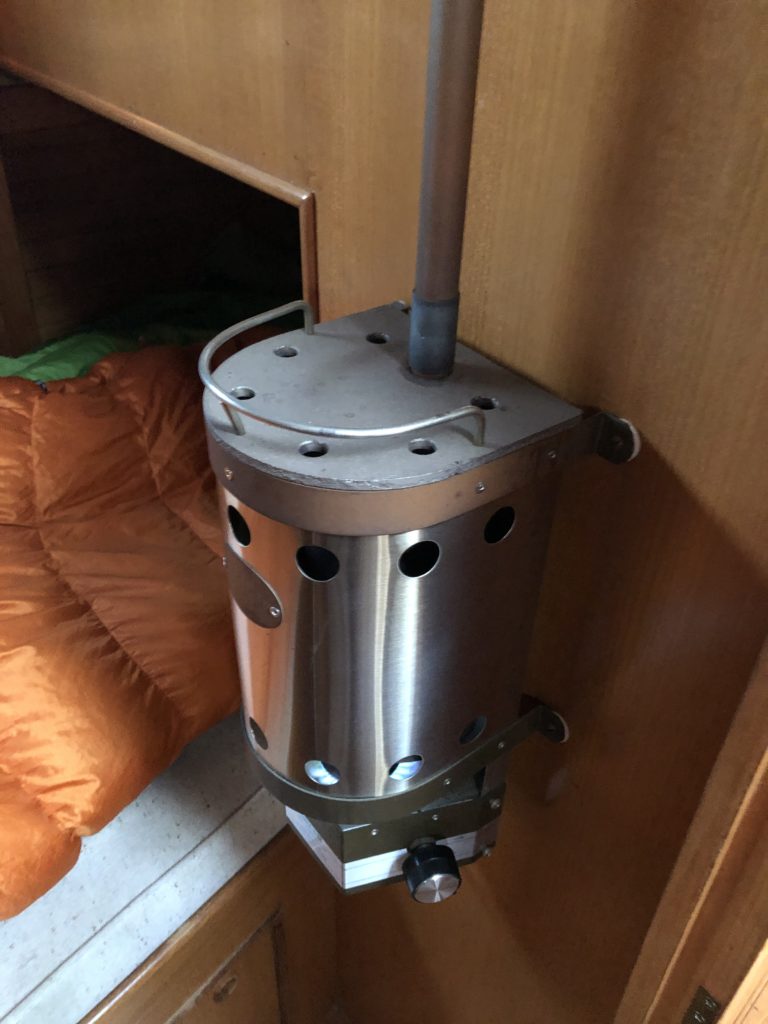
We had been a bit concerned about heat. The ship has a propane heater, which proved brilliant at providing nighttime warmth. We also learned that the sun would heat the cabin up quickly, once it was up.
Heater.
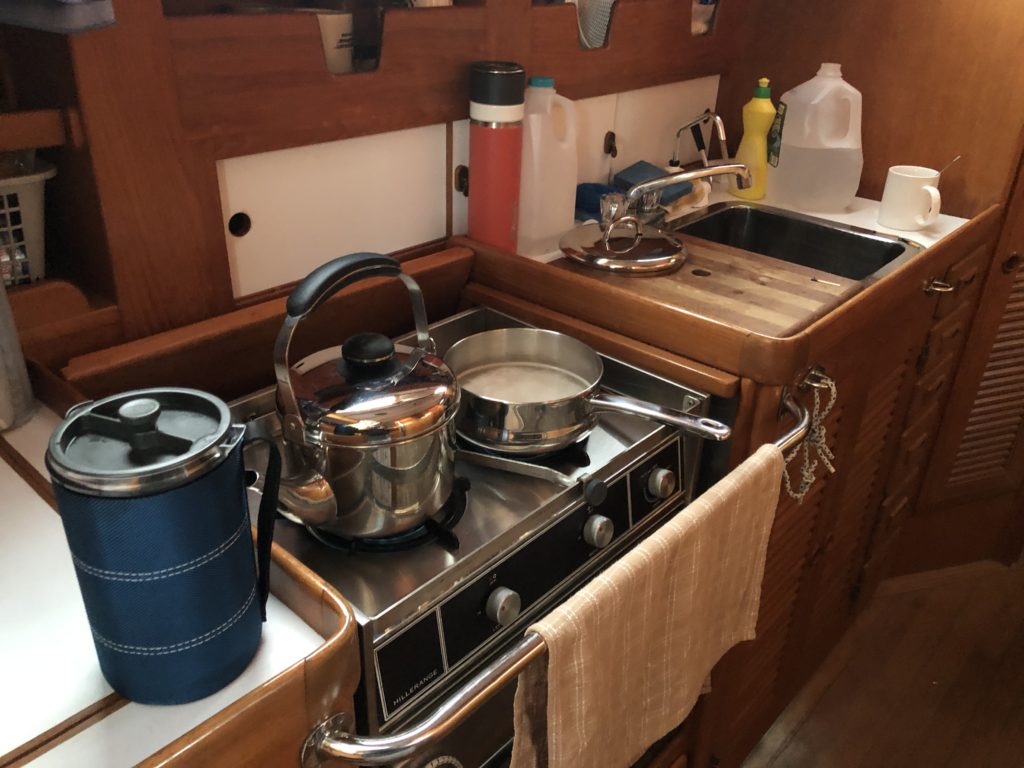
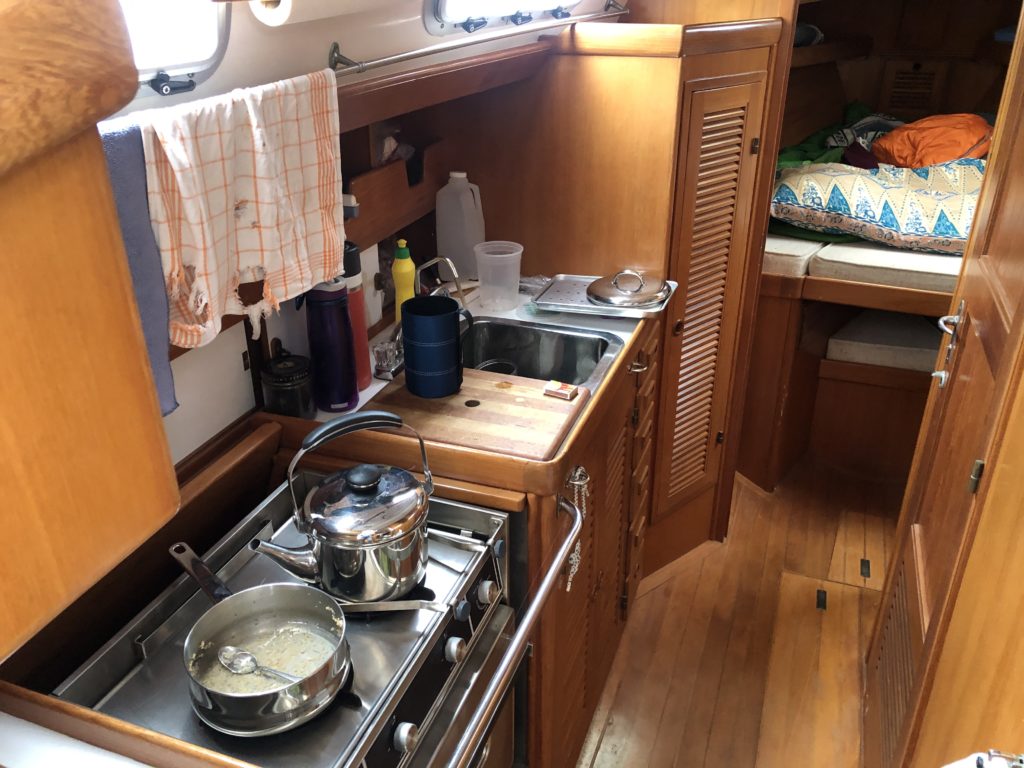
The galley proved more than adequate as well. The ship has an icebox built in, meaning it wasn’t refrigerated but, with some ice in, would keep things cool quite a while. The two-burner range worked, but the oven not so much; to my amusement the entire apparatus is mounted on a pivot, so it can swing with the ship. I didn’t cook on the go, but there were one or two rolly mornings where it was tempting to let it roll freely.
Preparing Breakfast.
Breakfast was mostly oatmeal and fruit, though we did do pancakes a couple of days. Coffee was a must.
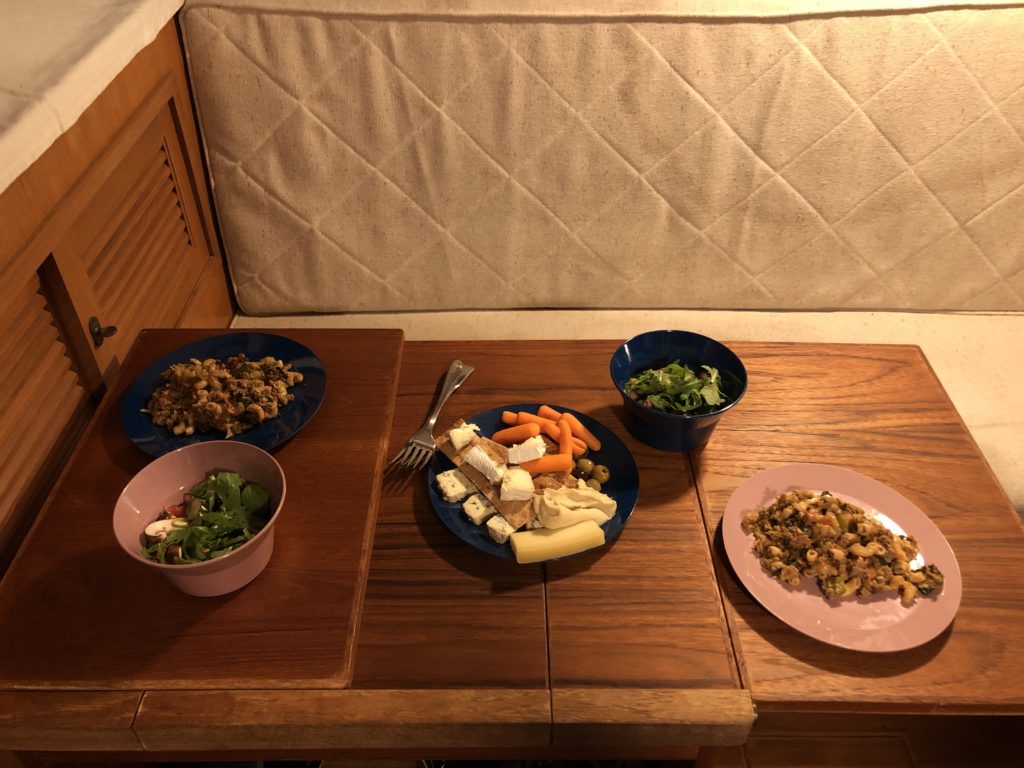
We didn’t have lunch so much as a snack plate – something we could either sit down to, or take turns snacking while we were sailing. Dinner was only put on once the boat was settled in for the night.
Day 3
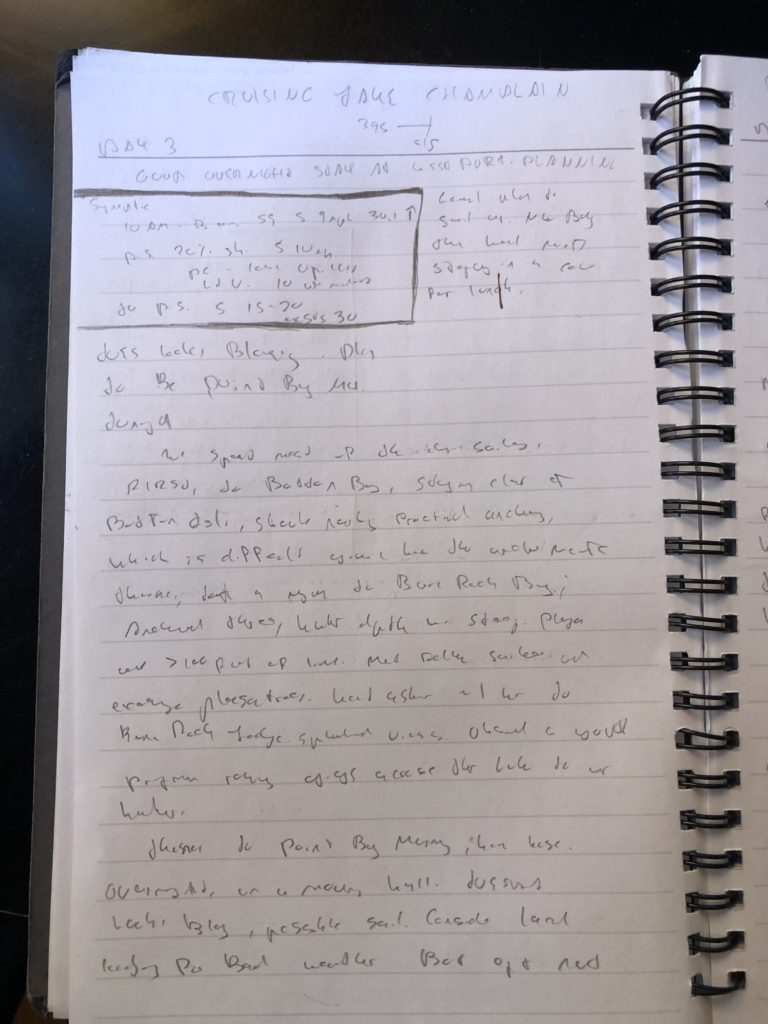
Good overnight stay at Westport. Planning. general Plan to sail ar Northwest Bay, then head north, stopping in cove for lunch.
Tuesday looks blowy. Plan to be Point Bay Marina tonight.
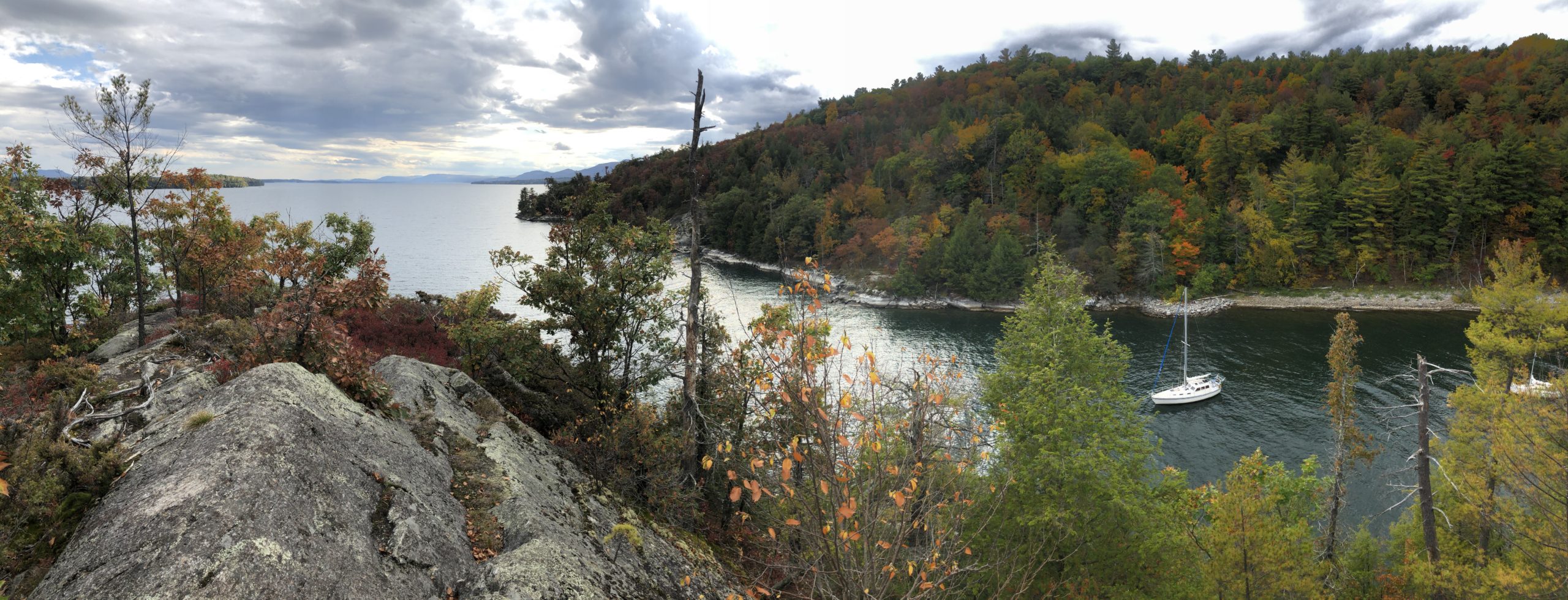
We spent most of the day sailing. First, to Button Bay, staying clear of Button Island […] practiced anchoring, which is difficult given how the anchor mounts. Then, kept a course to Barn Rock Bay [Harbor]. Anchored there, harbor depth was steep. Played out >100 feet of line. Met fellow sailor and exchanged pleasantries. Went ashore ~1 hour to Barn Rock Ledge, splendid views. There is a youth program rowing gigs across the lake to our harbor.
Thence to Point Bay Marina […]. Overnight, on a mooring ball. Tuesday looks blowy, possible sail. Consider land lodging for bad weather. But optimistic not.
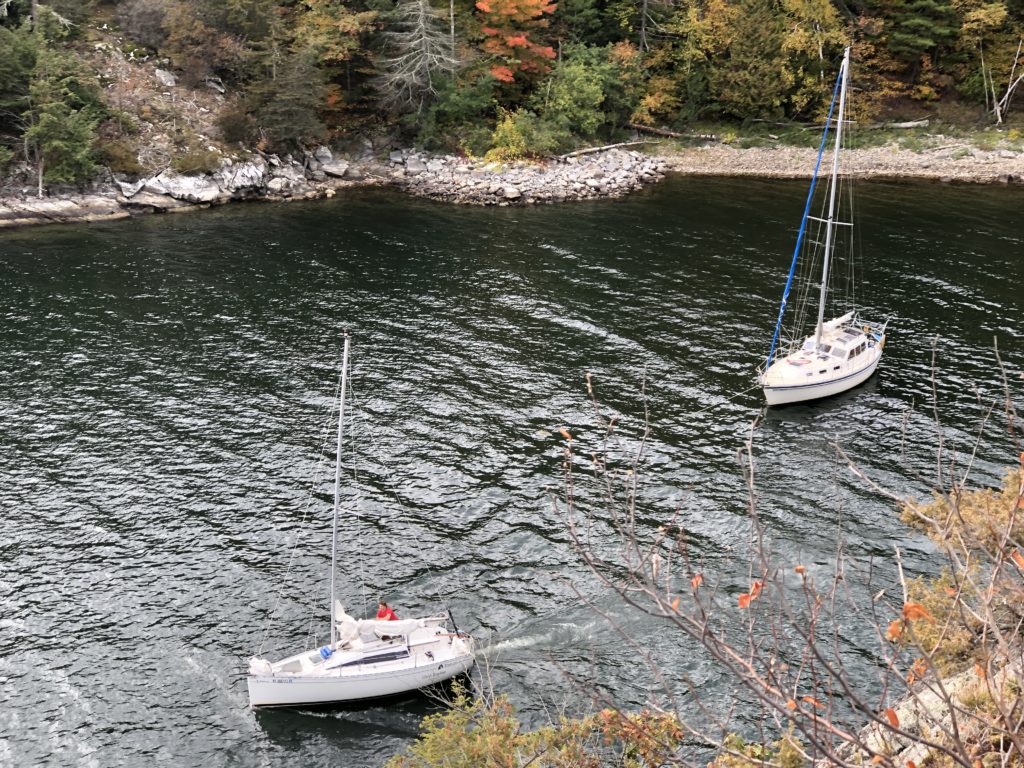
Barn Rock was great. It was simply daunting, because it is a small cove with a very steep dropoff. There’s a narrow window between too-deep and too-shallow. In hindsight we could have anchored farther in, but we didn’t want to cramp our neighbor.
Our neighbor departs.Kids Rowing.
We could hear them from almost a mile away – the sound of kids, rowing hard in a race across the lake. By the time we climbed down and were sailing again, they were rowing back, and we steered around them.
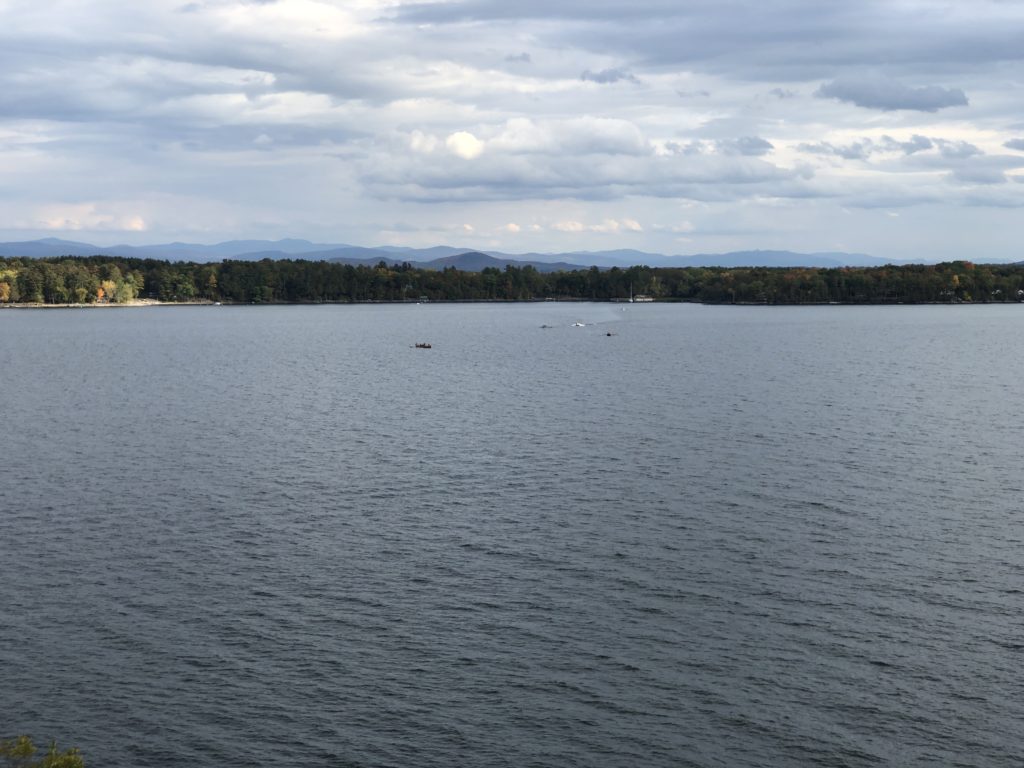
A View From Barn Rock.
The weather was predicted to be formidable Tuesday (Day 4) and possibly thunderstorms on Wednesday, so we set out to “home base” of Point Bay Marina. As I recall though, after consulting with the owner and looking at the wind, we opted to stay in Kingsland Bay, south and facing north across Town Farm Bay to see “home base”.
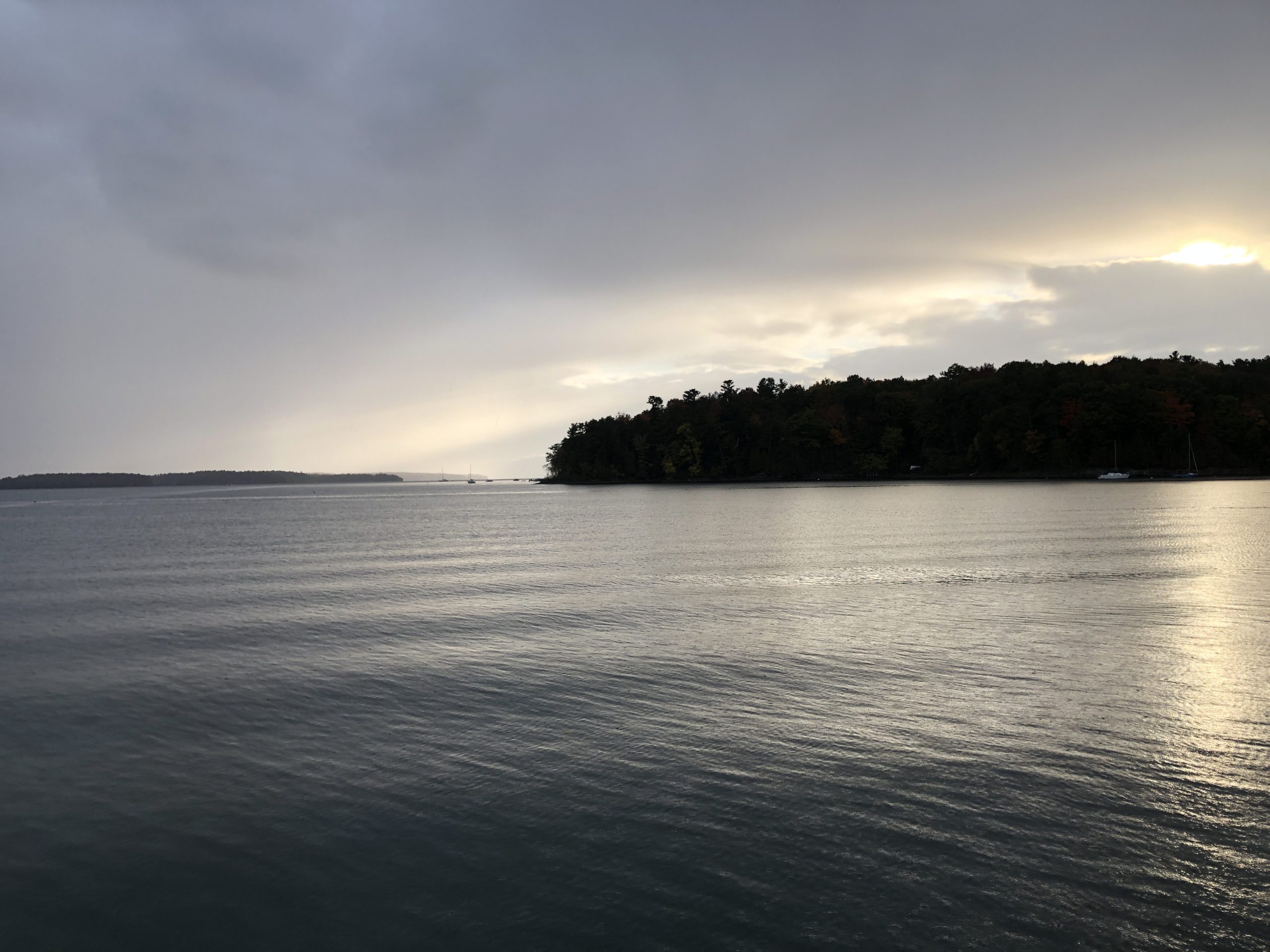
You can hear the wind. Not just the wind in the air, rustling trees, rattling lines. Inside, whether a boat or a building, the wind might be imperceptible, until you look outside and see its effect on the world around you.
Yet inside, you can still hear the wind, howling from across the lake, pushing the boat to strain audibly against the lines that hold her to the dock. The wind might push the boat against the dock, creaking against the fenders. Howling, mighty, the wind reminds you of its power, even fully inside the harbor.
David and I were aboard the Wind Rose, a Vancouver 32 closed-cockpit sailboat his parents own, on Lake Champlain. We were trying out living and sailing on the boat over a long weekend. I’m happy to say it was a success, and we hope for a longer journey aboard her soon.
After a Friday evening sail with his parents, who showed us the ropes, as it were, we slept and ate aboard the vessel. This came about in part because so many of the travel restrictions due to Covid require quarantine; here, we were able to minimally quarantine while still having a bit of a holiday.
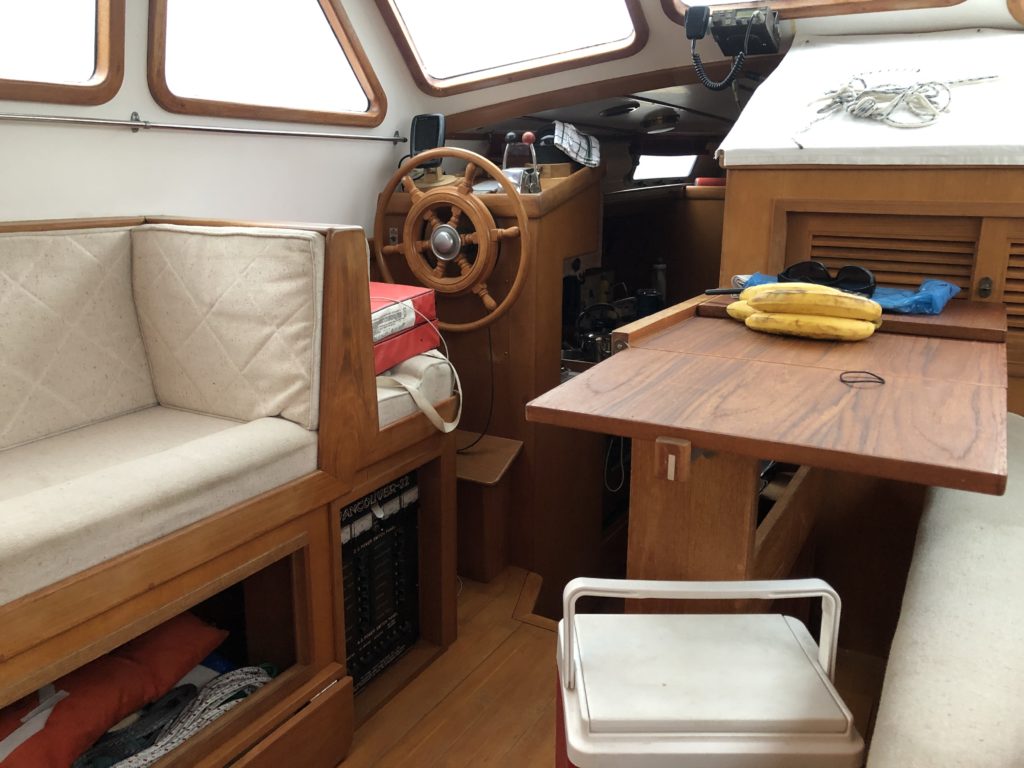
The Closed Cockpit.The Galley.Dinner.
David has taken me sailing a few times on smaller boats. There was a 24-foot boat we rented for a day in Florida; we’ve been out once or twice on a friend’s boat, recently sold; my paddling club has a sunfish, and most recently he’s been part-owner in a 23-foot Oday kept in Piermont, New York, near the Tappan Zee. Mostly, I steer, or work the jib when we tack.
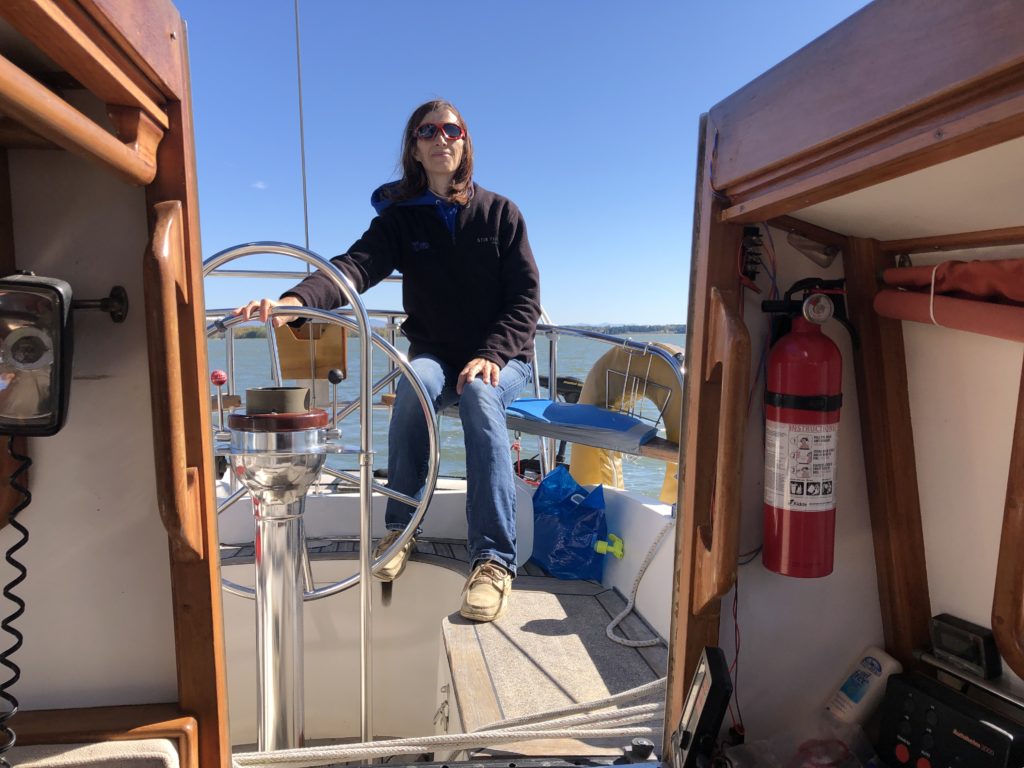
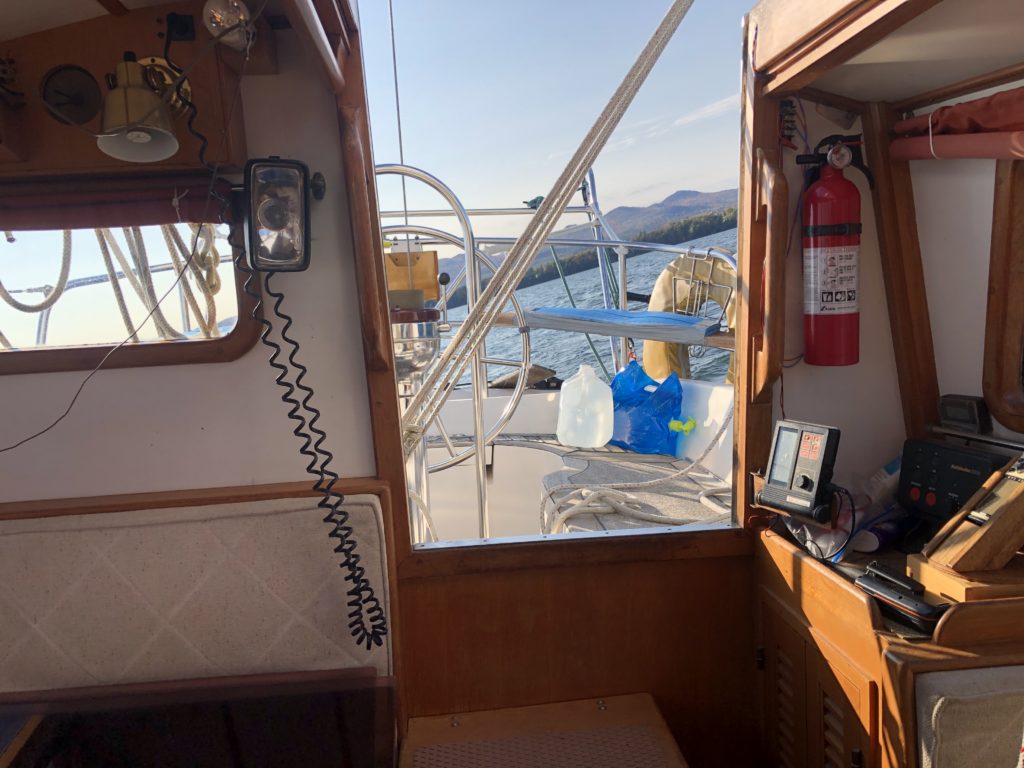
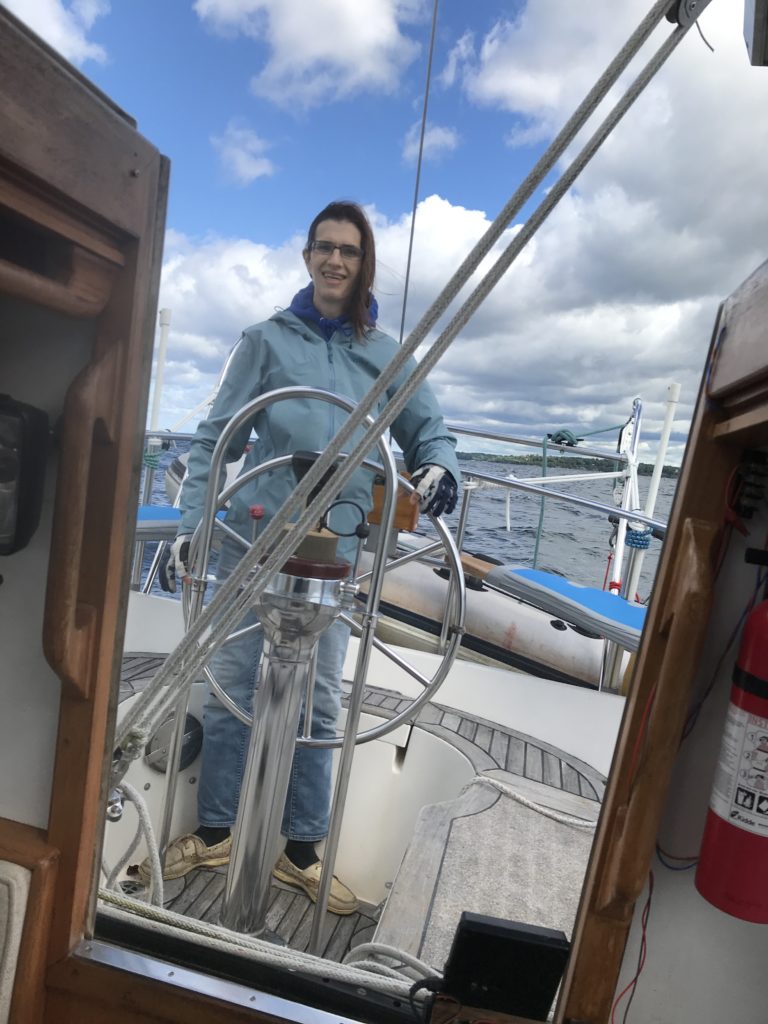
This was my first experience using a wheel for the helm; everything else has had a tiller. That took a bit of getting used to. Gaining a feel for how far to turn the wheel to change course or hold a course took a bit of practice. Additionally, while we did most of the driving from the open cockpit in the back, we made sure to try steering from the closed cockpit position, which offered less visibility in exchange for a bit more shelter from the wind. That was a novel experience.
The Wind Rose is also by far the largest vessel we’ve sailed. At thirty-two feet overall, she was steady and more reassuring in bigger waves. Fortunately, her size belies her handling; she turns very quickly, and in the world of sailing, and handled well both jib-only as well as main-only.
Day 1
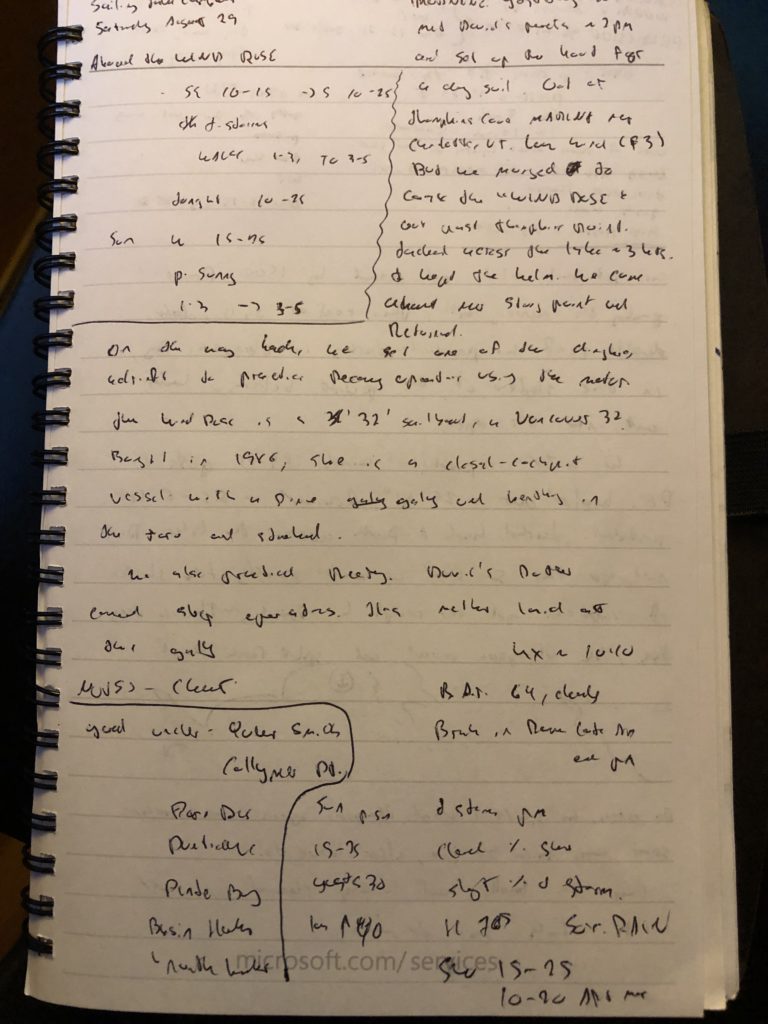
SATURDAY AUGUST 29
SE 10-15 growing to S 10-25; chance of thunderstorms.
Yesterday we met with David’s parents ~2PM and set up the boat for a day sail out of Thompsons Cove Marina, near Charlotte, VT. Low wind (F3), but we managed to coax he Wind Rose out past Thompsons Point. Tacked across the lake ~3 hours. I kept the helm. We came about to Split Rock Point and returned. On the way back, we set one of the two dinghies adrift to practice recovery operations using he motor. The Wind Rose is a 32 foot sailboat, a Vancouver 32. Built in 1986, she is a closed-cockpit vessel with a fine galley, and berthing in the fore and starboard. We practiced reefing. David’s father commanded ship operations. His mother laid out the galley operations. We were given a list of potential destinations to sail should conditions prove charitable.
Unfortunately, our sailing plans were curtailed by the weather. High winds predominated, in the F5-F6 category, gusts to F7 (16-25 mph, gusting to 30). Thunderstorms were predicted Saturday. Coupled with this being the first time David would be sailing the Wind Rose, and our limited area knowledge, we stayed in Saturday, although by the end it was evident that the worst of the conditions had passed to the east.
We pored over the weather all weekend: the synoptic over the radio, radar maps and raw data on our phones. How strong would the wind be? From which direction? What about wave height? Lake Champlain is notorious for winds running north and south, the long, relatively skinny lake offering plenty of fetch for the wind to grab the surface of the water and push it into mighty waves.
Ultimately we stayed in, reading, talking, learning how the boat’s systems worked. The galley proved quite usable, with a built-in icebox, propane cooking range, and tanks for water and fuel.
Day 2
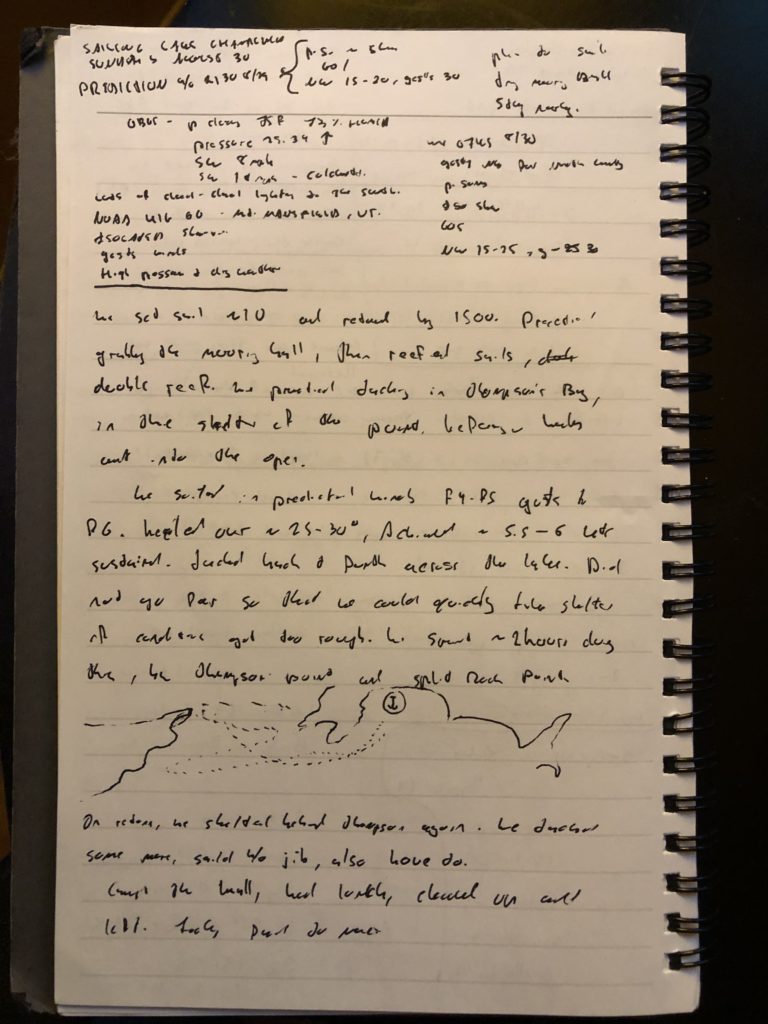
SUNDAY AUGUST 30
Isolated showers, gusts of wind. High pressure system and dry weather coming in from the west. P cloudy 75 F, pressure 29.34 and climbing. Winds NW 15-20, gusts to 30.
We set sail ~10 and returned by 1500. Practiced grabbing the mooring ball, then reefed sails, double reef. We practiced tacking in Thompsons Bay, in the shelter of the point before heading out into the open. We sailed in predicted winds of F4-F5, gusts to F6. Heeled over 20-30 degrees (?), achieved 5.5 to 6 kts sustained. Tacked back and forth across the lake. Did not go far so that we could quickly take shelter if conditions got too rough. Spent ~2 hours doing this, between Thomspons Point and Split Rock Point. On return, we sheltered behind Thompsons again. We tacked some more, sailed without jib, also hove to. Caught the ball, had lunch, cleaned up and left. Looking forward to next.
Sunday was our big sail. We were underway by 10, and returned a bit before 3. The first thing we did after leaving the slip was to practice grabbing the mooring ball and tying up, which was easier than anticipated. We then tacked back and forth in the shelter of Thompsons Point; with the wind from the northwest, the point protected us from the brunt of the wind while we got a feel for the boat’s handling, and our ability to handle her. We could see bigger water out past the point.
Eventually we set out, and oh my did we catch some wind. We heeled over and our speed ramped up considerably; we touched seven knots but were generally cruising in the five to six knot range. We did not go far; our thinking was that we wanted to be able to quickly duck back behind the point if conditions became too much. Essentially, we tacked back and forth across the lake.
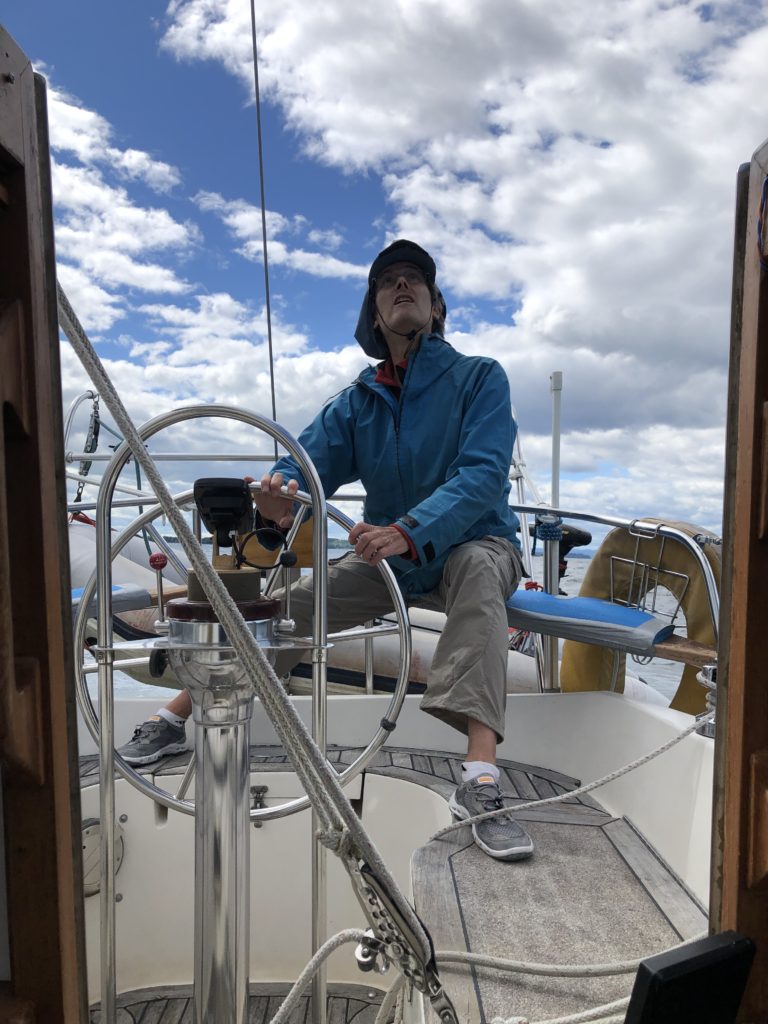
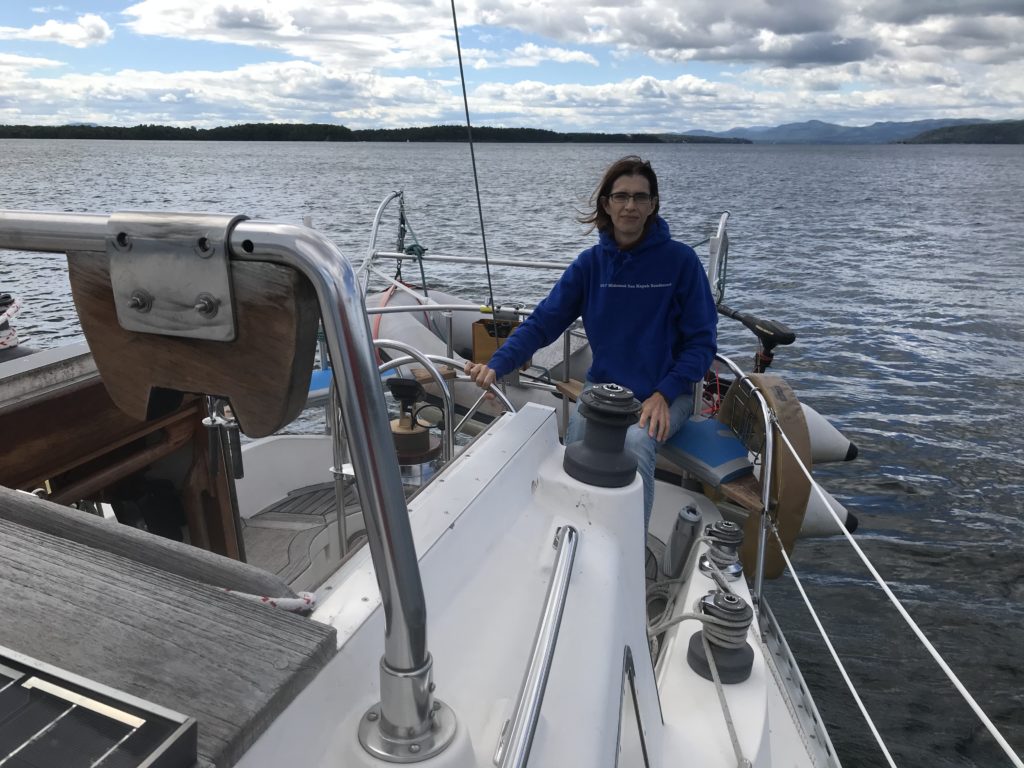
Helmsman.Helmslady.
While it was exciting, I have to admit that after a while I was a bit queasy, and didn’t want to prepare lunch while slapping bow against the waves, which were solidly in the two-foot range. We pulled in behind the point and compared strategies of vessels heading out; one was under full sail, another was jib only. We later saw a motor boat being towed back by the marina’s crane rig.
Relaxed Steering.
When we decided to try and heave too, it turned out his parents were on shore, watching, and apparently we didn’t look too shabby in our efforts. Stopped, barely moving sideways, we took a much-needed break.
When we were done, we started the long process to break things down. Caught the ball, lowered the sails, cleaned the berths, head, and galley, gathered our belongings. We left her ship-shape, and took the dinghy back to shore.
“I am so tired!” Madame moaned as she set the fish on the table.
“Certainly not from baking the fish, Madame,” said the Musician. “It is so simple, no? Herbs, oil, bake?”
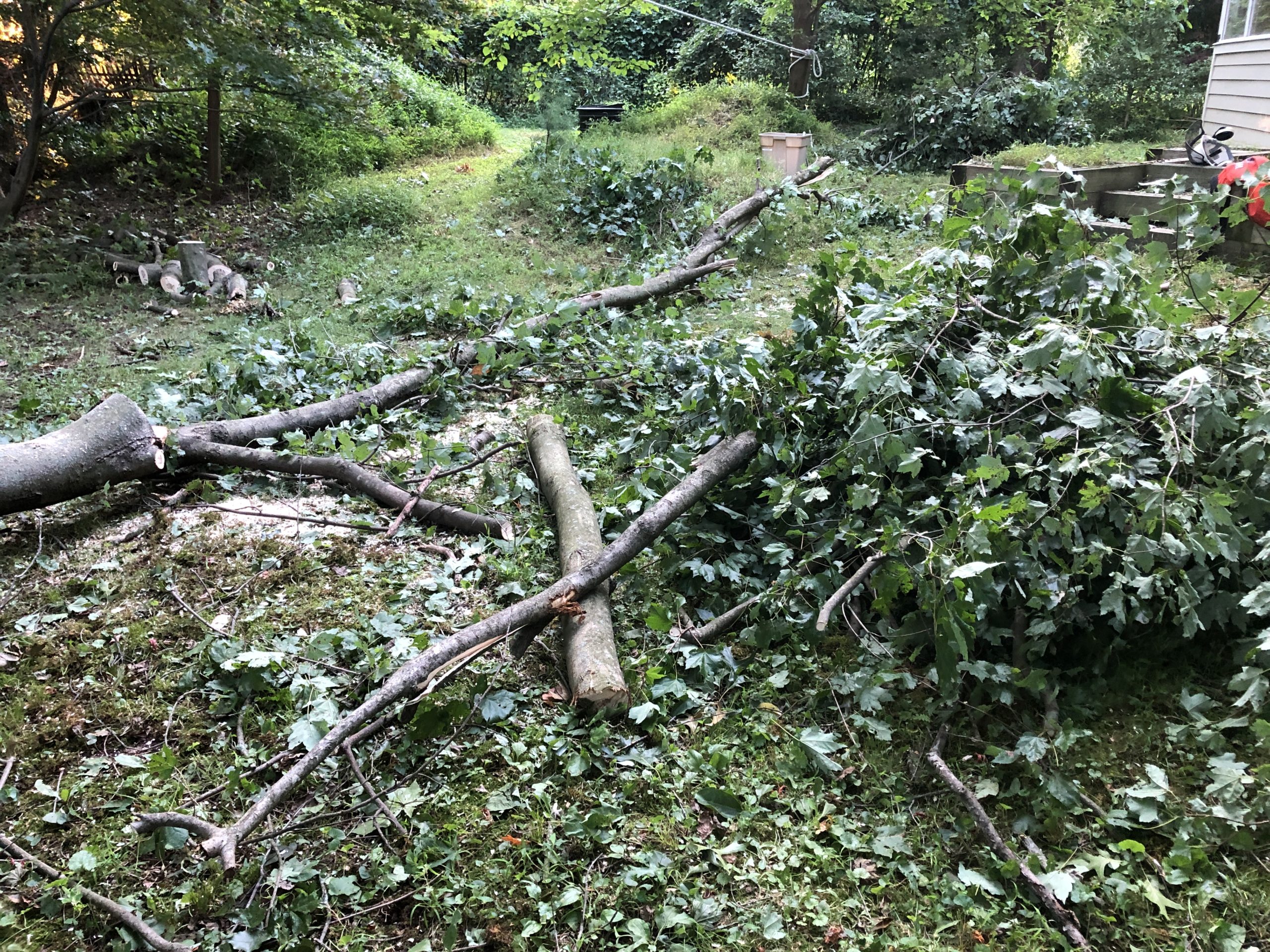
“I was chopping wood! Do you not notice the distinct lack of tree pressed up against the house?”
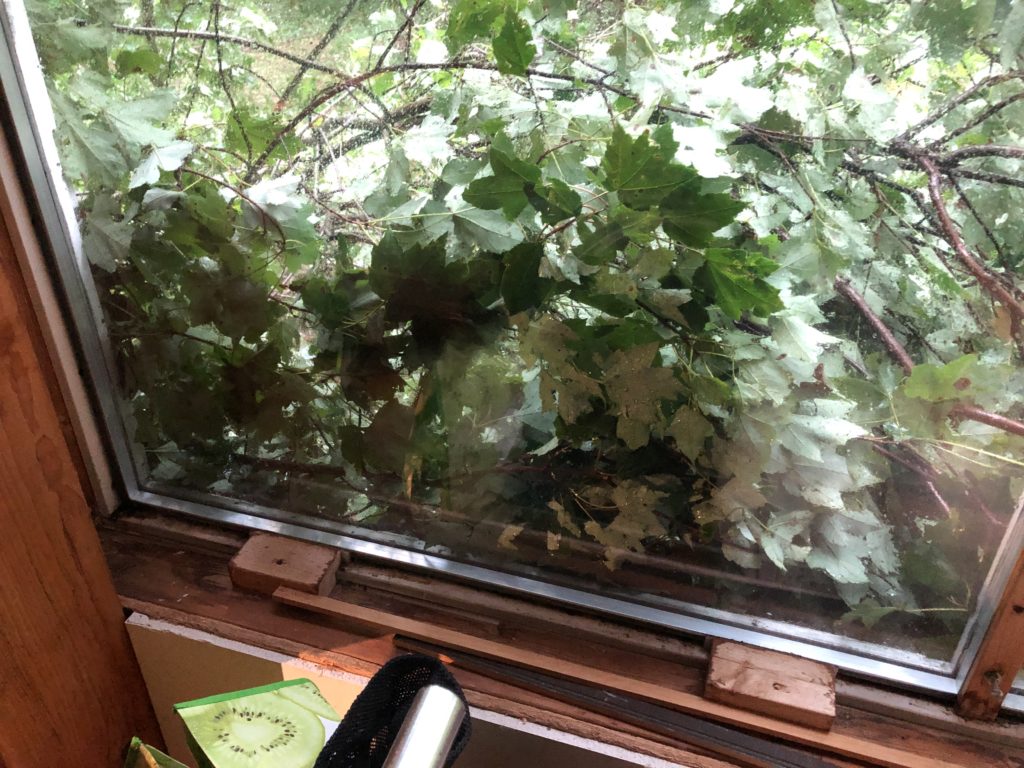
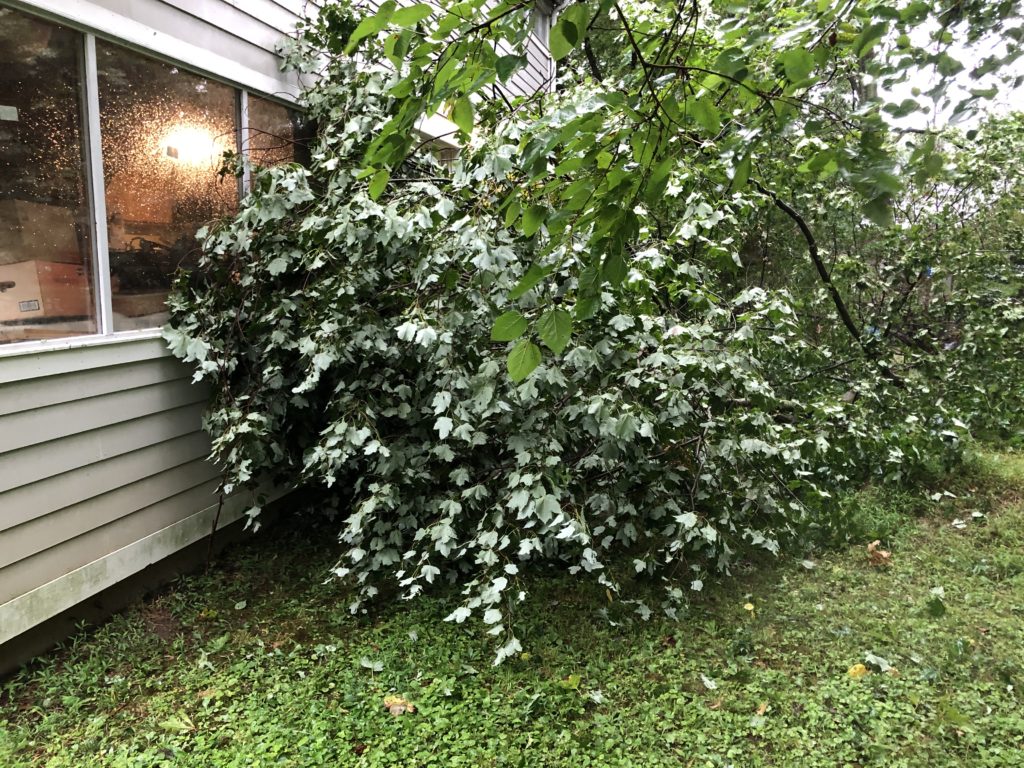
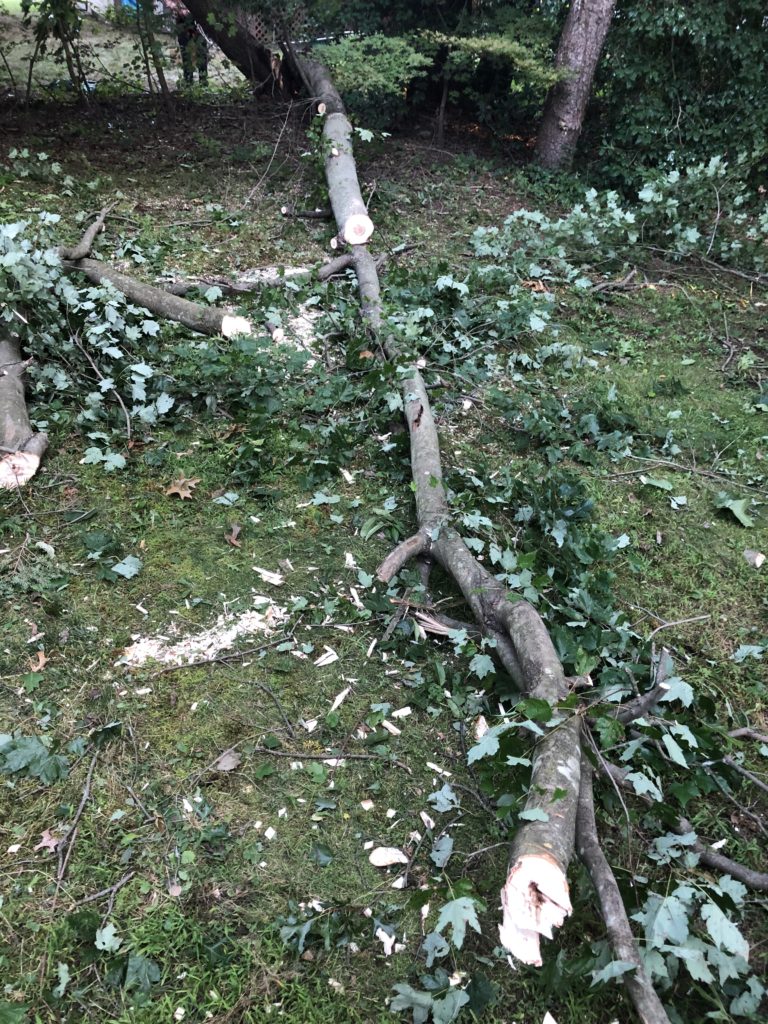
Tree Against House.
The storm had come through the day before, dropping immense amounts of rain, but also bringing high winds.
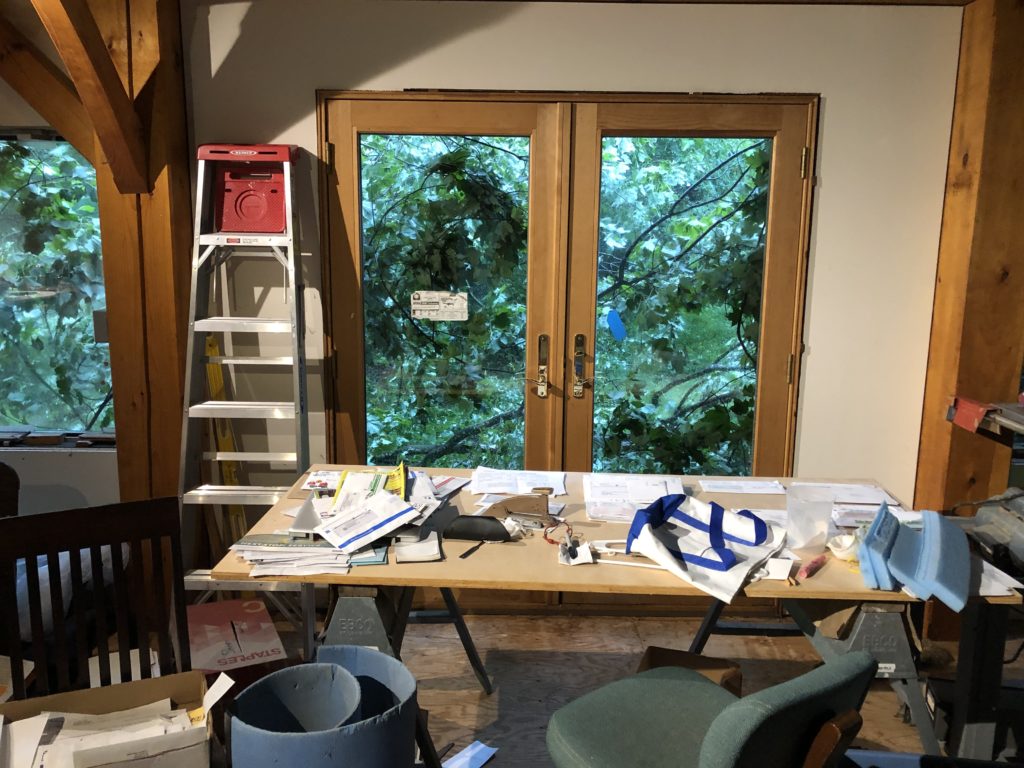
“I was in the office, working, as I often do,” said the Engineer. “I heard a loud whomp sound. I thought it was inside the house, but found nothing had fallen. I looked out the front door, and saw nothing had fallen. When I turned around, however, I saw a bunch of leaves pressed against the back windows of the house.”
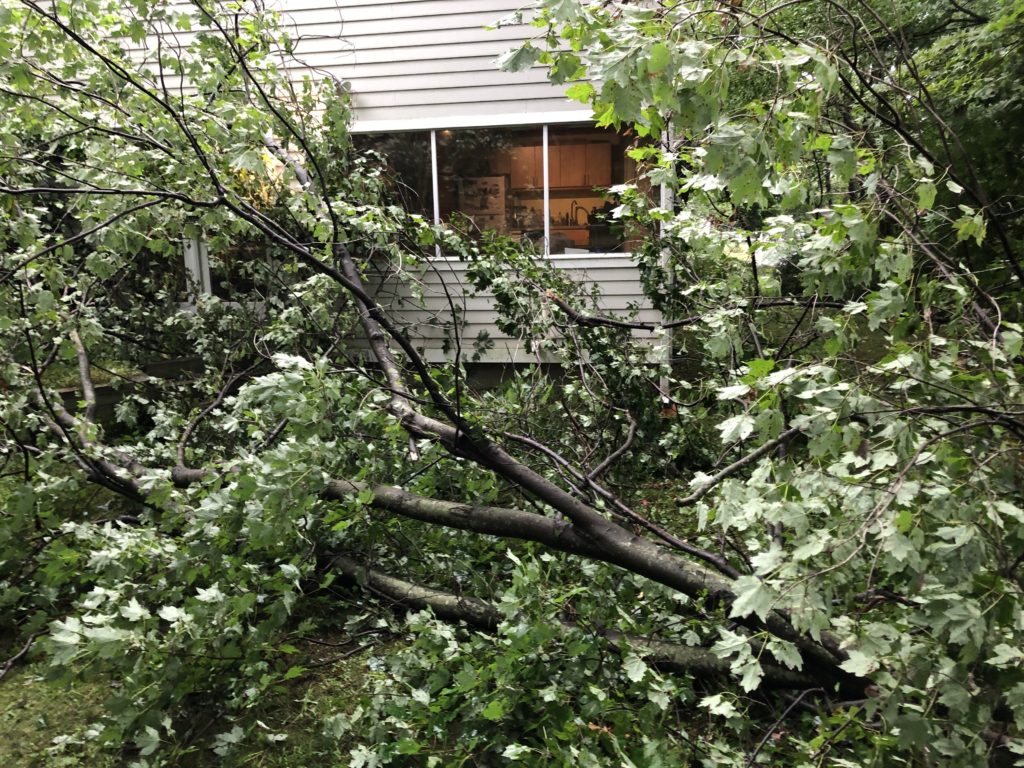
“Oui, we were so lucky,” Madame continued. “The tree fell to the ground and only tickled the house. It could have been worse.”
Tree Closeup.Tree External.
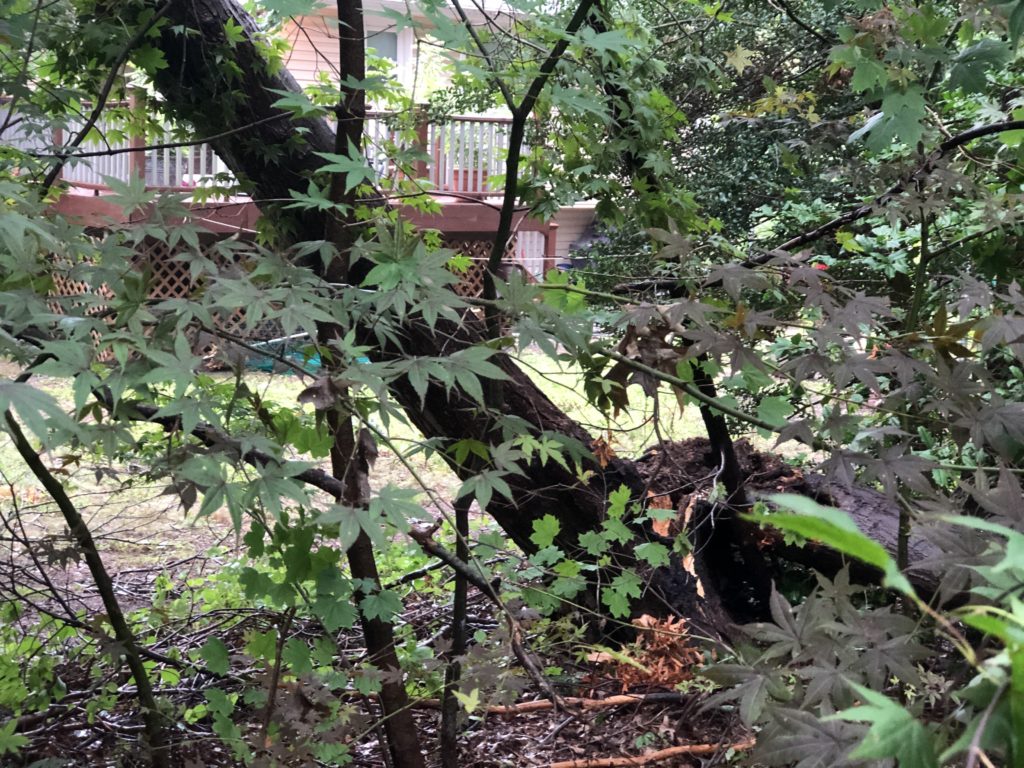
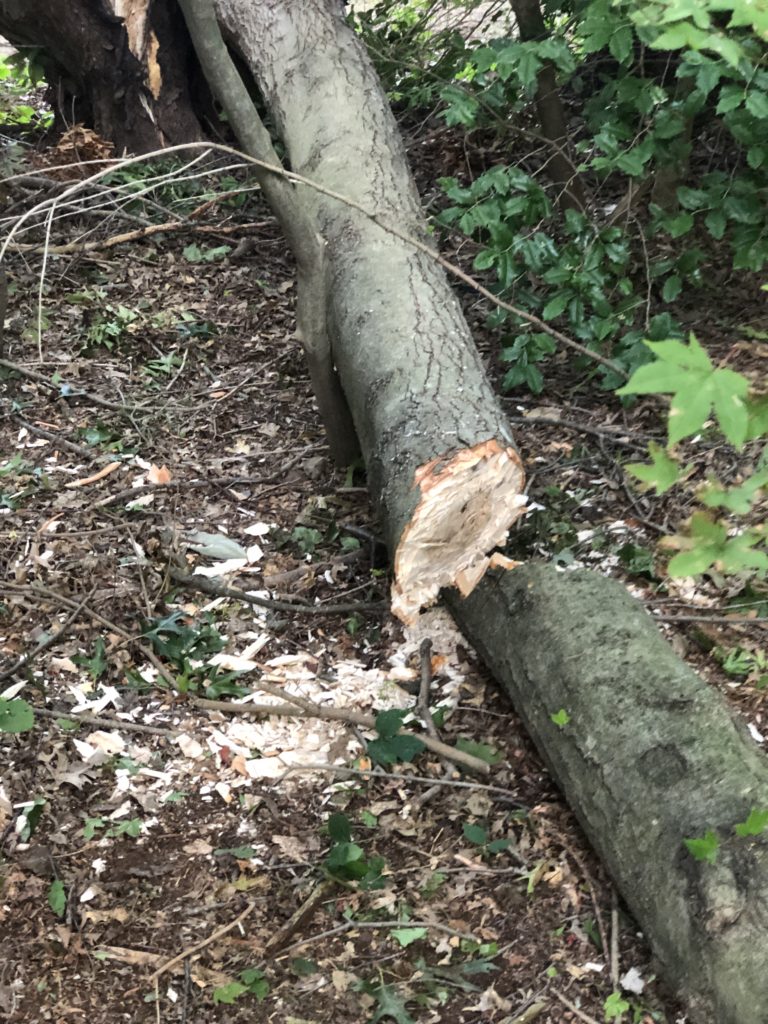
“As it stands – or rather, no longer stands – the tree was actually two trunks, split near the base. The other trunk has fallen towards the neighbor’s yard, threatening their trampoline.”
Root of the Problem.
“An amusing image, that of a tree against a trampoline,” said the Musician.
“True and fair,” declared. “But it presented a challenging obligation, of how to safely re-safe-itize the area, by careful removal of the looming flora.”
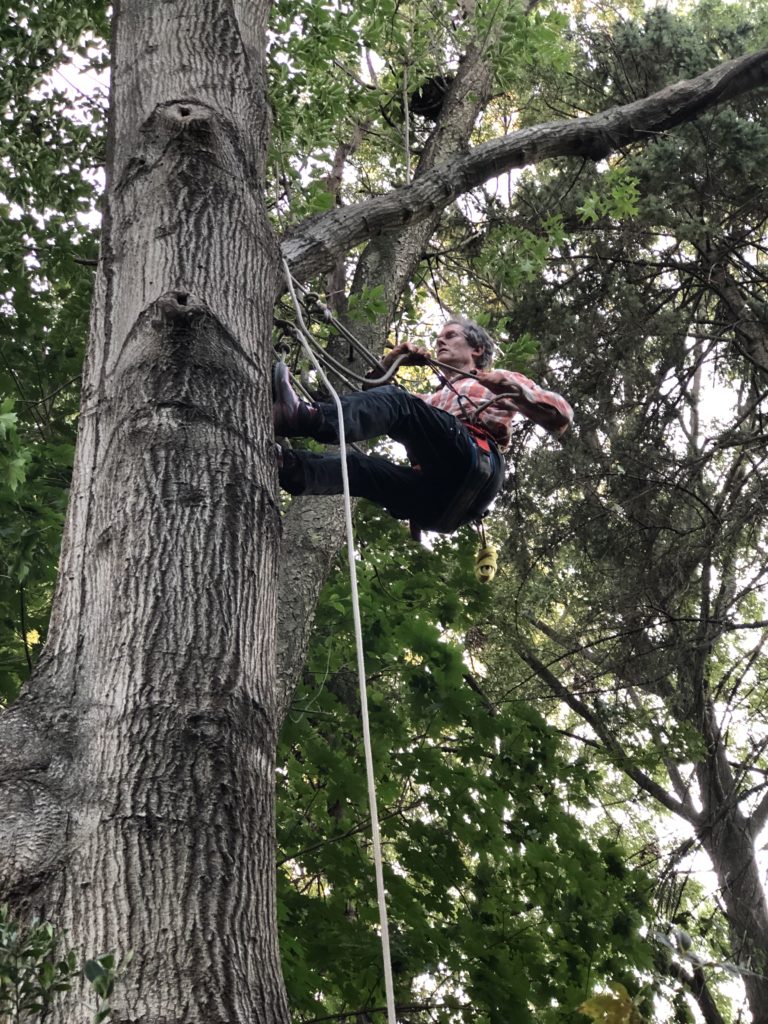
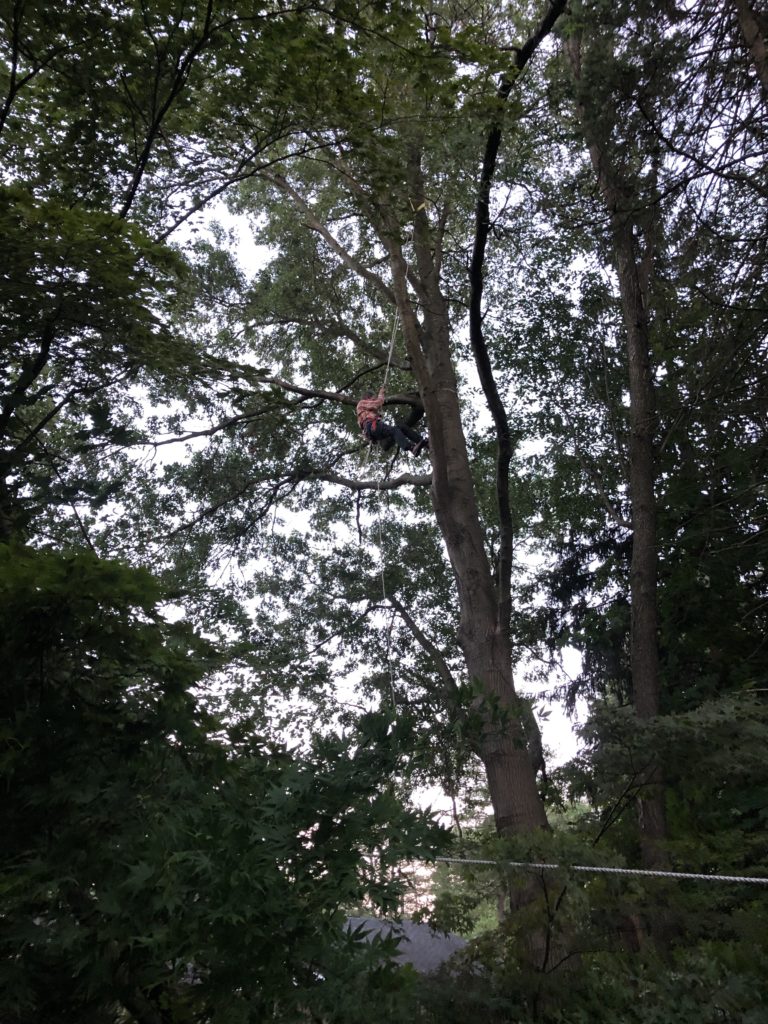
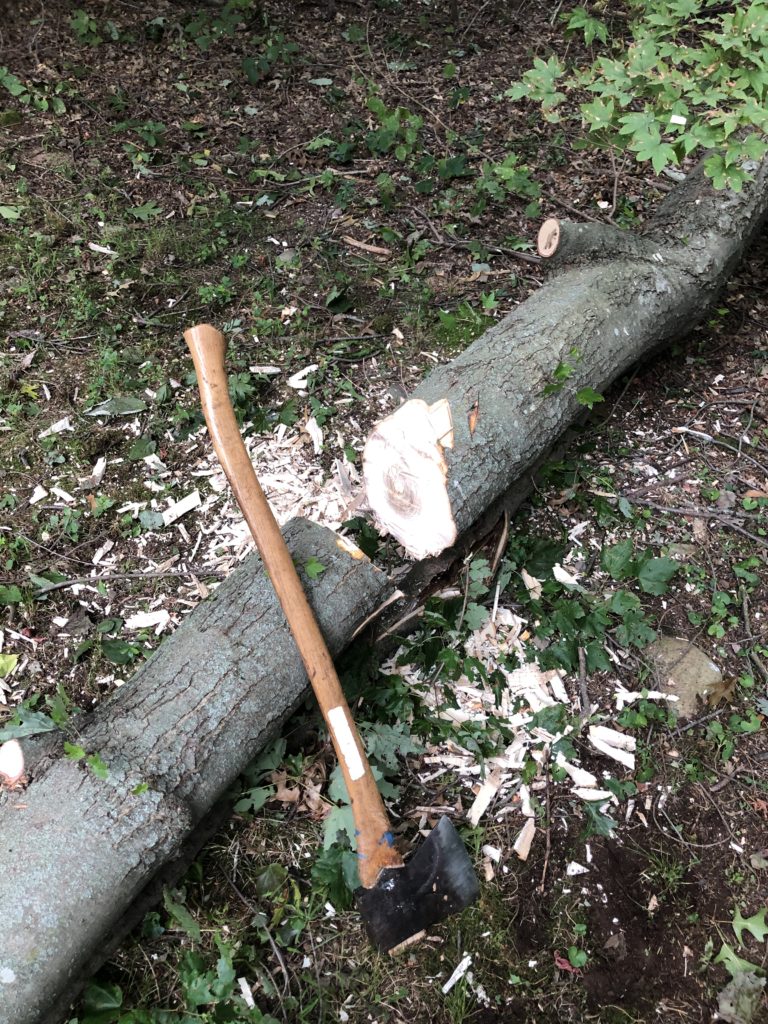
“And yet still the tree!” Madame was exasperated as she sat down, and served cuts of salmon fillet, with roasted baby potatoes and sauteed cauliflower. “I am not qualified to climb such a tree, but I took clippers and an axe to the one in the yard.”
“Aye, she did,” nodded the Engineer.
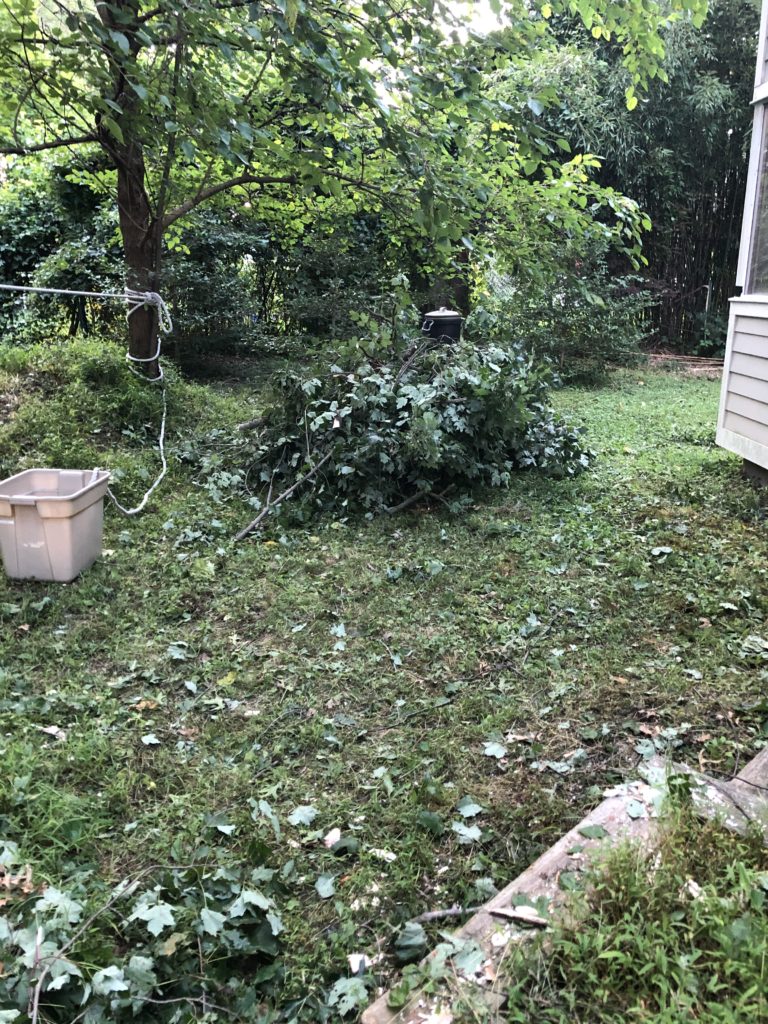
From Behind the House.Progress!
“That would explain the pile of yard waste I saw this morning. Whatever happened to it? It was gone when I returned from music practice.”
Yard Waste.
“The children!” Madame exclaimed. “The family next door insisted on helping! They said the children loved to move branches. They were like the von Trapps of tree disposal. No more than seven years old, they dragged each branch to the curb.”
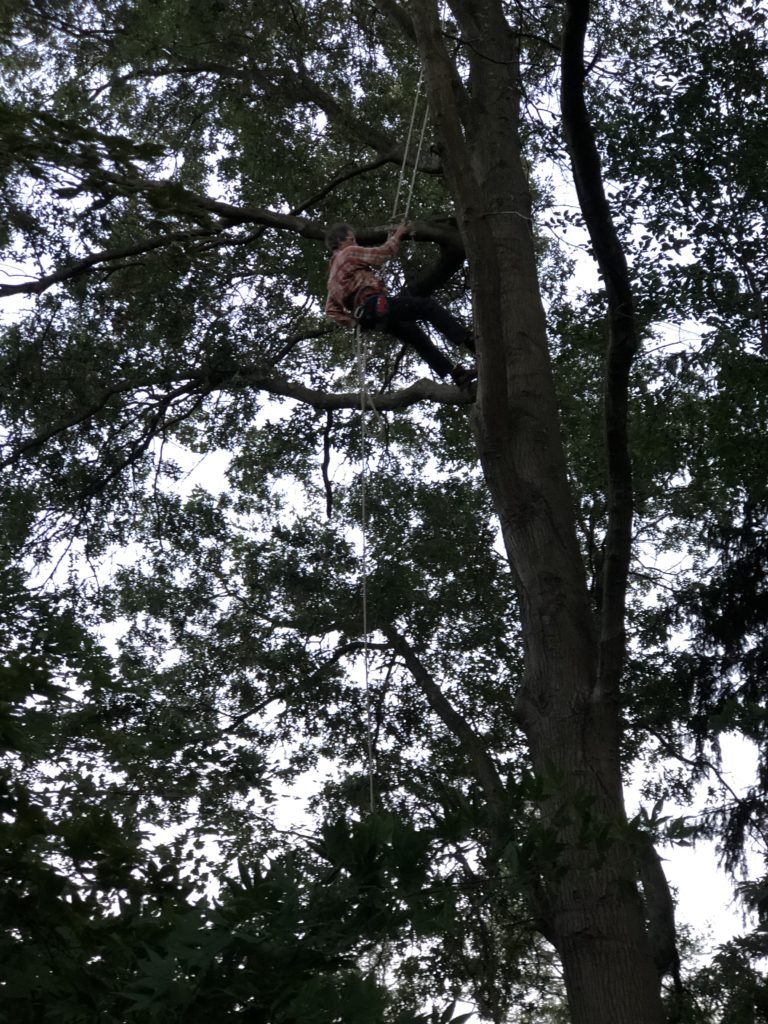
“We are still left with the remaining problem, that of the other trunk. I believe we will have to call a professional. Our man went to great lengths to determine whether he could dispose of it himself.”
Climbing the Good Tree.Higher.Higher and Higher.
“What’d I miss?” Jody Hipster entered, leash in hand, having taken Polo for a walk on the rail trail.
“Nothing we can’t leave behind,” said the Musician.
“We might branch off the conversation,” said the Engineer. “Did the dogs bark?”
“Why no,” said Jody. “Why would you ask?”
“It was sick. As I chopped through, in the middle was soft, dark wood, like mulch. It is no wonder the tree gave way.”
“Poor old tree,” said Jody.
Clovis circled the table, angling for fish, his tail arched like a shark swimming near the surface of the ocean.
“May I?” The Musician’s heart always melted first.
“He is transactional by nature, that one,” said the Engineer. “Don’t expect good behavior supplied on credit.”
“Someone else do the dishes tonight, please,” pleaded Madame. “I’m so tired!”
The numbers have come down, in the northeastern United States at least. Numbers are going up in the south, out west, in Texas. Coronavirus and COVID-19 aren’t going away anytime soon, but life in New York is almost normal again.
This was not the case three months ago. By mid-March, our local political leaders were starting to try to do something, anything, often contradicting each other and postponing vital decisions. We were told to stay home except for essential tasks, and in short order, various employers started work-from-home plans where possible.
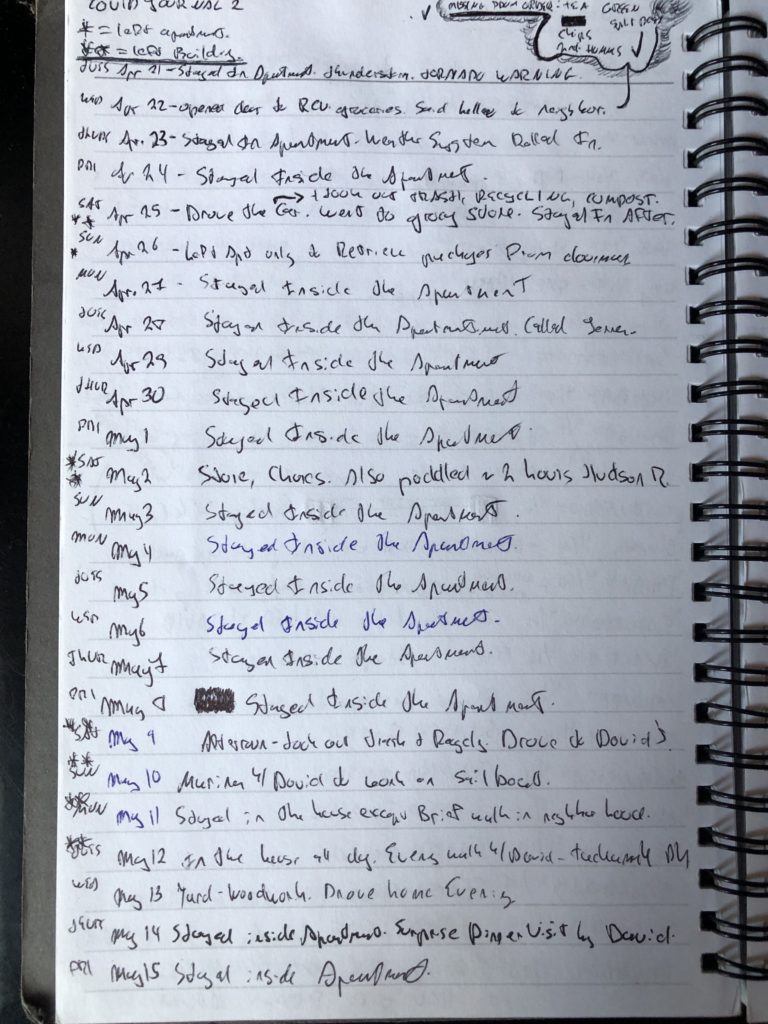
I’m not going to look up the details of what decisions occurred when, or what the body count was week-on-week, day-on-day. I started keeping a diary, partly to keep myself sane. When every day is in the same 500 square-foot apartment, and more and more people are dying daily, it’s good to have a hobby.
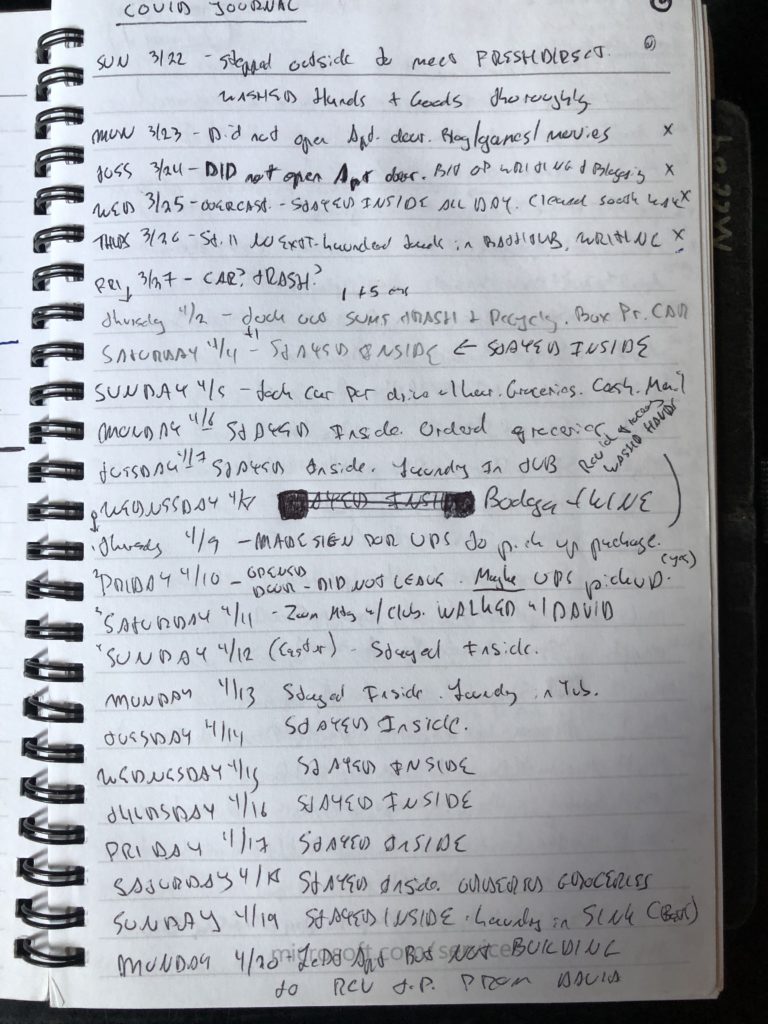
In late March I seem to have been playing it by ear. Would I go out? Would I need to? What was my normal routine? Yet by early April I was writing “Stayed Inside” a lot.
COVID Journal 01
There were some challenges early on. David and I talked about whether to visit one another and we decided not to, partly because he’s old enough to be (in the knowledge of that time at least) in a vulnerable group, and I was safer staying at home while he was out in the open for work. I also started a new job and got to witness the company figuring out how to do all the normal hiring things, like paperwork and delivering a new laptop – when I couldn’t go in to the office.
On April 5 I took my car for a drive around Manhattan. I don’t believe cars should sit idle too long, and it had been a couple of weeks since I drove.
On April 11 my paddling club had a virtual meeting using Zoom. After that, David stopped by, and we went for a walk. We both wore masks, I wore gloves, and we met in the garage, where he dropped off his bike.
On April 20, he dropped off some toilet paper for me, having bought a large quantity, on his way to work. I didn’t leave the building; I met him at the entrance.
By late April, I’d adjusted to a new routine. I would stay inside for a week at a time, and save my outdoor requirements for a single day. There are a lot of “Stayed Inside the Apartment” entries.
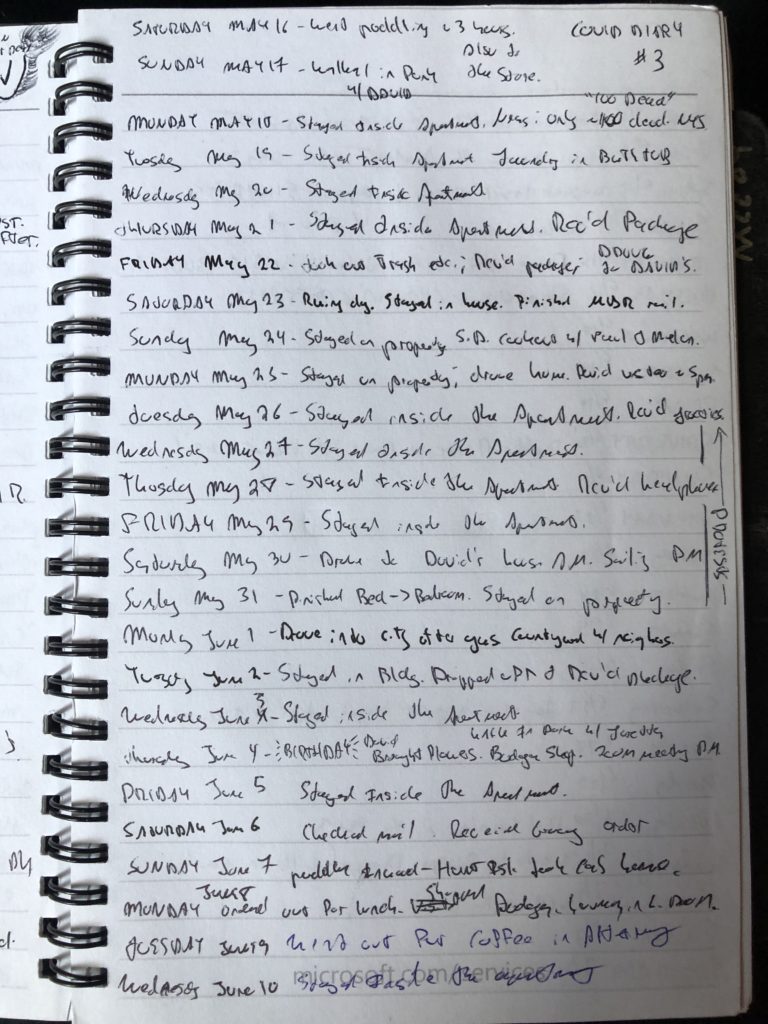
COVID Journal 02
By mid-May, however, I was starting to venture outside more. On May 9 I drove to David’s and spent the better part of the weekend there. Later in the week, he had some downtime at work and was able to sneak in a dinner visit to my place.
By that point, the numbers were beginning to decline.
COVID Journal 03
In early May I went kayaking a couple of times. My club had worked out some rules for keeping the total number of people at the boathouse low, as well as cleaning equipment. All the same I was very paranoid. Once, I walked home in my drysuit, wearing nitrile gloves, even though it was nearly eighty degrees and sunny.
Besides paddling, I ventured out more and more in general. My neighbors had a get-together in the courtyard. I met up with a friend for a walk. I was more willing to go to the store.
I still stayed inside a lot.
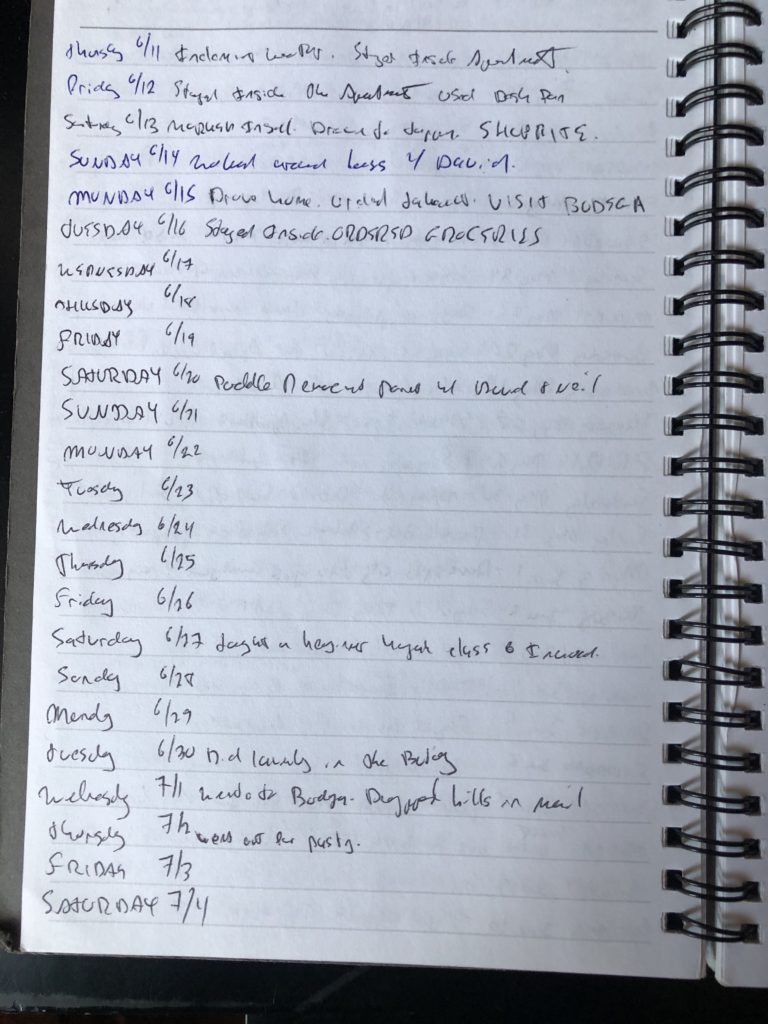
COVID Journal 04
For the past six weeks, life has gotten progressively more “normal”, with frequent reminders of how not-normal things are. I’ve gone up to David’s house a few weekends, and in the suburbs, we can walk around in the yard without a mask. We went out for walks in parks, we even got to a point where, as you can see, I lost track of time – what did I do which day? Did I stay inside? Did I go to the store? The new normal set in. Whatever I did, it was “normal”.
I know I went to a suburban grocery store for the first time. Mask on, basket, sanitizer, do my shopping, stand in a well-spaced line after negotiating the one-way aisles. I’ve taken a first aid course in a state park – a small class, masks on, distancing as much as possible. I’ve developed a fatalistic streak even. I advocate masks and distancing and minimizing time away from home, but when things need to be done, they be done.
With takeout, and grocery orders, and occasional walks to get coffee or bodega runs . . . this is the new normal. We watch and wait to see if the numbers go up, or down, locally, nationally, globally. We silently judge people for wearing masks, or not wearing masks; for opening too soon or overreacting. That’s new normal too.
Wearing a mask is the simplest thing one can do. It’s a kindness to others; it protects oneself too.It’s frustrating, it’s silly, it muffles out voices, but makes a difference. Places where people wear masks have lowered their infection rates.
We can argue about whose fault it is, or how we should spend money to address the problem, but most importantly we have to address the problem. Official guidelines in the US are being treated as optional; speed limits where there is no enforcement. There is not enough testing, and therefore data, to make the kind of fine-tuned decisions that everyone wants. Too many politicians want to be the cool parent who lets their kids run free, only to find the have to be the responsible parent when they come back from spring break with a highly contagious respiratory illness.
The numbers are going up. Various states are rolling back their opening plans. I don’t plan to start another COVID journal. I hope I don’t have to. Nonetheless, July 4 or thereabouts marked a different sort of Independence Day.
Here is the current state of affairs, as we walk over Memorial Day weekend here in the United States, into the summer.
In New York State, the daily death rate due to Coronivirus is reported to have fallen below 100. While terrible, that is amazing compared to the peak near 800 just a few weeks ago.
The state has also announced criteria for regional emergence from “New York on Pause”, and some parts of the state are reopening for business. New York City, however, is at least a month away from being able to re-open. Also while the state is allowing beaches to open, the city is not.
Farther afield, various states have lifted various restrictions on activity, and everyone is eying the effects. Meanwhile, the cumulative death toll due to Coronavirus is approaching 100,000 for the nation.
Over the past couple of weeks I’ve experienced a change in general emotional state. It’s a strange thing to remember how one felt just a short while ago, in contrast to the present.
I remember the end of March and early April, a period I generally refer to as, “when the city was on fire”, when every day brought new developments, new highs in infection rates and body counts, along with grim anecdata like refrigerated trucks being used as makeshift morgues and a Navy ship being brought in as a hospital. Death was right outside my window, right outside my door. Death touched every doorknob, every handle, every package, the slightest piece of mail.
I washed every grocery, and would toss my keys into a sink filled with soapy water when returning from outside. If I drove my car, I kept my mask on in the car. I stayed inside my apartment for over a week at a time, FaceTiming with David, using Teams with my co-workers, and Zoom with my club. It was a state of terror I hadn’t felt since the days immediately after 9/11.
Now, however, I’ve grown more lax. More data leads to changes in behavior. Supposedly surfaces are a less potent vector than other peoples’ exhalations. I still stay in my apartment during the week but have ventured out on weekends, either to David’s house or to walk in the park with him, to go to the grocery store or, in a couple of cases, to go kayaking at my club’s boathouse.
Three weeks ago I still felt like an astronaut; nowadays, more like a warm-water scuba diver. Some assembly is still required, but less than before, and it’s more routine.
Talking with others, taking in the news and the comments and the opinions all around, there seems to be an overall feeling of having shifted into a new sense of what is normal; whereas in the beginning there was a bit of a lark, ha ha we’re going into quarantine, oh my working from home is a zany new concept, look at me I’m baking with all this time on my hands. Now, there is experience on the one hand and a track record on the other.
We’re all experienced with whatever changes in our lives we’ve had to make. The novel is no longer new; it’s routine. For myself, I was already working from home before the pandemic occurred, and the only real changes have been 1) not going out for a daily constitutional and 2) not kayaking nearly as much.
The track record of governments and employers has come under scrutiny, and while it’s easy to forgive mistakes at the beginning (even if it’s debatable “when” this all began), three months since documented arrival of the virus in the United States and its subsequent spread, there is plenty of blame to go around.
Were controls put in place for people returning from abroad? Were necessary medical supplies procured or ordered? Were restrictions enacted wisely, and were they too soon or too late? What about economic adjustments for the thousands of businesses and millions of workers thrown out of work?
Also, not to forget, this is an election year, and America is less than six months away from its quadrennial decision about who gets to lead the country.
Summer is here, and the weather is nice. The world we live in today is not the world we will live in tomorrow; it certainly is not the world we lived in very recently. Things are better, but not good; improved, but disaster looms right around the corner.
That is the state of affairs as we pass through this gateway to summer.
David and I saw each other in person last Saturday, the day before Easter, for the first time in at least three weeks. Work assigned him the week off – something kinda normal, not virus-related – and he needed to drop the truck off at work, with a plan to bike home.
I met him at the garage entrance for my building. We put his bike next to my car, and he put on some warmer layers and walking shoes. We were both wearing masks; I was also wearing gloves, and offered a pair to him. Fully sorted, we walked up to Fort Tryon Park.
This was a variation of my ongoing dilemma: do I invite someone in to my apartment, potentially violating the sanctity of cleanliness, or do I meet them outside, exposing myself to contamination? I know on the one hand that I am overreacting to the possibility of contagion, but on the other hand – the virus causes a terrible illness, and there is a non-zero chance of contracting it with every exposure to the outside world.
Well, I wanted to see my boyfriend, and at this point, there were some risks I was willing to take.
Walking along, we learned a new normal of monitoring spacing between us and Others; silently judging groups that spread out in a wide line, like volunteers looking for a missing person in a field, or groups of children or young people, randomly veering in and out of the flight paths of others. Some parents admonished their children to stay near. Some work masks, and others did not.
In the park itself, we felt things were a bit crowded on what previously might have been a normal day. We walked through the flower garden and quickly ventured down to one of the overlooks, gazing at the bridge and the Palisades across the water. It was a beautiful day, nary a cloud in the sky, bright with the promise of spring.
We continued on, following a path I don’t believe I’ve ever walked, taking the opportunity to explore as well as avoid the more commonly used paths. Eventually we connected back to the main route and went up some stairs to the Stan Michels Promenade, where we sat on a bench and David had the lunch I’d made for him – three-bean chili served over rice and eggplant, in a thermos jar.
We compared notes on making the chili, since we’ve both given it a shot. We also talked about roasting vegetables, and listened to music coming from a boombox not far away. I danced a bit, posing more than dancing.
On we went, until we decided it was more crowded than we cared for, and we walked back towards my neighborhood. Along the way, I wanted to stop at my local grocery store, and as we walked up the sidewalk from the east, the sun in our eyes, I turned into the store and there was a woman gatekeeping there.
We hadn’t realized there was a line, snaking back in the opposite direction, to the west. A well-spaced, orderly line of people wearing masks, under the scaffolding for some building work being done next door. I apologized; I felt like a jerk. Across the street we were able to discern the line for another grocery store.
Because of social distancing, it’s hard to make out the lines. They look like a series of people waiting for a ride pickup.
On we went, defaulting to my original plan of stopping at the Korean bodega. Here, there were two men standing outside, separate from one another, but they were not a line. I went inside and was able to get the things that were missing from my grocery order earlier this week, plus some additional items I figured I might need sooner rather than later. Korean bodega for the win.
We wanted to keep walking, so we proceeded to the bottom of the hill and walked over the pedestrian overpass to the bike path along the Henry Hudson Parkway. Usually I take this route walking or riding to the boathouse, but today we turned south and proceeded down the switchback that leads to the shoreline and the Little Red Lighthouse. All the while, still wearing our masks.
We passed some young men working out together, and a couple of skateboarders were at the top of the hill waiting for traffic to slow enough that they could ride down. We saw equipment at the base of the bridge tower, presumably related to the refurbishment project high above.
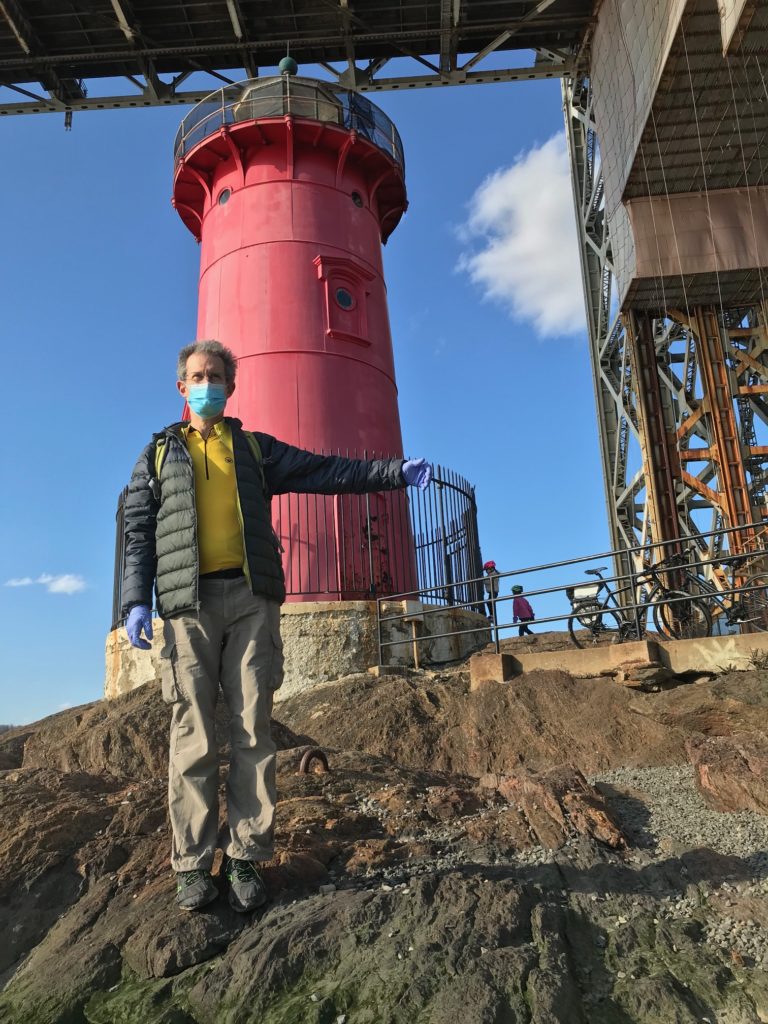
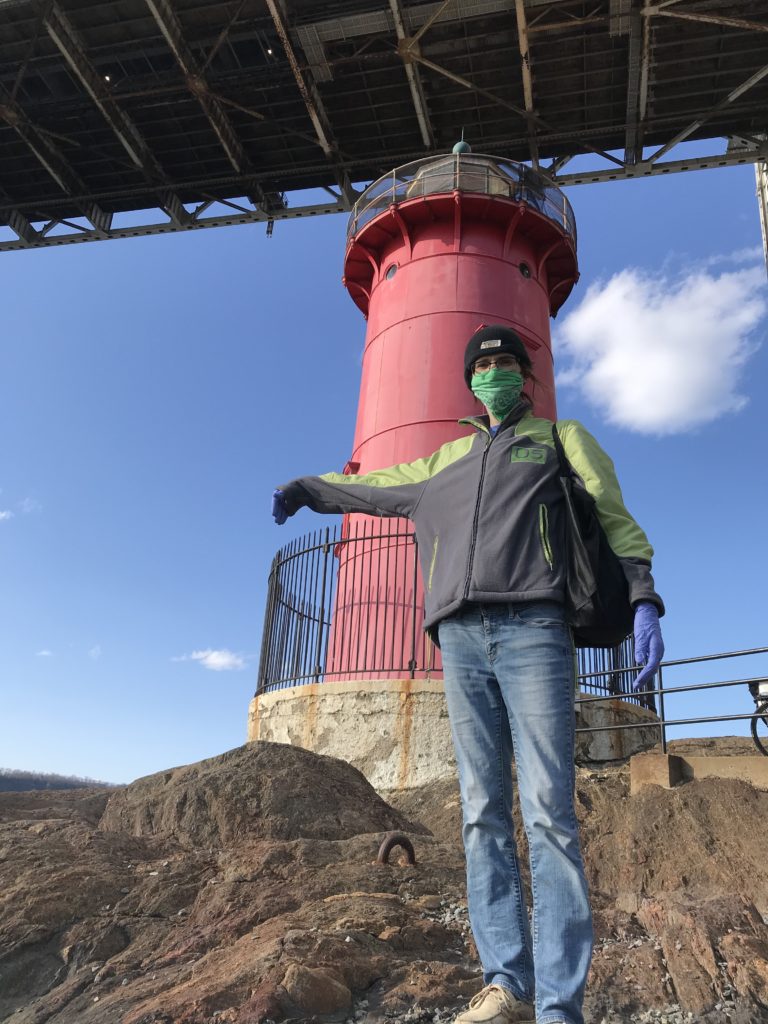
At the Little Red Lighthouse, the tide was low and we clambored down to take some pictures of each other in front of the lighthouse. We made light of the requirement for social distancing, staging each other in poses implying the presence of the other.
David.Julie.
By then, the evening hours were creeping in, and David would still need to bike home, preferably in daylight. We made our way uphill, retracing our steps, across the overpass and to the garage, where the beginning occurred in reverse: he took off layers down to his biking clothes, put on his cycling shoes, and everything left went into his backpack. We said goodbye, both noting it was a special afternoon.
I picked up a package from my doorman, and once in my apartment followed my usual protocol: coat and outer layers, as well as shoes and socks, removed in the entrance; mask removed, keys and wallet dropped on the floor for later cleaning; gloves peeled off, followed by a thorough soapy washing of hands, arms, and face.