Food Under Orders

David reports that at the Northvale Shop Rite, they were only allowing fifty customers in at a time and, after eyeing the length, he and his friend drove to Stop & Shop, where there was no line. He lives near the state line between New York and New Jersey, and basically Shop Rite is in New Jersey and Stop & Shop is in New York, so whether this is a difference in states or stores, we’re not sure.

I have heard from other people in both states of lines at stores, a similar symptom with a very different cause as often compared to lines in the Soviet Union. There is plenty of food, though some things run out quickly. The challenge is that they want to keep people as far apart as possible.

At the Stop & Shop, aisles were designated one-way; like streets, presumably to help people avoid running into each other with cross traffic. One imagines a lengthy assembly line where the worker moves along the tracks, collecting their required parts for final assembly at home. Everyone wears masks.

Contrast all of this with my own experience in Manhattan. I have long used a grocery delivery service, one that until recently was excellent. They still are, but if you go to their website they basically advise to check delivery availability first, and nothing is available for at least a week.

My local “posh” grocer has had a delivery service for a while, and I’ve used it twice now. They’re not really that posh; they have some fancy things, but the non-fancy things are reasonably priced. The first time I ordered delivery, they delivered to the apartment in the other building, which is an easy mistake to make. Yesterday they dropped off my delivery in the right place, and early to boot.

In both cases though, my orders were missing items because they’re run out. There are methods they use to put in substitutes, but I expect they have their limits.

This leads to my chief conundrum: do I venture outside to seek these items on my own, or forgo them until the next time I need to order groceries?

I generally settle for the latter but two days ago, I realized I’d forgotten to order hummus, and it was too late to add hummus to the order, and I knew I would want hummus, so I put on my coat and shoes and extra layer of pants, and my mask and a scarf and gloves, and I walked up to the Korean bodega, and I bought not only hummus but some produce that the posh story had been empty of, and some chocolate, and some Omega-3 nut mix for snacking on. Oh and I picked up six bottles of wine from the wine store because I like them and want them to stay in business.

If only I’d known then what wouldn’t show up, I’d have gotten that. This leads me to realize I need to be more systematic about my grocery shopping. In the past, if I ran short of anything, my worst case was some inconvenience in having to ugh put on shoes and coat and walk five minutes up the hill, buy that thing, and walk five minutes back down.

Now, to do so means breaking a streak of staying in home. It means following my meager protocol of excursions, summarized more or less as:

  1. There is a “dirty” coat that stays near the door and is not hung with other coats.
  2. I wear gloves and a mask. A hat or scarf as well to cover my head.
  3. I wear shoes that are easy to don and doff.
  4. When I return, pants and socks stay in the hot zone.
  5. Goods stay in the decontamination zone. Anything that requires refrigeration gets cleaned and stowed within an hour or two, but everything else stays in the hot zone.
  6. Eventually items in the hot zone get either 1) washed in soapy water or 2) stowed once whatever material they are has been inside long enough for the virus to no longer be a threat.

It’s exhausting just thinking about it.

On the other hand, I’ve bought and cooked and frozen so much food that I really have run out of room and containers. I may not always be able to have what I want, but I have enough food that if I had to, yeah I could stay inside for two weeks.

And that, thankfully, is more than a lot of people can say. So, no complaints.

Touch

I count in my head the number of touches I need to accomplish anything outside of my apartment.

  1. the door to the laundry room, coming and going, washing and drying: four.
  2. to the grocery store: the two doors for my building, coming and going (4), the basket (1-ish?). Minimizing the handling of goods: five minimum, but not accounting for proximity to people in the aisles.
  3. going for a walk: the four for my building door as above, although if I’m lucky I can draft on the doors that use mechanical assistance to stay open longer while still maintaining social distance.
  4. to the garage below my building: the breezeway door, the door at the top of the stairwell, the door at the bottom of the stairwell. I debate whether it’s better to touch or hip-bump the first of those, which has a horizontal press-bar to open from the inside. In any case, yikes, that’s six touches just to go to the car.

And so it goes. As of March 20, we’ve not been ordered locked down, or quarantined, or “shelter in place”, in either the Empire State of New York or the great city of New York, but I have essentially been practicing that. I was already working from home before the outbreak occurred, so it’s been easy for me to simply stay inside as much as possible.

That said – when our mayor, who resisted closing public schools and was still going to the gym hours before a ban on that went into effect, said that New Yorkers might want to plan to shelter in place, that was the one moment of true panic I had. What groceries did I have on hand? Would there be a run at the market as nine million people across five boroughs rushed to stock up? Should I get in my car and evacuate to the suburbs, where my significant other has a house?

I decided to stay, mostly on two key assumptions. One is that, despite living in an apartment building in one of the largest cities in the world, I am alone in my apartment, as isolated as a person can get. The other is that, while David and I were planning to spend next week together, which we both have off, it’s not clear whether I’d be able to come back home afterwards, and the nature of his job is such that he is out and around people constantly.

Even at that, the job has changed just in the past couple of days. He works in television news, driving the truck, shooting and editing video, then transmitting it back to the station. They stopped having reporters do “man on the street” interviews, since that inherently breaks social distancing, and recently, he’s not been driving with reporters – alone in a truck.

A shared truck, mind you, though even that appears to be about to change.

This was the hardest decision of all. I was looking forward to a long week with my loved one, neither of us having to go to work, spending time with each other, and maybe getting some work done ’round the house. Even here I counted touches: the keypad on the lock, and visits to the grocery stores there.

It’s clear we’re in a different world now, and it’s one that will continue, in varying degrees, for months to come.

Coronavirus and COVID19

It’s Thursday, March 12, the day after the President announced that the US was banning flights by non-citizens from Europe, except the UK, for thirty days.

David called me last night to say he was working at the station and about to watch Fearless Leader. When I called, since it’s our usual talk-time, he asked if I was watching. Why would I be watching? Anything important that comes out of that man’s mouth, I can read a day later in a reputable news outlet.

“You should watch,” he said.

I’d missed the part about the travel ban at the top. I watched as the most deadpan, first-pass script-reading session proceeded apace. I had questions, but it would take a while to process. A great economy. Virus doesn’t stand a chance. It was clear what the priorities in this speech were.


David had been considering a ski holiday in Europe. Every year, he takes some kind of exotic ski trip, and most years in the past five, it’s been to Austria or Switzerland. Far from civilization, atop the peaks and glaciers of the Alps, he’s with a small group skiing from hut to hut for about a week. We had been worried about airports, but the majority of his time would be away from crowds.

There was a really good trip in the Alps shaping up, as well as some alternates in Norway. First he had to confirm getting the time off, which he did, but by that point the virus had spread to Italy, and we were wondering if or when it would get to Austria. That was perhaps two weeks ago, and if last week was a search of flights, this week was, the Austria trip was outright cancelled by the organizers, and now the entire continent was mooted.

We were both considering domestic travel, but at this point we would rule out airplanes. A driving holiday is about the most we would expect.


I already have one friend who’s holed up with his wife in a cabin in the Catskills, large quantities of dried foods (rice, legumes) handy, in a remote area where they can ride out the worst. His advice, only half-joking, mirrors two others I’ve heard from: go get the virus now. Get sick now, before the hospitals are overwhelmed. Get it, get through it, be done with it.

This sounds bonkers to me, at first. I understand the logic – embrace the inevitable – but that wouldn’t work for anyone who’s caring for others, especially the vulnerable. I would go further to say it’s almost a grasp at having control: I will choose the time of the battle, even if I can only choose to make it sooner rather than later.

In the meantime, the rapid escalation in the past forty-eight hours has me, for the first time, worried. Maybe I should be stockpiling food, and cleaning supplies, and deciding where I want to live in the event that I can’t leave for a few weeks.


For several months I have been one of those “work from home” people. It’s a topic deserving of its own post sometime, but suffice it to say, it’s been an adjustment. Now, however, it’s all over the news: companies are telling employees to work from home if at all possible.

The emails started last week, maybe the week before. I work for a consultancy, which is in turn owned by a larger consultancy, and between the two I get staffed at other companies, so I have been receiving all sorts of internal emails. We’ve gone from “no unnecessary international travel” to “we’re not sure how to handle the ban that was launched last night”, along with “Campus X is closed”, and of course helpful reminders on how to use technology to work remotely.

On the other hand, my more left-wing acquaintances have been reminding everyone on social media that not everyone has this choice to make. People who must be present – cab drivers, construction workers, store employees, and certainly doctors and pharmacists – can’t exactly do their jobs remotely. Many of these same people won’t have the safety nets that us office drones have, either: savings and other emergency funds to dig into if things get really bad. Furthermore, despite precautions, they’re inherently at greater risk than someone who is single and could, if she wanted to, stay in her apartment for days at a time.

The above all bears repeating even if you’re not a lefty-wing person.

Today, I had my first cancellation of a call due to “dealing with coronavirus” by a customer. I’ve previously had chats with others in the idle moments before a call properly starts – the small talk while we wait for others to join. It doesn’t feel like small talk anymore.

Part of adjusting to a work-from-home job was recognizing that I needed to keep some sort of schedule that isn’t driven by my calendar, and to get outside and go for a walk. At least twice a day I go for a short walk in my neighborhood, and I frequently put off little errands to ensure I have something to do each day: drop off sweaters for mending, pick up some salsa, go get a fancy coffee (Wednesdays, an almond milk turmeric chai latte).

But now I wonder, do I need to go to those places? Even doing laundry in my building, I wonder how many other people have touched the handle to the laundry room, how many have opened and closed the washer and dryer machines? Even the gym – I’ve decided not to go for a while, even though I’d like to work out more. Despite precautions, I’m not going to avoid thinking about the worst.

And yes, I am washing my hands thoroughly.


The latest – as of about 1430 Eastern, Thursday March 12 – in New York is that gatherings of more than five hundred people are now prohibited; New Jersey is capping gatherings at two hundred and fifty. This of course affects Broadway shows, as well as concerts and sports events. Some NYC public schools are closing as well; the challenge there is that public schools are often the front end of social services, so closing them affects far more than education: they are where many children get food, medical services, and counseling. The Mets (Museum, Opera) will be closing as well.

That is all there is to say about that.

Forties on 181

. . .the cars stand out on their own, irrespective of plot.

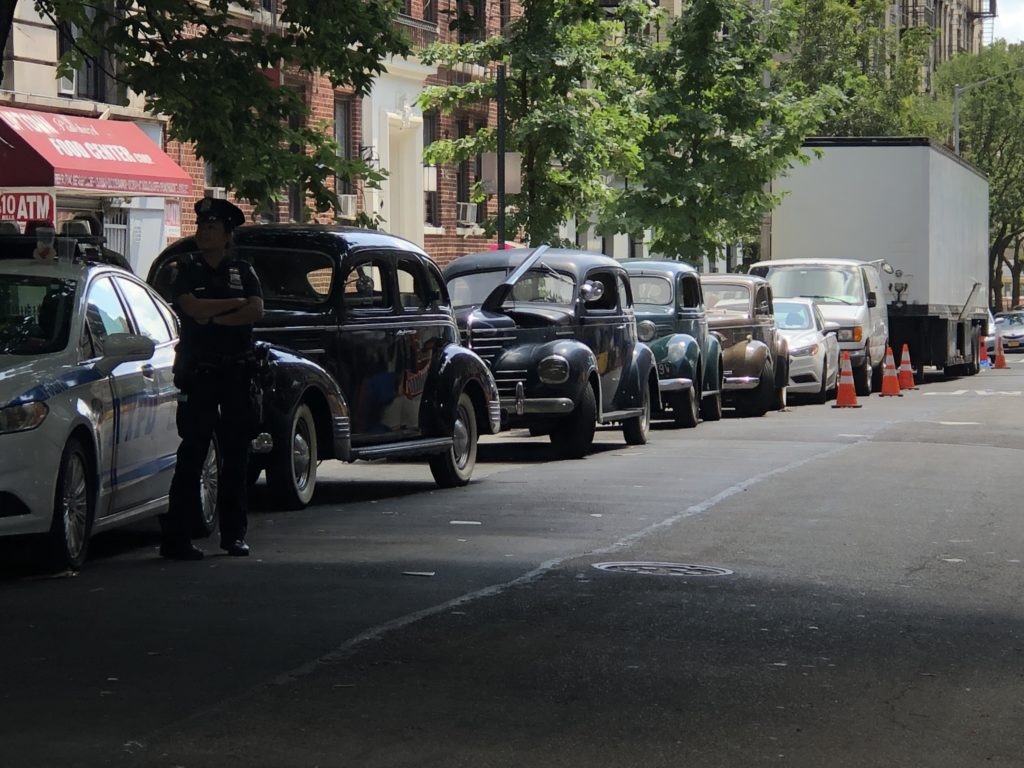
A recent film shoot brought an array of interesting, old-timey cars. There was a similar yet smaller array a few months ago, for what I later learned was a shoot for a film version of Philip Roth’s The Plot Against America, which is set in the early 1940s, in an alternate history wherein Charles Lindbergh defeats Franklin Delano Roosevelt for President, largely on an isolationist and anti-semitic campaign platform.

While that sounds bleak, the cars stand out on their own, irrespective of plot.

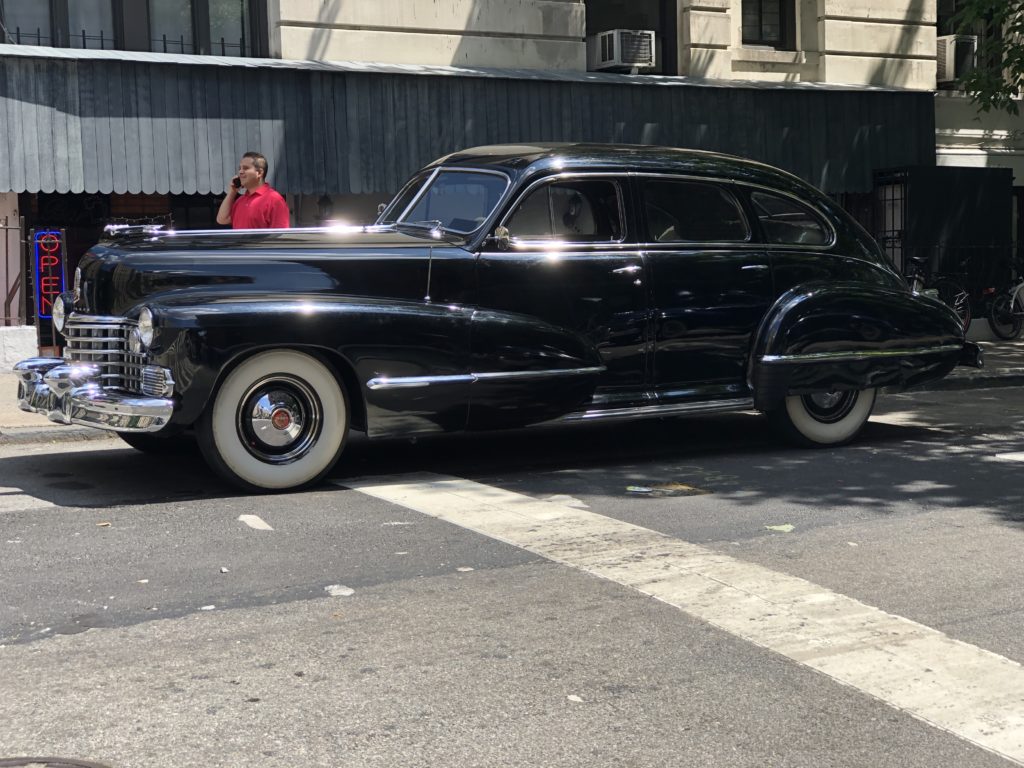
It’s the Caddy that really caught my eye. That thing was a beaut.

Cadillac
Black Cadillac, Film Shoot. July 2019

“Long, black Cadillac,” indeed.

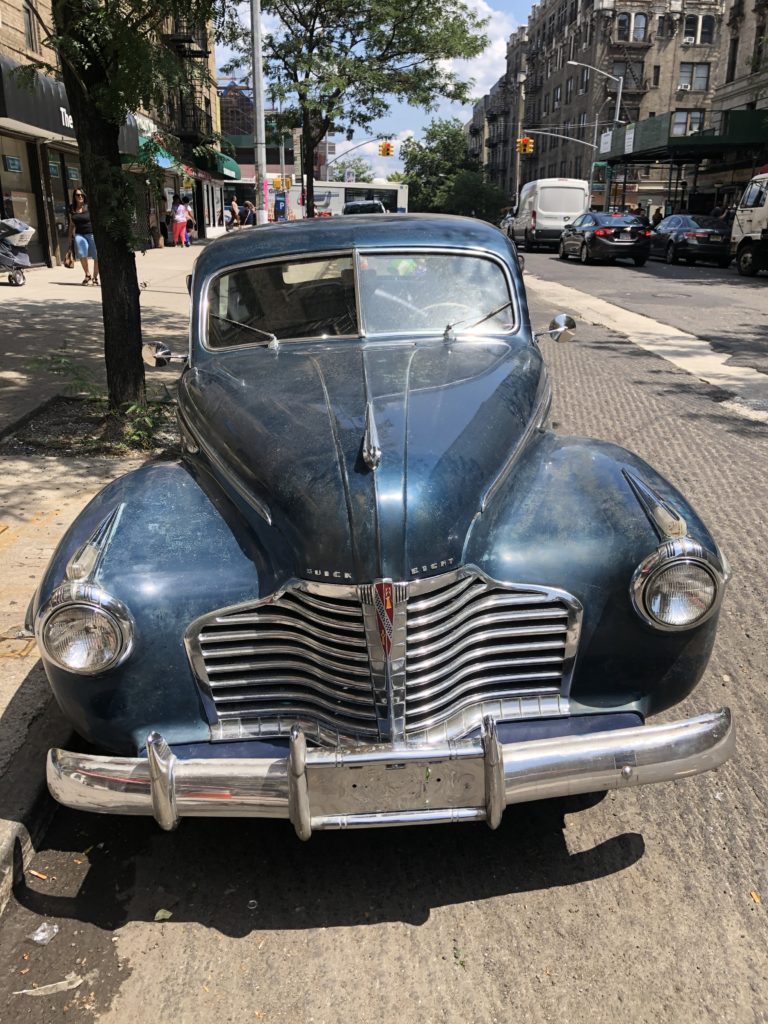
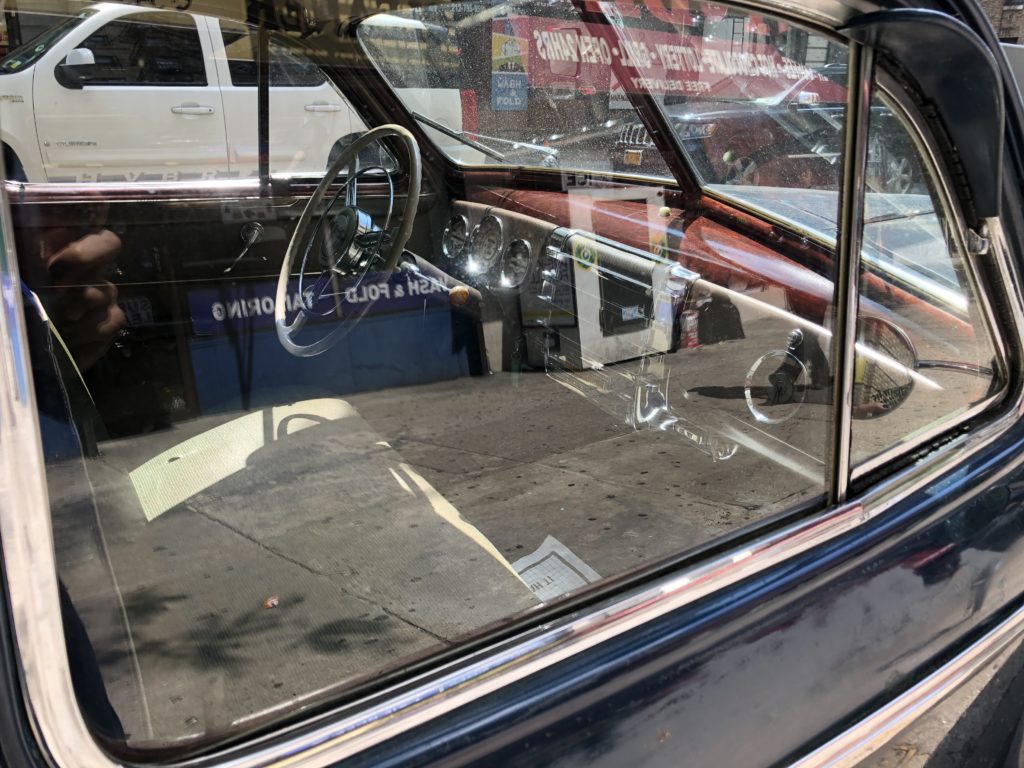
While the Dodge was equally gorgeous, I was able to get closer to a Buick Eight, not quite as shiny, but seemingly all the more lovable for it.

Buick Eight
Buick Eight. Film Shoot. July 2019

Look at that grille!

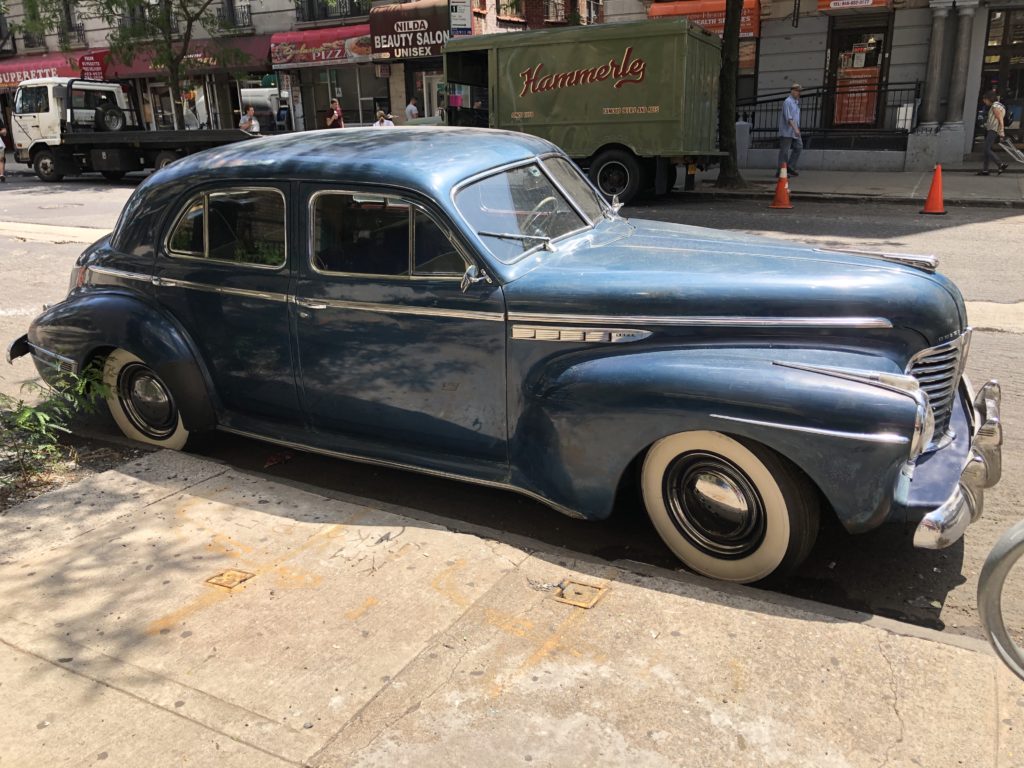
Buick Eight
Buick Eight. Film Shoot. July 2019

And now, the interior:

Buick Eight (interior)
Buick Eight (interior). Film Shoot. July 2019

Back to a time of bench seats and solenoid buttons. I had to wonder, what would people then make today of our touchscreens for everything from music to phone calls to navigation?

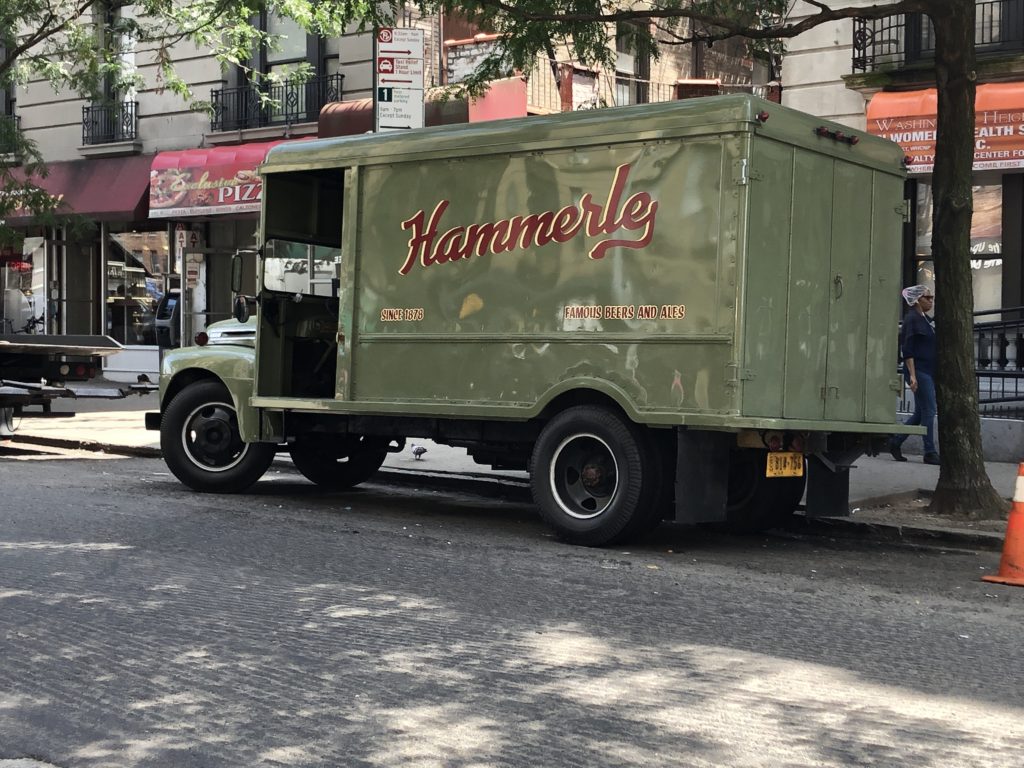
There were some more cars staged down the block. Here’s the rest.

Old Cars
Old Cars. Film Shoot. July 2019

Forbearing Witness

I received a handwritten letter the other day from a Jehovah’s Witness. From the envelope, the purpose and contents were unclear; the return address as well as mine were handwritten. Of course, the return address is a JW hall in Harlem, approximately thirty blocks south.

It’s a friendly letter, succinct and to the point. Important information to share, and our work is not commercial. There’s an expression of hope someday soon I will be able to speak to it personally.

Perhaps this is how Jehovah’s Witnesses solicit in an urban environment? I’m more familiar with them going door to door; that happened to me in college, as well as to a friend around that time. In a city full of apartment buildings, though, access to front doors of homes is challenging, and in some cases might result in legal action. So, I suppose writing letters makes sense, and the handwritten approach certainly caught my attention in a way that a mass flyer would not.

Yet, I’m wondering: how did they get my mailing address? It is addressed to me by name, not “resident” or something similarly generic. Certainly, in this age of information processing, innumerable sources of mailing addresses are available, but just how did they come by my information? Was this a one-time transcription or is there a database owned by the Jehovah’s Witnesses?

I don’t know very much about their theology, other than that they don’t celebrate birthdays or several other holidays, including those based in mainstream Christian traditions. I take that they’re a more austere sect, and from the pamphlets are focused on bible study.