I had jury duty recently, in New York State Supreme Court, based on my residency in Manhattan. I had postponed earlier in the year because of some other commitments, so I had to go. I’m staying with David while I get my apartment remodeled, so this meant driving in to the city to park in my garage, then taking the subway downtown to 100 Centre Street.
I don’t mind jury duty, as inconvenient as it is. It’s a civic duty, and whatever the flaws of our justice system, the notion of judgement by fellow citizens is overall a positive one, in my opinion. Yes, jurors may be challenged and dismissed, and in some cases juries are formed in unfair and impartial ways, but the idea of a jury, at its most ideal, is a sound one for participatory democracy.
The building at 100 Centre is an old one, and a large one, home to both New York State Supreme Court as well as New York Criminal Court. I was surprised at how for north it was; exiting the Q train station at Canal street, I walked a few minutes and there it was.
It was easy to walk into the wrong entrance; on the north end, west side, I was told to go back out and come in farther south; this was a mistake I would make again coming back from lunch. The proper entrance had doors each for employees and the public. The only difference was that on entry, you either walked right in or walked to a security checkpoint.
Phone, watch, coins, keys, anything with metal went through the belt-fed scanner, with humans going through a frame scanner, followed at times by a wand-down. Then, up to the fifteenth floor for the jury room.
I had arrived quite a bit early, mostly to avoid traffic. When the appointed hour came, the jury administrator explained the paperwork and played a couple of videos on how juries work, including one on implicit bias; I thought this was a good addition, though I can imagine most people tuning it out.
By that point it ten in the morning, and we basically just sat for two hours waiting to be called. We would be given a lengthy lunch, and by half past three, we were informed we could go home. No cases were called, and we were all considered to have discharged our duty.
It might be strange to say, but walking in such an old building, it’s hard not to feel a sense of ongping-ness, to think about our justice system, flaws and all. There are lengthy glories to justice chiseled in stone on the outside, and plenty of homages to the ideals of justice inside, juxtaposed with more mundane signage of which way to go for this court or that, for arraignments, for the cafeteria (this was reduced to a place selling muffins and coffee, cash only).
More to the point, in riding the subway, walking to a municipal building, I felt a connection to my longtime home that I had not for a while; the subways were full again, and my fellow jurors and I all rejoiced at the news of our early release. Suffering together, that is a key aspect of living in a large city. We’re all strangers, sharing a moment.
I remodeled my kitchen this past summer. First answer: no I did not do it myself, I hired a contractor. Second answer, it took about four months, which was about six to eight weeks longer than expected. Final answer? Yes, I am very happy with the results.
My apartment kitchen is essentially a six-foot hallway with nooks on each side. Along the north edge is space for a small cooking range, sink, and cabinets; along the south, an angled wall and then space for a refrigerator and shelving.
I’ve lived here for over ten years, longing to replace the cabinets and make other improvements. When I moved in, I replaced the fridge and range, and added an adjustable baker’s shelf, but that was about it. The cabinets were OK, but I suffered a loose hinge and an even looser handle that would fall off without warning.
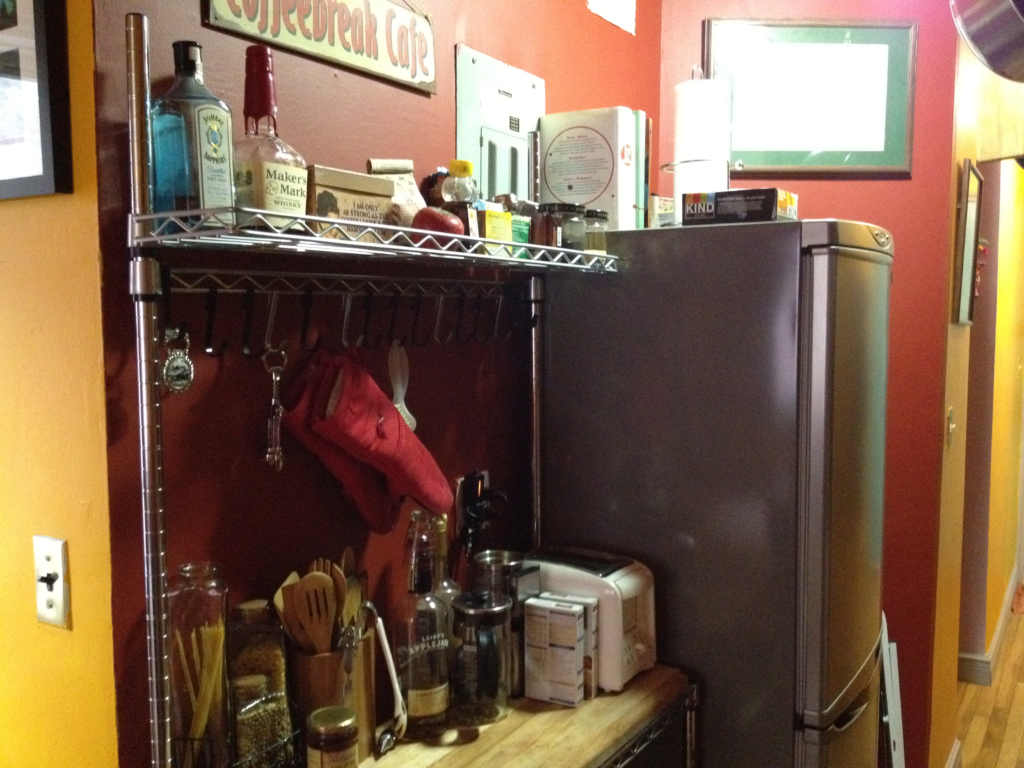
Here’s what the south edge looked like before the remodel:
The Old Setup (South Wall).
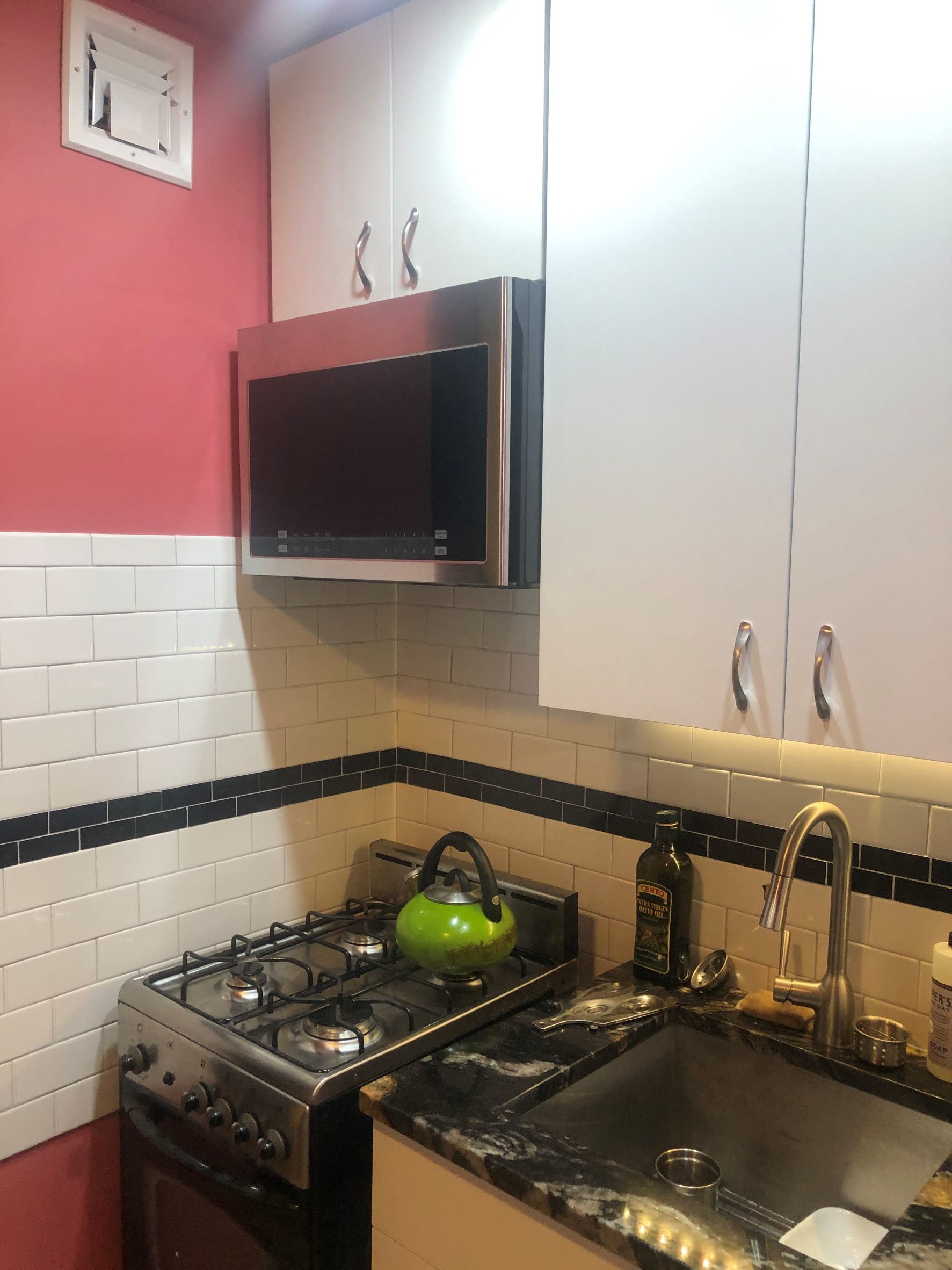
I don’t have good pictures of the old north wall, but basically: a smaller sink, and the cabinets stopped short of the ceiling about a foot. I also did not have a wall-mounted microwave, and I had no dishwasher.
Notice how in the picture above, the butcher-block shelf does not extend out as far as the fridge.
My goals in this remodel were to 1) get more counter space, 2) get better lighting, and 3) refresh the cabinets.
Mission Accomplished.
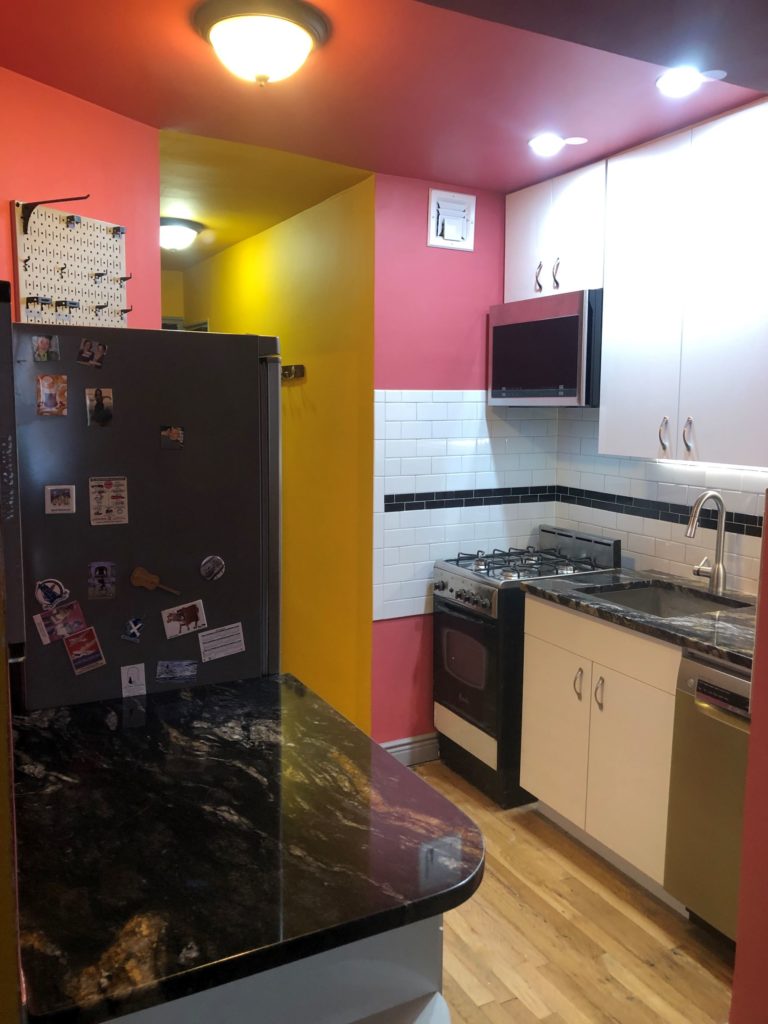
The new kitchen (view from SE)
First of all, from a similar angle: the new south countertop extends fully, givign me almost +3sf of counter space. Also, by adding the dishwasher, I no longer need to keep a dish rack in the space right of the sink – just a little flat towel for the occasional hand-wash item. Additionally, there was tile under the north edge, and old tile for the backsplash.
The new sink is wider by about 4 ” and quite a but deeper, and undermount. The countertops are quartz. In a perfect world I would have had more of an ebony black, but the mottling is nice, and altogether it breaks up what would otherwise be an all-white space.
The cabinets have an acrylic cover – the best way to get the modern slab look I wanted. Originally I wanted color cabinets and white tops, but reversing that scheme was an acceptable compromise.
I spent a ridiculous amount of time choosing a sink faucet. The array of choices are dazzling, and the range in costs quite wide, and I know nothing about design. In the end I went for something less baroque and more modern, and I’m happy with it.
We did have to angle the handle out though – if parallel with the wall, the “on” for cold could not extend fully back. I say it gives the sink character.
The cabinets now extend to the top, offering better storage for rarely used items. I also took the opportunity to relocate where things are kept – the baking dishes are now lower, in the bottom drawer of the south cabinet, and decorative/seasonal things are up high. The bread machine lives in the cabinet above the microwave.
Speaking of which: originally I just wanted a range fan. My old microwave, probably 15+ years old, was fine, but when I learned of combination range fans/microwaves, and searched for the most narrow one I could find, I settled on a Haier. It’s a GE brand I was able to get a discount on through work. It has fancy options I’ve only begun to explore.
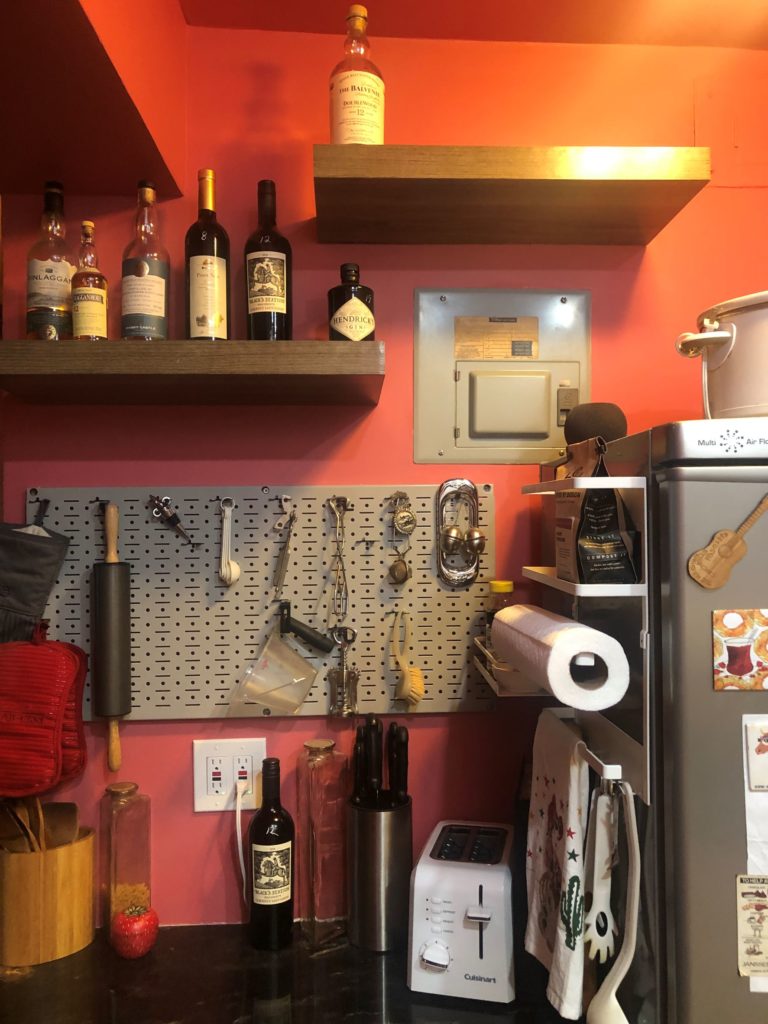
New South Wall.
I now have some cheap shelves to make up what the baker’s shelf provides, and these industrial Wall Control brand panels provide great customizable pegboard storage. Originally I was going to have 4×4, but with the outlets I split them, as you’ll see.
With that increased counterspace, I have room both for the toaster and cooking utensil bins, as well as room to prepare food.
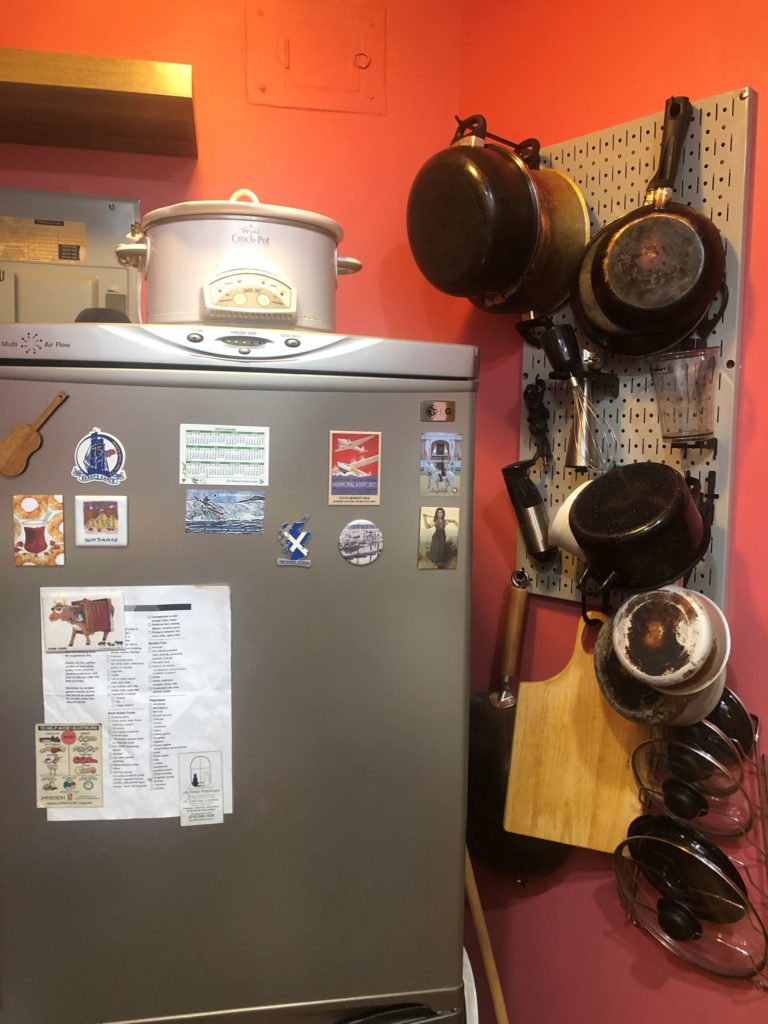
New Pot Rack.
The other Wall Control unit ended up becoming a pot rack in the little nook between the fridge and the angled wall. I also bought a lid holder. The pot fleet will clear up when some new cookware arrives is cleared up (it’s arrived!) but even at this level it is manageable, including the electric hand mixer.
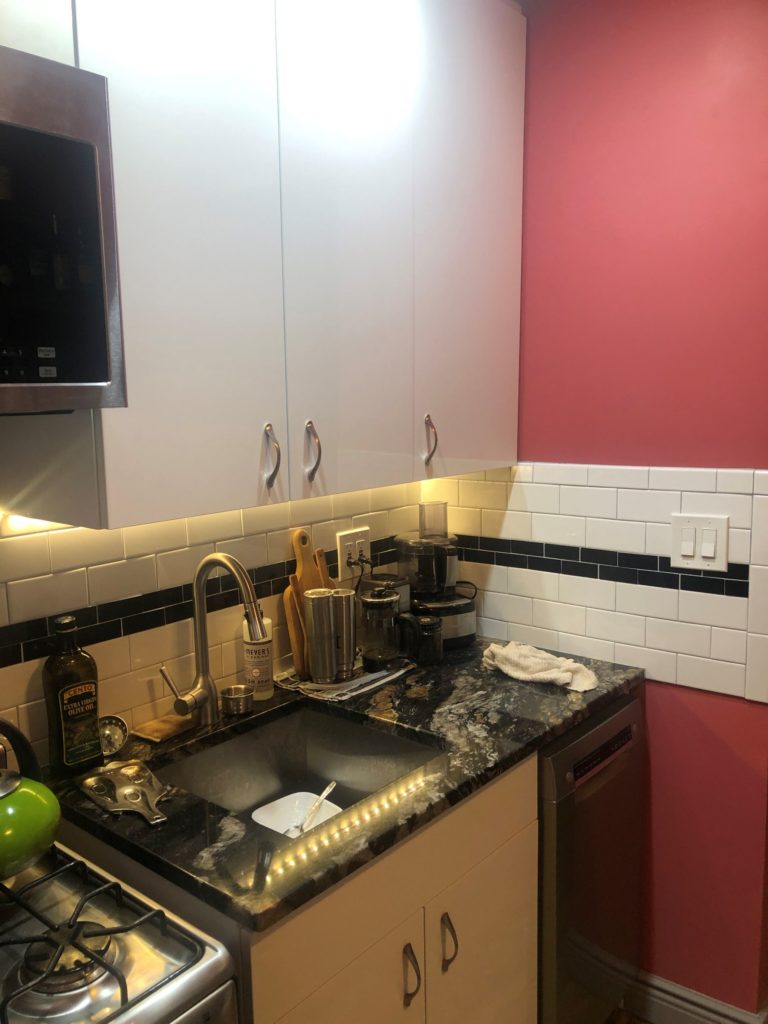
New Cabinets.
Here’s the north edge, with the sink and counter in action. I have a roomy place now for both the food processor, which has hardly been used, and the coffee grinder, which has seen considerable user. Both are Cuisinarts, as is the toaster.
The under cabinet lighting has been desired for years, and its lack was a regular complaint by Mister Autoclast. The only downside to the work is that with a deeper sink, the sliding rack for trash and recycling would no longer fit, so I have to pull those cans out more manually.
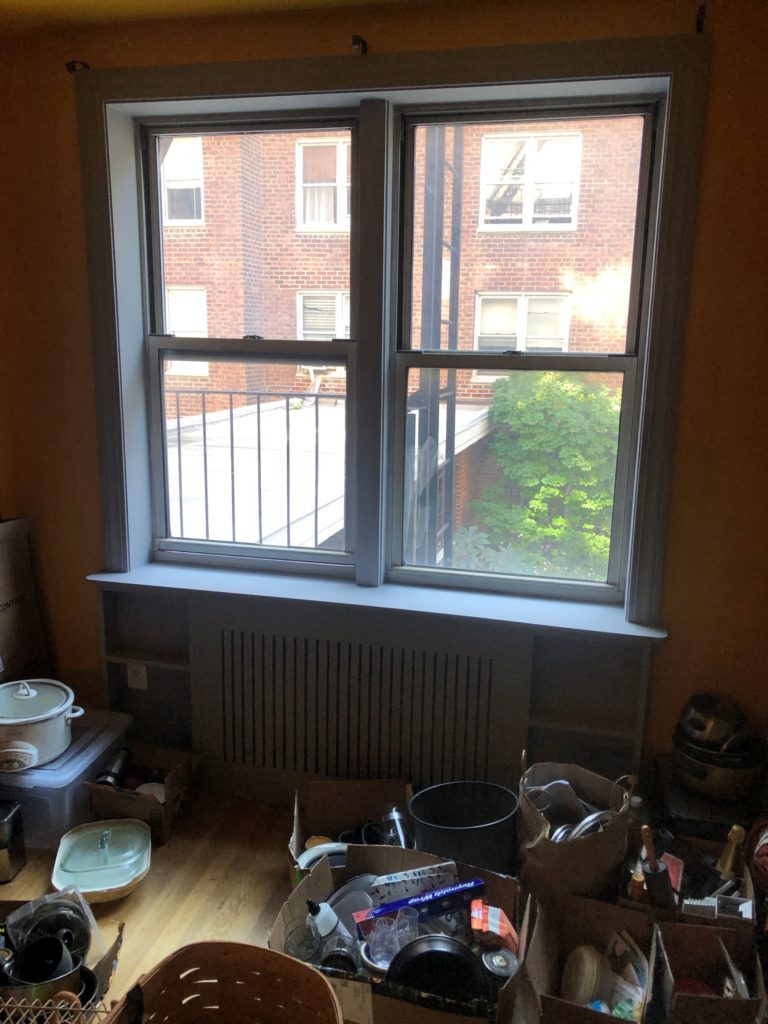
In addition to the kitchen, I also had the window frame and radiator cover redone. My original idea was just to paint the radiator cover – the radiator lives in the wall – but my contractor suggested building out a wooden frame with shelves.
This picture is from before I put things away.
The new window sill and heater cover.
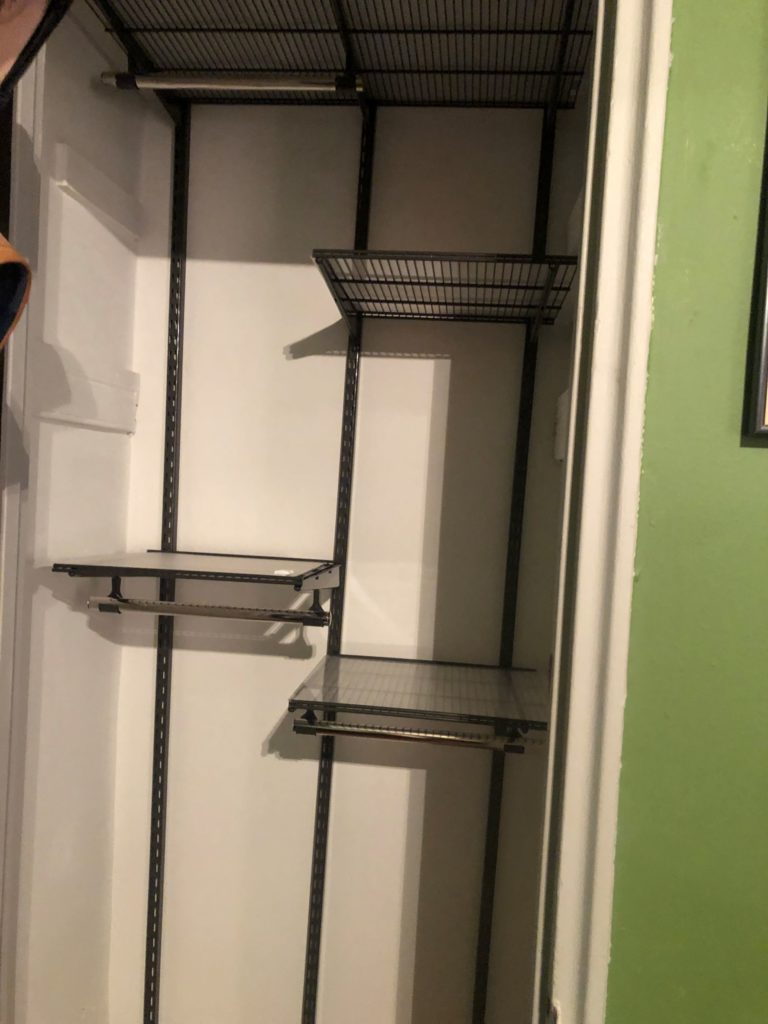
I also had Elfa closet organizers installed. I have to mention that I had a very good customer experience with Elfa. Basically the hall closet is slightly narrower that the bedroom closet, and the organizer I wanted for the former was too wide by about two inches. I called to ask about adding on items to the next smaller kit-size, and the rep said they could just trim the kit I wanted at the factory, at no extra cost. So yeah, if you’re looking for custom cabinet organizing, you could do worse.
Closet Organizers.
This brings me to the only negative I had in the whole experience. Up until this time I was able to sleep in my apartment if I needed to, to do something in the city early the next day, for example. Even with no stove or sink, I could crash out even while I lived most of the time at David’s. To get the organizers installed, however, I had to dump everything out of the closets, to the only place left: my bed.
I thought they would get installed in a few days, and I could load everything back. Somehow, all work seemed to have stopped, so it was a month before I was motivated enough to say something firm enough to get the work done.
By that point, we were approaching Labor Day, and David and I were going on vacation. The very morning of vacation, I drove in early to go over some final details, and a week later, upon our return, almost everything was done. We just needed to add a couple of shelves and the pot lid holder.
Speaking of which, as I write this, my new cookware has arrived. I can’t wait to inaugurate it. The kitchen has worked well so far; in a way using proper pots and pans will make it feel official.
The numbers have come down, in the northeastern United States at least. Numbers are going up in the south, out west, in Texas. Coronavirus and COVID-19 aren’t going away anytime soon, but life in New York is almost normal again.
This was not the case three months ago. By mid-March, our local political leaders were starting to try to do something, anything, often contradicting each other and postponing vital decisions. We were told to stay home except for essential tasks, and in short order, various employers started work-from-home plans where possible.
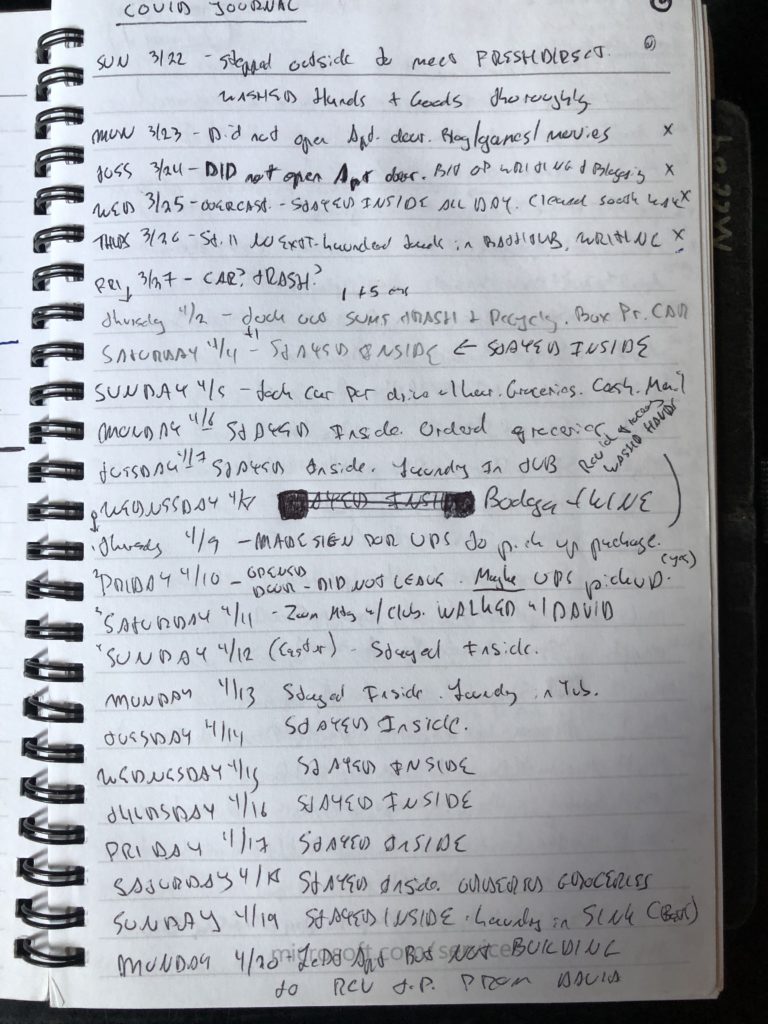
I’m not going to look up the details of what decisions occurred when, or what the body count was week-on-week, day-on-day. I started keeping a diary, partly to keep myself sane. When every day is in the same 500 square-foot apartment, and more and more people are dying daily, it’s good to have a hobby.
In late March I seem to have been playing it by ear. Would I go out? Would I need to? What was my normal routine? Yet by early April I was writing “Stayed Inside” a lot.
COVID Journal 01
There were some challenges early on. David and I talked about whether to visit one another and we decided not to, partly because he’s old enough to be (in the knowledge of that time at least) in a vulnerable group, and I was safer staying at home while he was out in the open for work. I also started a new job and got to witness the company figuring out how to do all the normal hiring things, like paperwork and delivering a new laptop – when I couldn’t go in to the office.
On April 5 I took my car for a drive around Manhattan. I don’t believe cars should sit idle too long, and it had been a couple of weeks since I drove.
On April 11 my paddling club had a virtual meeting using Zoom. After that, David stopped by, and we went for a walk. We both wore masks, I wore gloves, and we met in the garage, where he dropped off his bike.
On April 20, he dropped off some toilet paper for me, having bought a large quantity, on his way to work. I didn’t leave the building; I met him at the entrance.
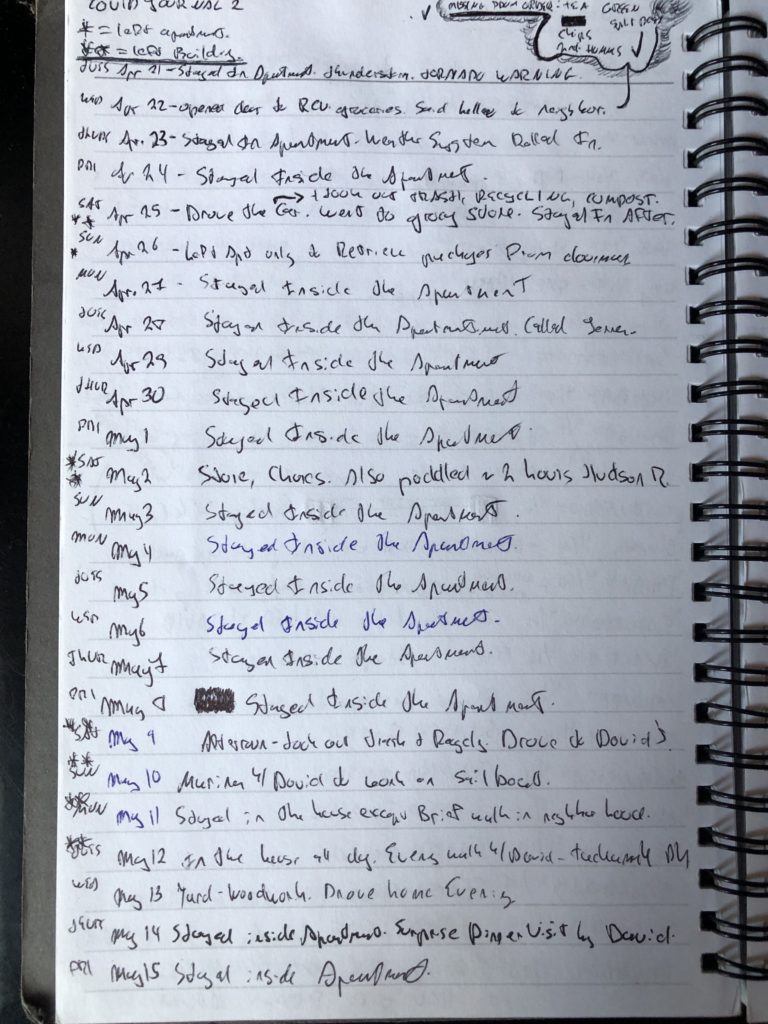
By late April, I’d adjusted to a new routine. I would stay inside for a week at a time, and save my outdoor requirements for a single day. There are a lot of “Stayed Inside the Apartment” entries.
COVID Journal 02
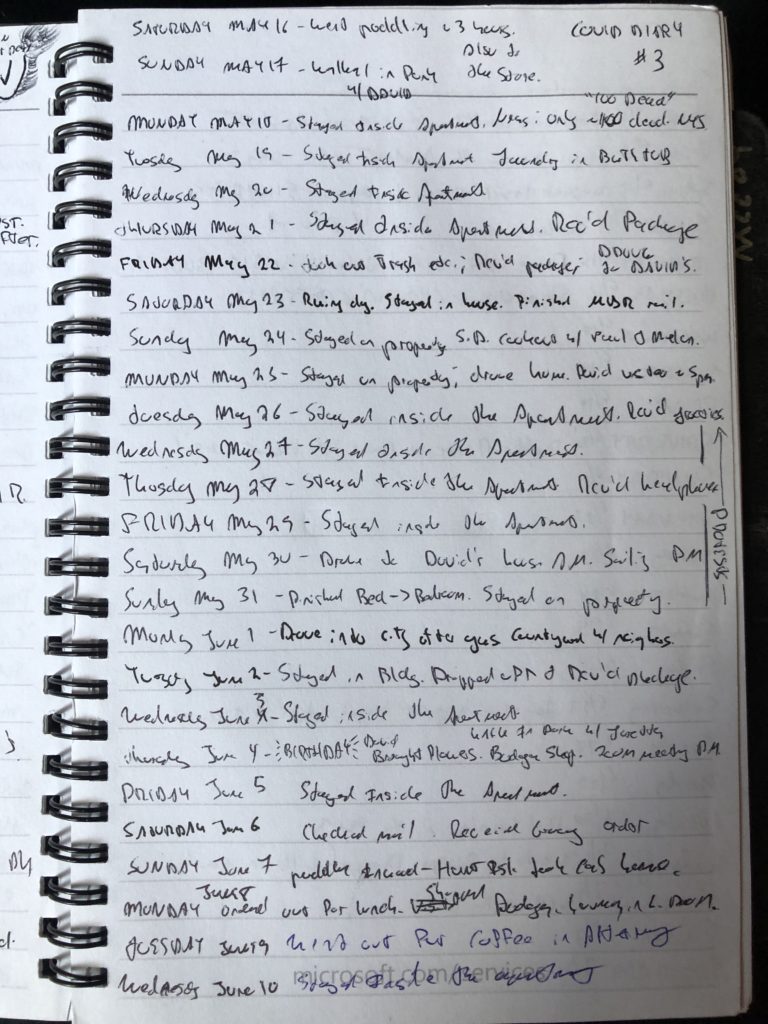
By mid-May, however, I was starting to venture outside more. On May 9 I drove to David’s and spent the better part of the weekend there. Later in the week, he had some downtime at work and was able to sneak in a dinner visit to my place.
By that point, the numbers were beginning to decline.
COVID Journal 03
In early May I went kayaking a couple of times. My club had worked out some rules for keeping the total number of people at the boathouse low, as well as cleaning equipment. All the same I was very paranoid. Once, I walked home in my drysuit, wearing nitrile gloves, even though it was nearly eighty degrees and sunny.
Besides paddling, I ventured out more and more in general. My neighbors had a get-together in the courtyard. I met up with a friend for a walk. I was more willing to go to the store.
I still stayed inside a lot.
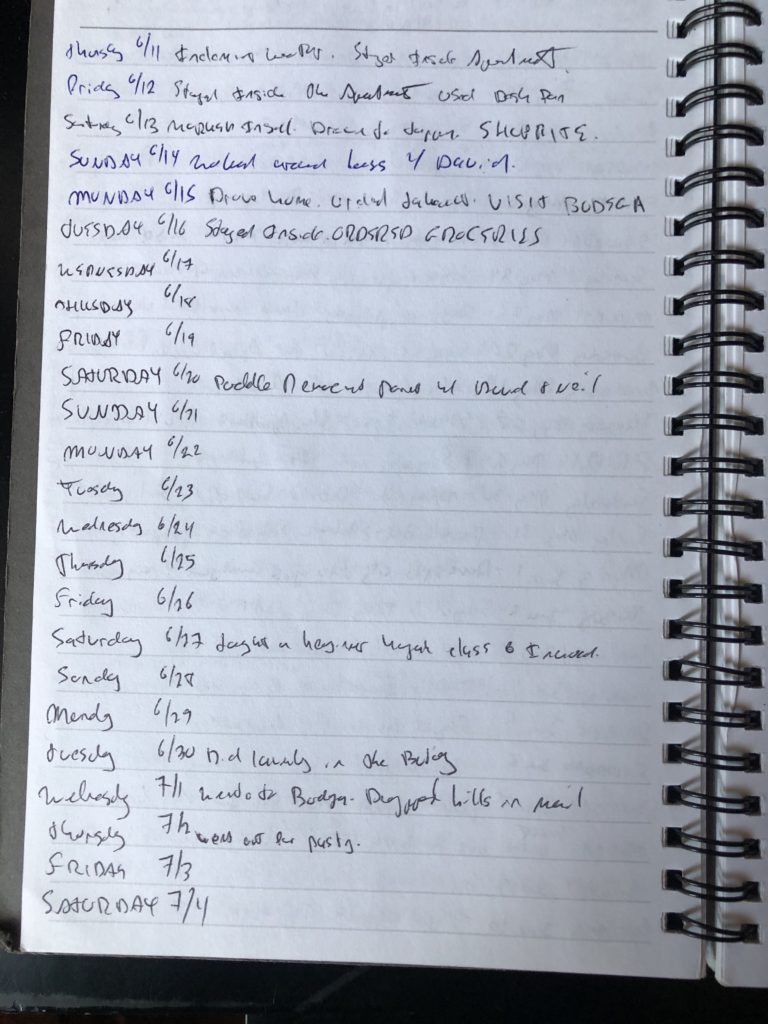
COVID Journal 04
For the past six weeks, life has gotten progressively more “normal”, with frequent reminders of how not-normal things are. I’ve gone up to David’s house a few weekends, and in the suburbs, we can walk around in the yard without a mask. We went out for walks in parks, we even got to a point where, as you can see, I lost track of time – what did I do which day? Did I stay inside? Did I go to the store? The new normal set in. Whatever I did, it was “normal”.
I know I went to a suburban grocery store for the first time. Mask on, basket, sanitizer, do my shopping, stand in a well-spaced line after negotiating the one-way aisles. I’ve taken a first aid course in a state park – a small class, masks on, distancing as much as possible. I’ve developed a fatalistic streak even. I advocate masks and distancing and minimizing time away from home, but when things need to be done, they be done.
With takeout, and grocery orders, and occasional walks to get coffee or bodega runs . . . this is the new normal. We watch and wait to see if the numbers go up, or down, locally, nationally, globally. We silently judge people for wearing masks, or not wearing masks; for opening too soon or overreacting. That’s new normal too.
Wearing a mask is the simplest thing one can do. It’s a kindness to others; it protects oneself too.It’s frustrating, it’s silly, it muffles out voices, but makes a difference. Places where people wear masks have lowered their infection rates.
We can argue about whose fault it is, or how we should spend money to address the problem, but most importantly we have to address the problem. Official guidelines in the US are being treated as optional; speed limits where there is no enforcement. There is not enough testing, and therefore data, to make the kind of fine-tuned decisions that everyone wants. Too many politicians want to be the cool parent who lets their kids run free, only to find the have to be the responsible parent when they come back from spring break with a highly contagious respiratory illness.
The numbers are going up. Various states are rolling back their opening plans. I don’t plan to start another COVID journal. I hope I don’t have to. Nonetheless, July 4 or thereabouts marked a different sort of Independence Day.
It’s Thursday, March 12, the day after the President announced that the US was banning flights by non-citizens from Europe, except the UK, for thirty days.
David called me last night to say he was working at the station and about to watch Fearless Leader. When I called, since it’s our usual talk-time, he asked if I was watching. Why would I be watching? Anything important that comes out of that man’s mouth, I can read a day later in a reputable news outlet.
“You should watch,” he said.
I’d missed the part about the travel ban at the top. I watched as the most deadpan, first-pass script-reading session proceeded apace. I had questions, but it would take a while to process. A great economy. Virus doesn’t stand a chance. It was clear what the priorities in this speech were.
David had been considering a ski holiday in Europe. Every year, he takes some kind of exotic ski trip, and most years in the past five, it’s been to Austria or Switzerland. Far from civilization, atop the peaks and glaciers of the Alps, he’s with a small group skiing from hut to hut for about a week. We had been worried about airports, but the majority of his time would be away from crowds.
There was a really good trip in the Alps shaping up, as well as some alternates in Norway. First he had to confirm getting the time off, which he did, but by that point the virus had spread to Italy, and we were wondering if or when it would get to Austria. That was perhaps two weeks ago, and if last week was a search of flights, this week was, the Austria trip was outright cancelled by the organizers, and now the entire continent was mooted.
We were both considering domestic travel, but at this point we would rule out airplanes. A driving holiday is about the most we would expect.
I already have one friend who’s holed up with his wife in a cabin in the Catskills, large quantities of dried foods (rice, legumes) handy, in a remote area where they can ride out the worst. His advice, only half-joking, mirrors two others I’ve heard from: go get the virus now. Get sick now, before the hospitals are overwhelmed. Get it, get through it, be done with it.
This sounds bonkers to me, at first. I understand the logic – embrace the inevitable – but that wouldn’t work for anyone who’s caring for others, especially the vulnerable. I would go further to say it’s almost a grasp at having control: I will choose the time of the battle, even if I can only choose to make it sooner rather than later.
In the meantime, the rapid escalation in the past forty-eight hours has me, for the first time, worried. Maybe I should be stockpiling food, and cleaning supplies, and deciding where I want to live in the event that I can’t leave for a few weeks.
For several months I have been one of those “work from home” people. It’s a topic deserving of its own post sometime, but suffice it to say, it’s been an adjustment. Now, however, it’s all over the news: companies are telling employees to work from home if at all possible.
The emails started last week, maybe the week before. I work for a consultancy, which is in turn owned by a larger consultancy, and between the two I get staffed at other companies, so I have been receiving all sorts of internal emails. We’ve gone from “no unnecessary international travel” to “we’re not sure how to handle the ban that was launched last night”, along with “Campus X is closed”, and of course helpful reminders on how to use technology to work remotely.
On the other hand, my more left-wing acquaintances have been reminding everyone on social media that not everyone has this choice to make. People who must be present – cab drivers, construction workers, store employees, and certainly doctors and pharmacists – can’t exactly do their jobs remotely. Many of these same people won’t have the safety nets that us office drones have, either: savings and other emergency funds to dig into if things get really bad. Furthermore, despite precautions, they’re inherently at greater risk than someone who is single and could, if she wanted to, stay in her apartment for days at a time.
The above all bears repeating even if you’re not a lefty-wing person.
Today, I had my first cancellation of a call due to “dealing with coronavirus” by a customer. I’ve previously had chats with others in the idle moments before a call properly starts – the small talk while we wait for others to join. It doesn’t feel like small talk anymore.
Part of adjusting to a work-from-home job was recognizing that I needed to keep some sort of schedule that isn’t driven by my calendar, and to get outside and go for a walk. At least twice a day I go for a short walk in my neighborhood, and I frequently put off little errands to ensure I have something to do each day: drop off sweaters for mending, pick up some salsa, go get a fancy coffee (Wednesdays, an almond milk turmeric chai latte).
But now I wonder, do I need to go to those places? Even doing laundry in my building, I wonder how many other people have touched the handle to the laundry room, how many have opened and closed the washer and dryer machines? Even the gym – I’ve decided not to go for a while, even though I’d like to work out more. Despite precautions, I’m not going to avoid thinking about the worst.
And yes, I am washing my hands thoroughly.
The latest – as of about 1430 Eastern, Thursday March 12 – in New York is that gatherings of more than five hundred people are now prohibited; New Jersey is capping gatherings at two hundred and fifty. This of course affects Broadway shows, as well as concerts and sports events. Some NYC public schools are closing as well; the challenge there is that public schools are often the front end of social services, so closing them affects far more than education: they are where many children get food, medical services, and counseling. The Mets (Museum, Opera) will be closing as well.
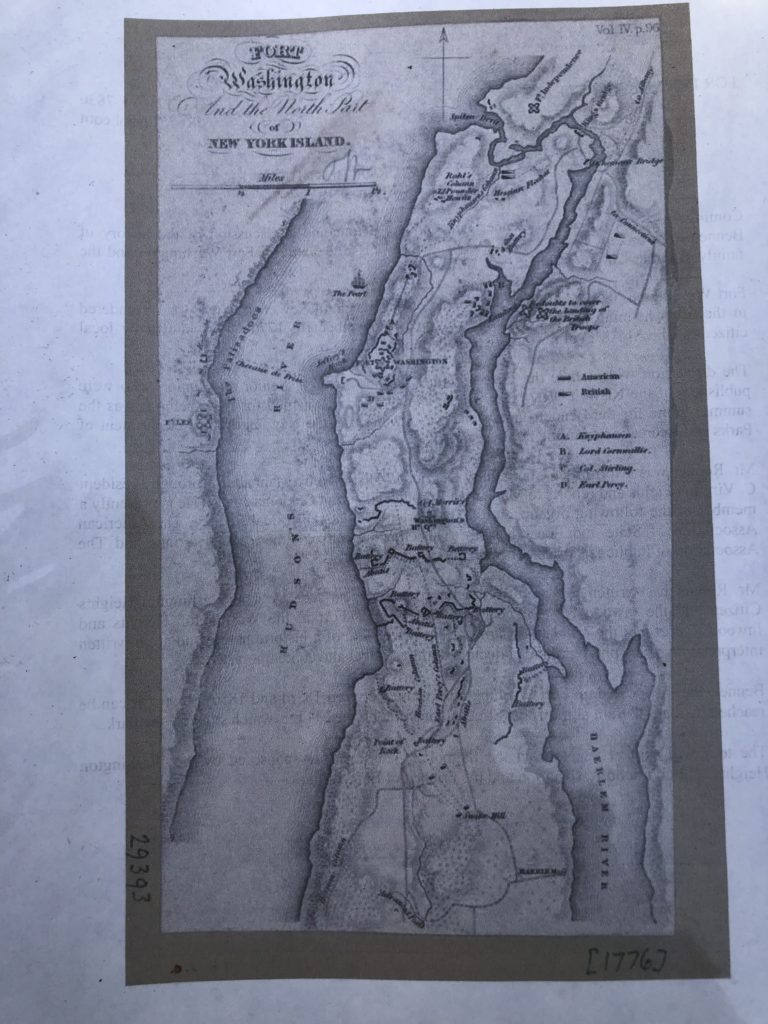
I live near Fort Tryon Park in New York City, site of the Battle of Fort Washington, one of several important battles fought by the retreating Continental Army during the American Revolutionary War.
The park is near the top of a sizable hill in the area, and the lawn where the re-enacting took place is just below the redoubts where Margaret Corbin took her husband’s place in battle after his injury, continuing the canon fire against the oncoming Hessian and British troops. She was badly wounded, but survived.
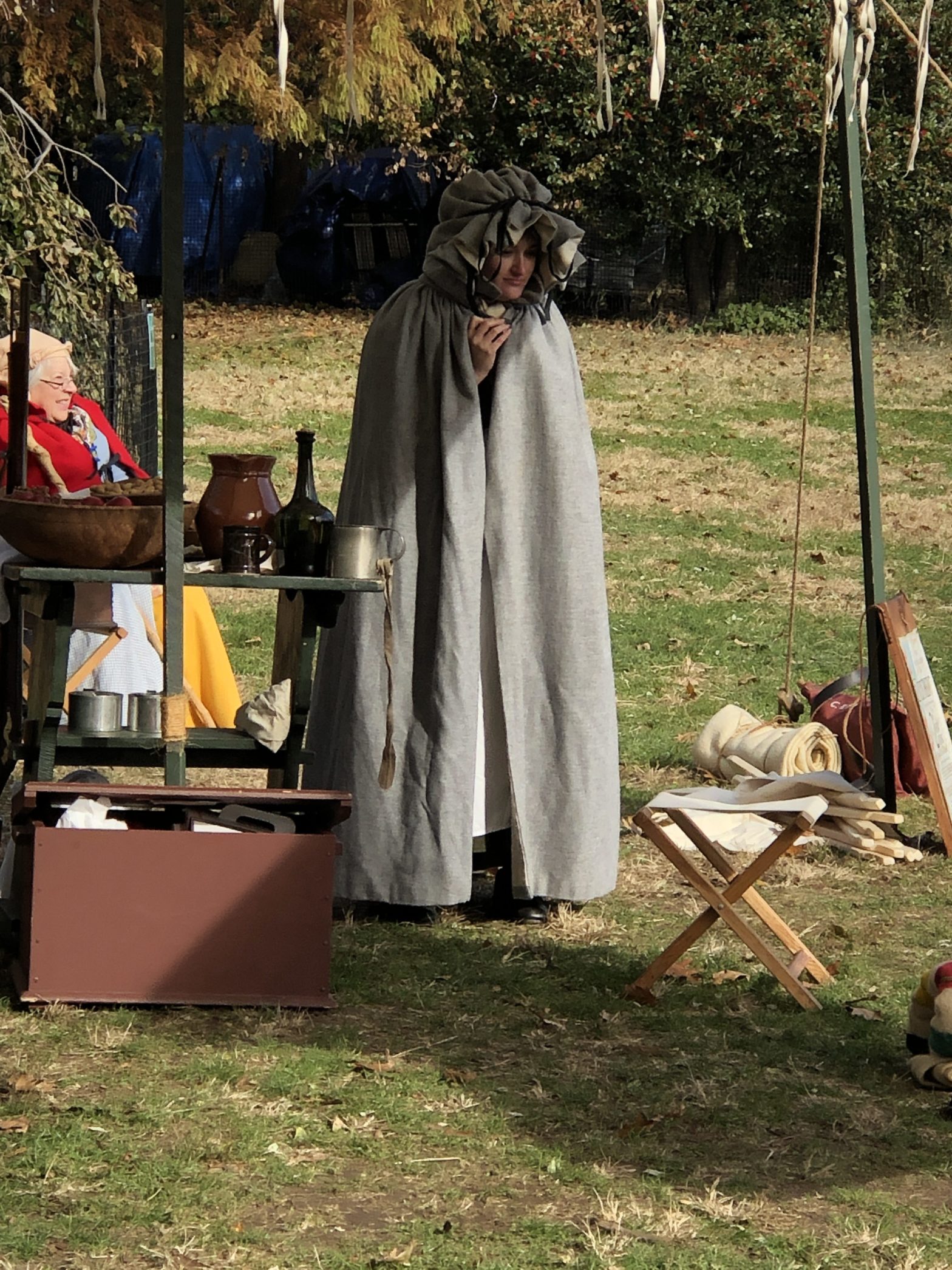
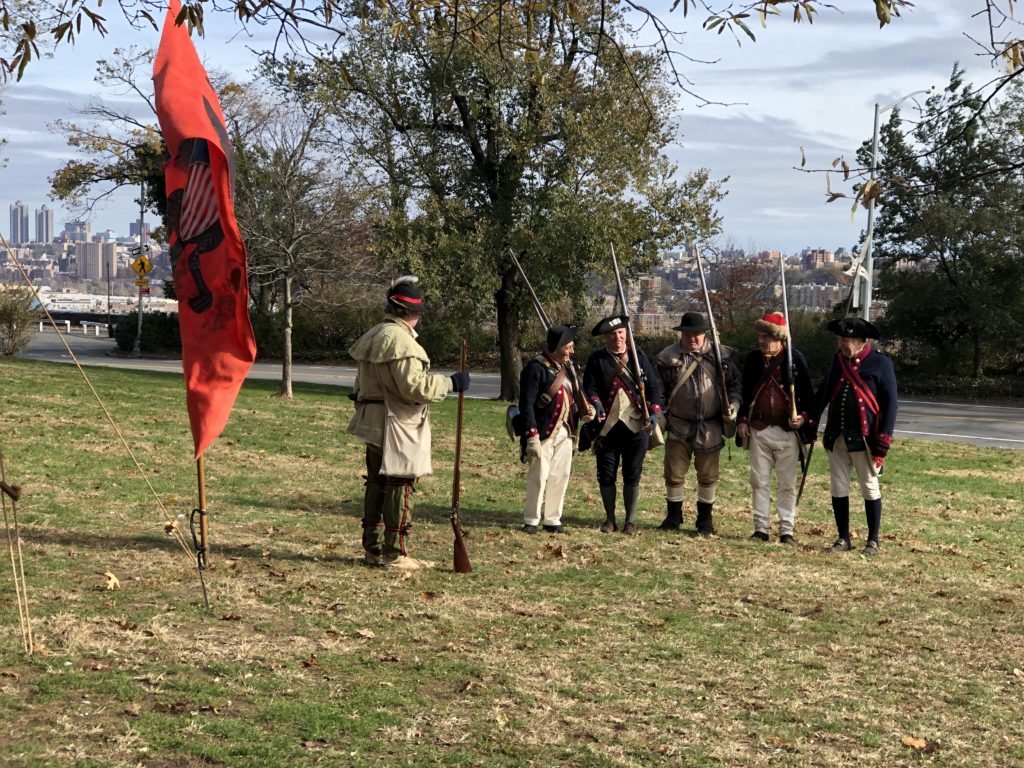
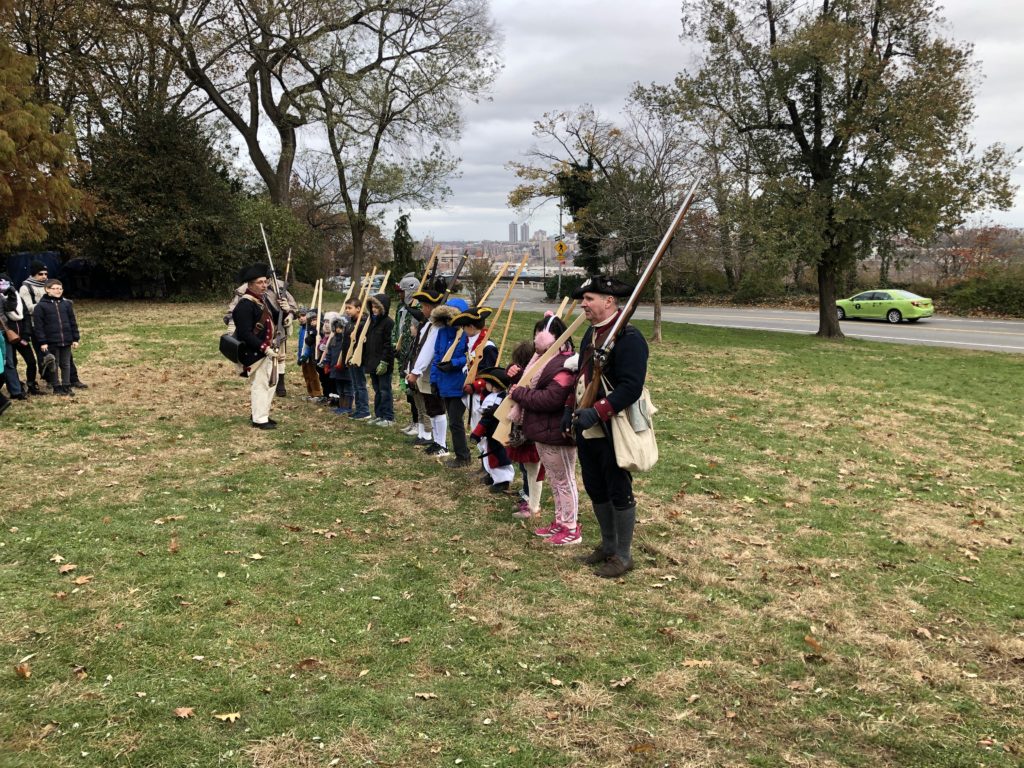
I was able to briefly attend a re-enactment of the battle, an event held annually in the park. It was, as our local parks administrator put it, a low-key affair. A small tent formed the “headquarters” for the re-enactors. There was one fellow dressed as George Washington himself, and perhaps half a dozen Americans dressed in non-uniform “uniforms”, just as the actual Continental Army was.
Continental Army.
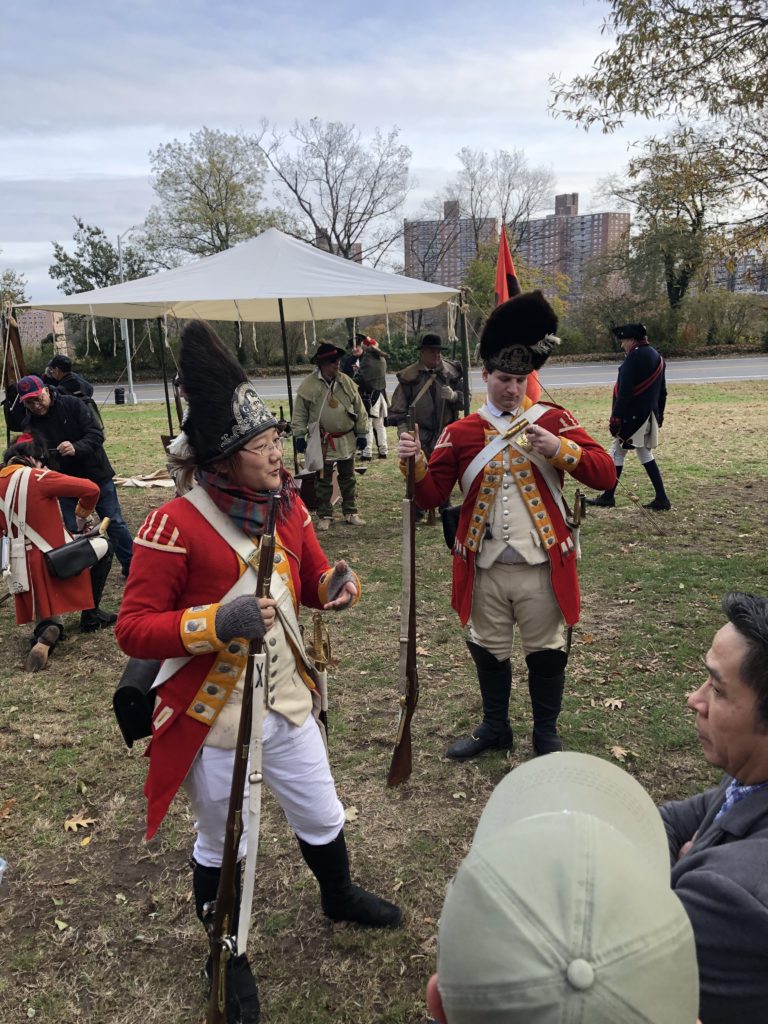
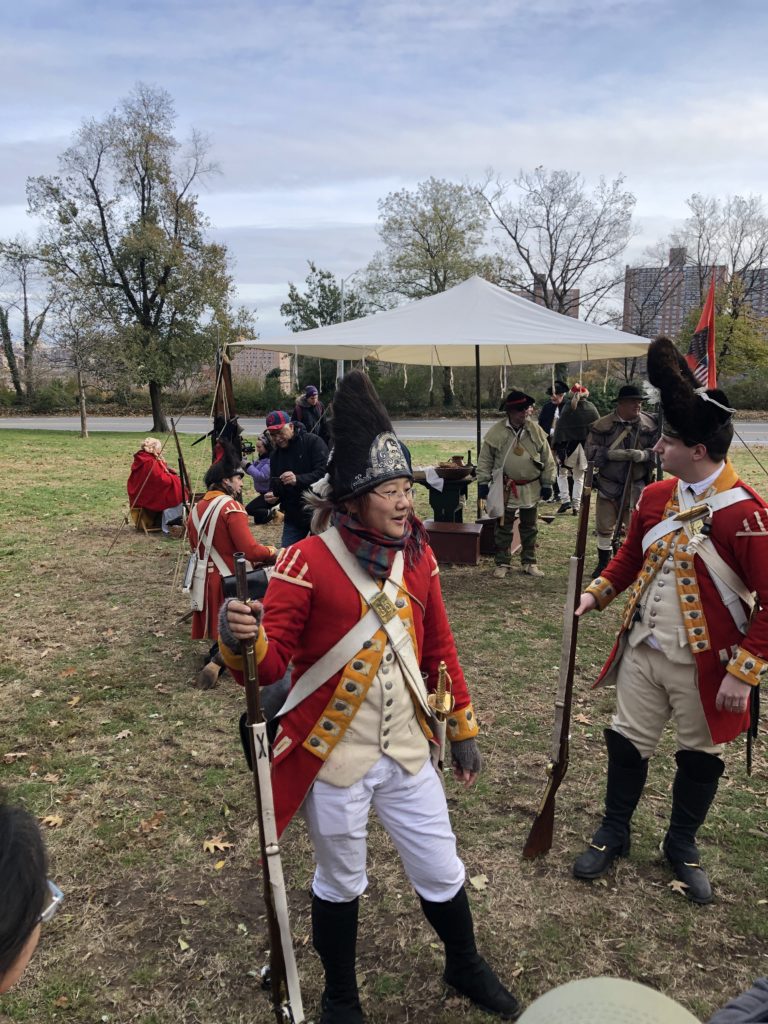
About three redcoats showed up, mostly from New Jersey; according to one, Monmouth County has a sizable number of re-enactors. Driving over the George Washington Bridge (ironically) and its $15 toll was the greatest deterrent to British invasion.
The Redcoats.
Several amateur historians had laid out tables with printouts of articles and biographies they’d written. It was a bit windy, and cold; fortunately the New Leaf cafe in the park provided complimentary hot cider and small pastries. There were also laminated reprints of old newspaper articles about the re-enactment; one that I read dated back over a century.
Old Northern Manhattan.
One woman dressed in period garb led fifteen-minute “tours” of Margaret Corbin’s life. The main road through the park is named for her (Margaret Corbin Drive), and she’s something of a local hero: troubled childhood, married young, and followed her husband, who served as a cannon loader in the Continental Army. In the battle, as he fell injured, she took his place, and was later captured, but released to care for the inform, while many of her fellow soldiers were sent to languish in British prison ships in the East River.
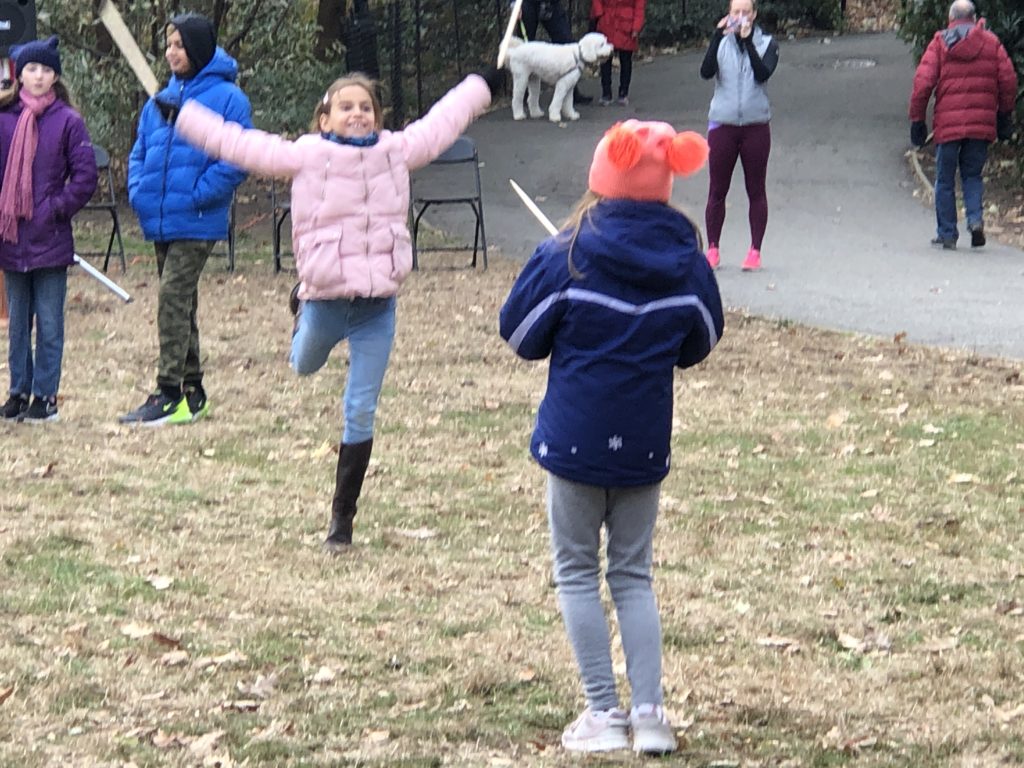
I waited and waited for the battle to start; even the re-enactors were unclear as to when; I suspect they were waiting for a sizable crowd. Loudspeakers were set up playing Colonial-era fife & drum music; children played happily with stick-and-hoop sets, which looked remarkably more fun than is commonly expected in the modern era of franchise toys and mobile device games.
Stick and Hoop Win.
I spoke with a couple of the re-enactors, both on the British side. One was a woman who not only clearly loved the history behind the uniforms and gear, but was also very good at explaining it all, to children and adults alike. I asked her about the tall, pointed fur hats they wore, and she said basically, they were meant to make the already tall, robust assault troops known as Grenadiers look even taller and more robust.
Redcoat Grenadier.
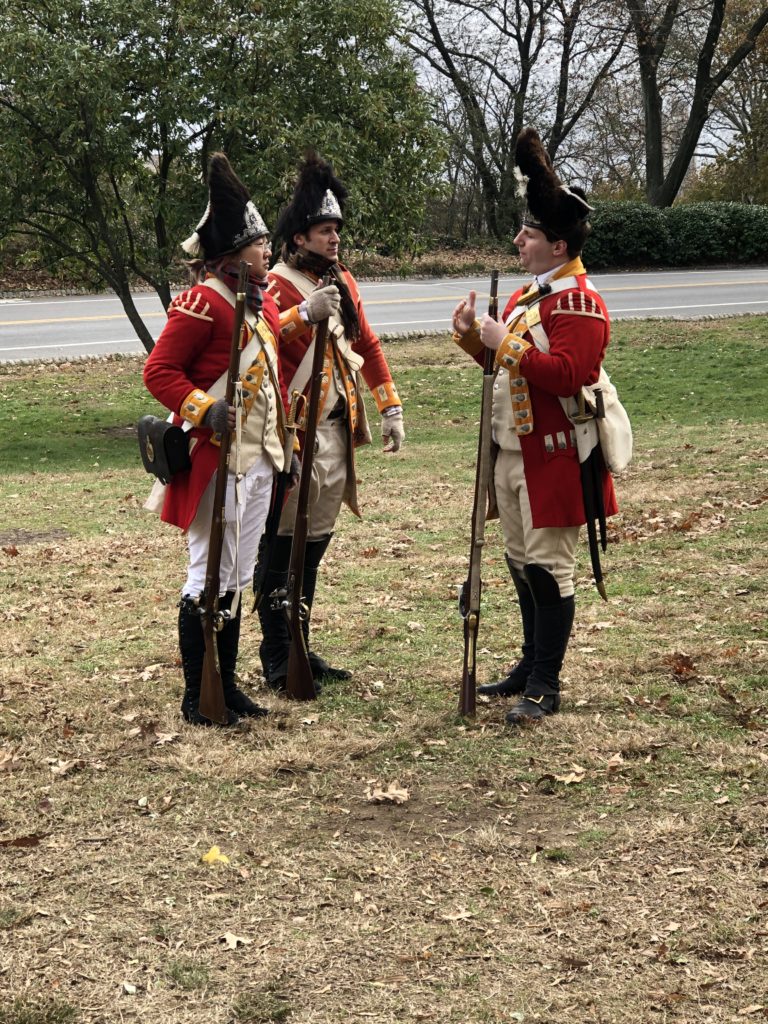
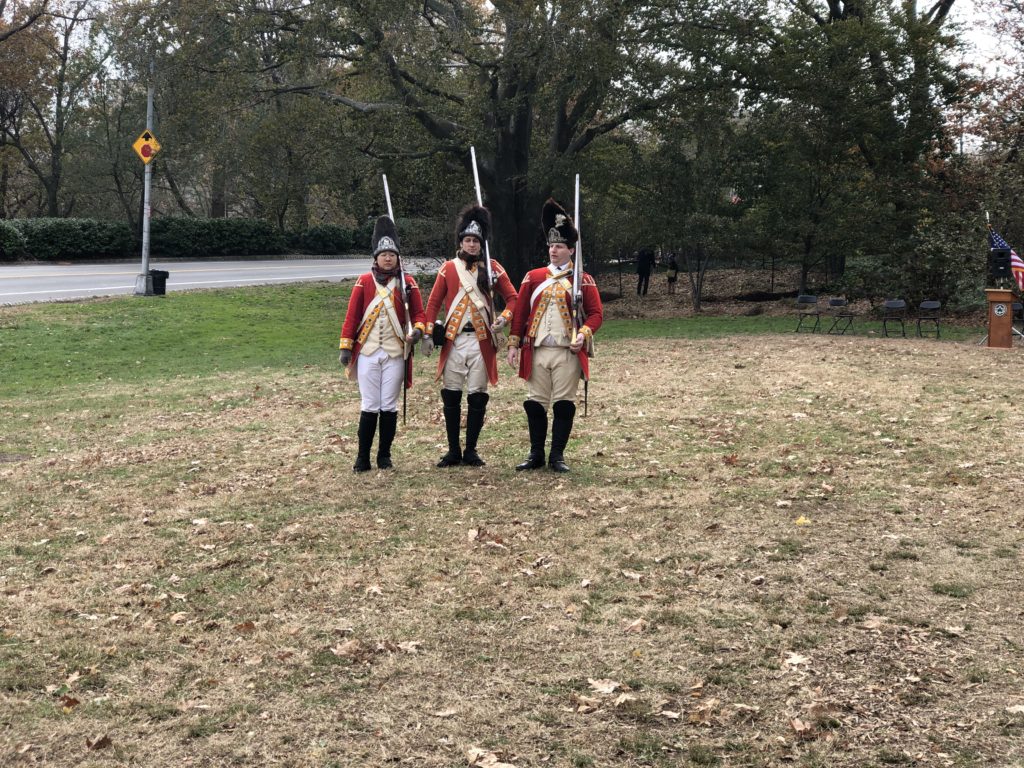
A fellow re-enactor said he’d been at this for eighteen years, and later, seemed to take the role of commanding the other two troops as they walked in parade drills.
Redcoats Drilling.Redcoats on Parade.
As I looked around, I tried to imagine the landscape largely devoid of human activity; mostly farmland, even Native American country. No Bronx rooftops, or long winding drive with an NYC taxi cab racing behind the Continental Army. Imagining the park without the grooming and care that it gets now, imagining what it would have been like to race up and down hills delivering messages, sighting cannons at incoming enemy troops; being fired upon, and stormed by large men in red coats, with burning matches hanging from their collars, hurling explosives and wielding large, pointy bayonets affixed to their muskets. Despite the small showing, the scene was very vivid to me.
New Recruits.
Unfortunately, I gave up on waiting; it was cold, and I had work to do. Still, it was good fun, feeling a part of that history, and a part of the neighborhood. Having just completed reading a biography of George Washington, the battle and its importance in American history was still fresh in mind, and it was a great feeling to experience it, however vicariously, with a simple walk in my neighborhood.
“Man at the Community Board meeting wants to rename Fort Tryon Park,” said the Engineer.
“To what? Did he offer any other names to ‘try on’?” The Musician scooped up butter for his toast, and they settled down around the table.
“That is silly,” said Madame. “It has always been Fort Tryon Park.”
“That’s what the woman from Parks said. Fort Tryon Park. So named since the Revolution.” The Engineer carefully sliced his eggs open, to let the runny bits spill out. “But he opposed it since that was the name of the English governor at that time. Said the man tried to kidnap George Washington himself. Rather, he hired or ordered men to attempt that.”
“Sounds like he was just doing his job,” said the Musician.
“Well that’s what I thought. But also apparently the governor was considered cruel even by his own people.”
“Perhaps it is not so terrible an idea,” said Madame. “I mean, it is strange to keep a park named after an opposing side’s leader. Especially since everything else around here is named after George Washington.”
“Every melody has its counter,” said the Musician.
“I feel things should maintain their history no matter how ignoble. And, in any case, the woman from Parks said even the Americans back then called it Fort Tryon. Even though it was originally part of the Fort Washington defenses, after the Americans were defeated, it was renamed Fort Tryon and after the war no one bothered to rename it.”
“How strange,” said Madame.
“After that, it was essentially private property until the Rockefellers gave it to the city and it became the park it is today.”
“It occurs to me,” said the Musician, “that perhaps there is wisdom in keeping the name as it is. Would we even be talking about this Tryon man if not for the name of the park?”
“We could name it after Margaret Corbin,” said Madame. “She was the wife of an American solider who took his place on the line when he was injured. She only has the road named after her. Margeret Corbin Drive.”
“Now that is an idea I could get behind,” said the Engineer. “But the bigger question is, do we bother honoring our enemies, at least those we defeated? The British won the battle and renamed the fort, but lost the war. Perhaps little informational signs in the park.”
“I do not know. I only go there for the flower garden. And the view.” Madame sighed as she sipped her coffee.
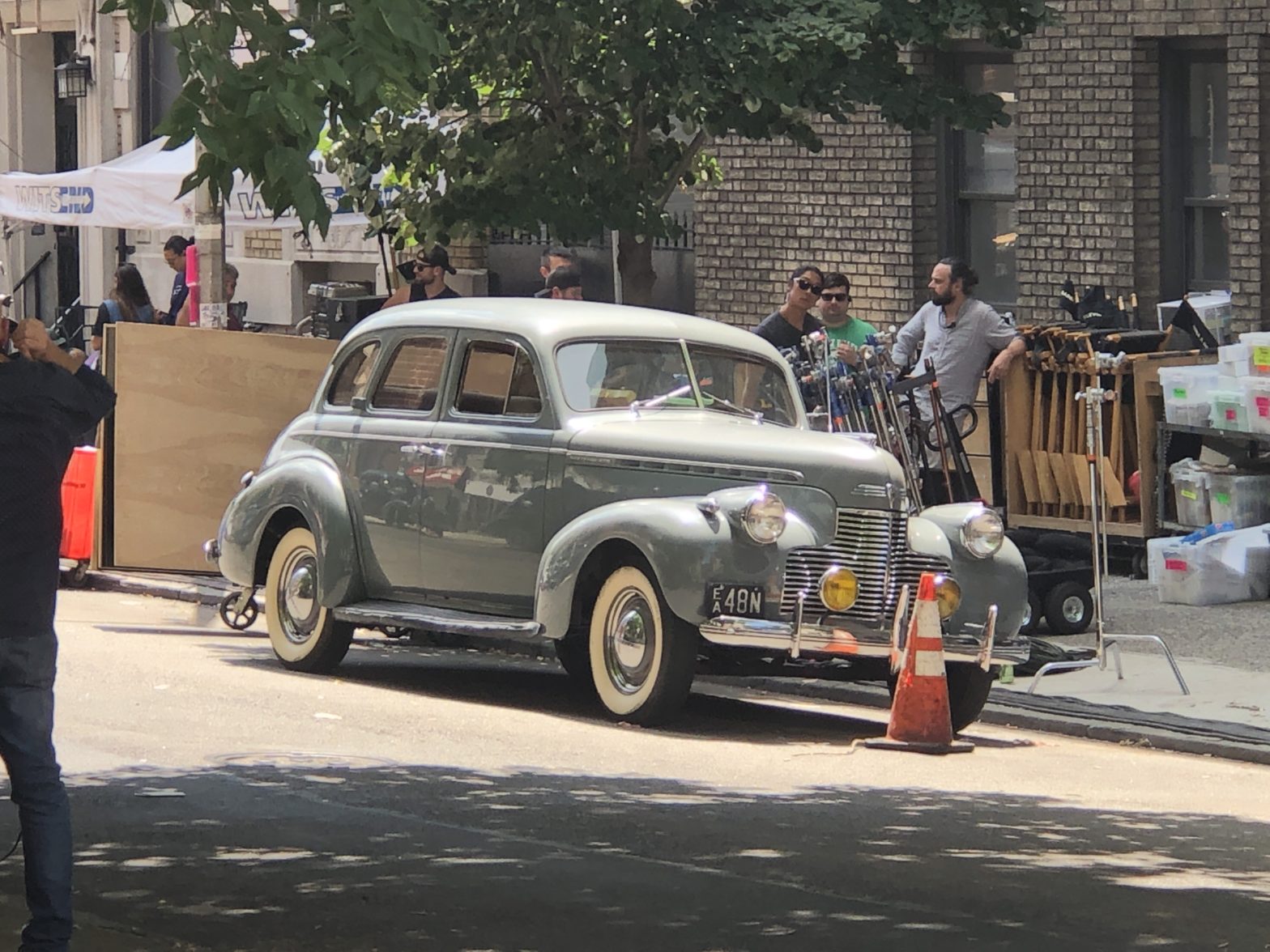
. . .the cars stand out on their own, irrespective of plot.
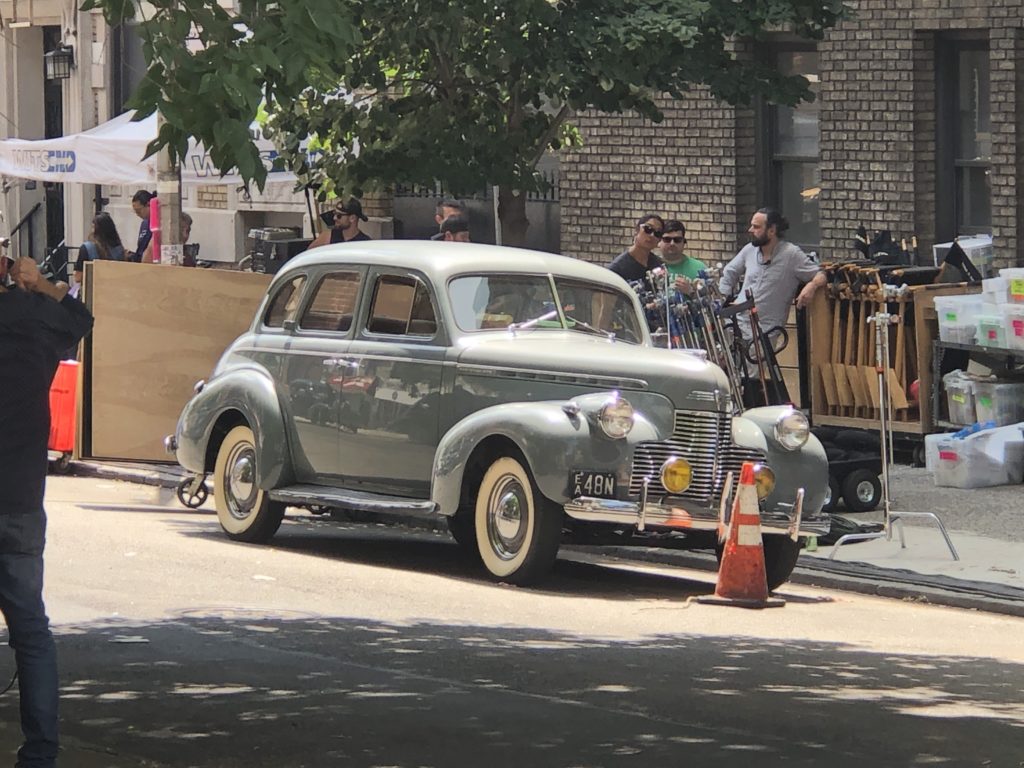
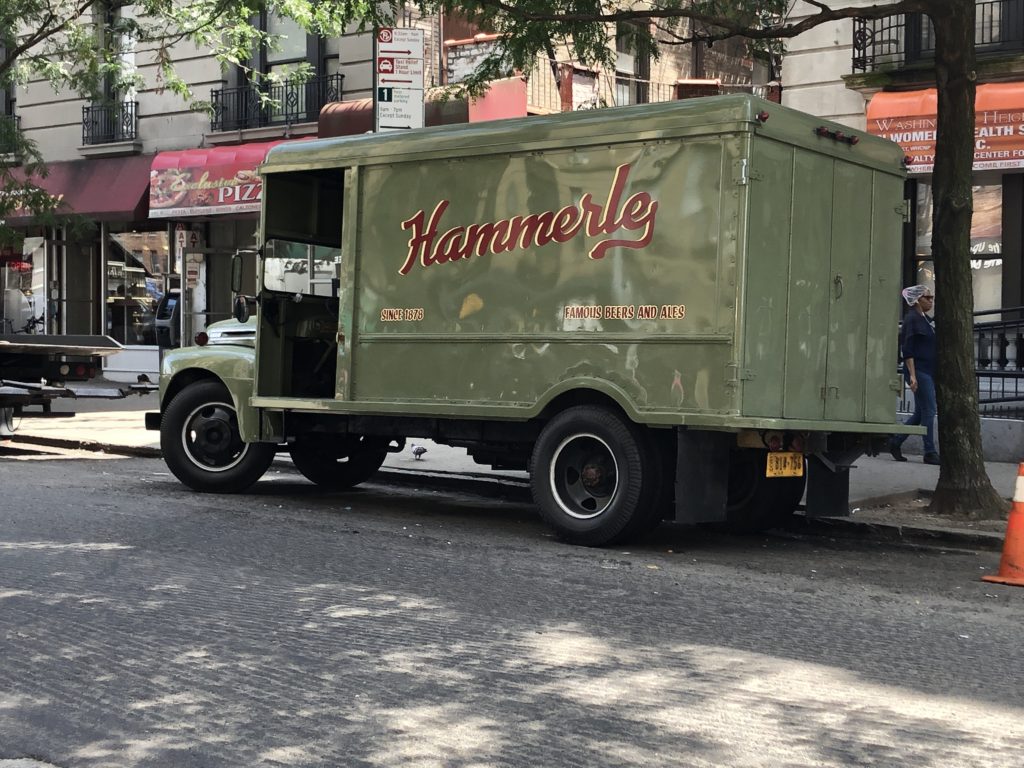
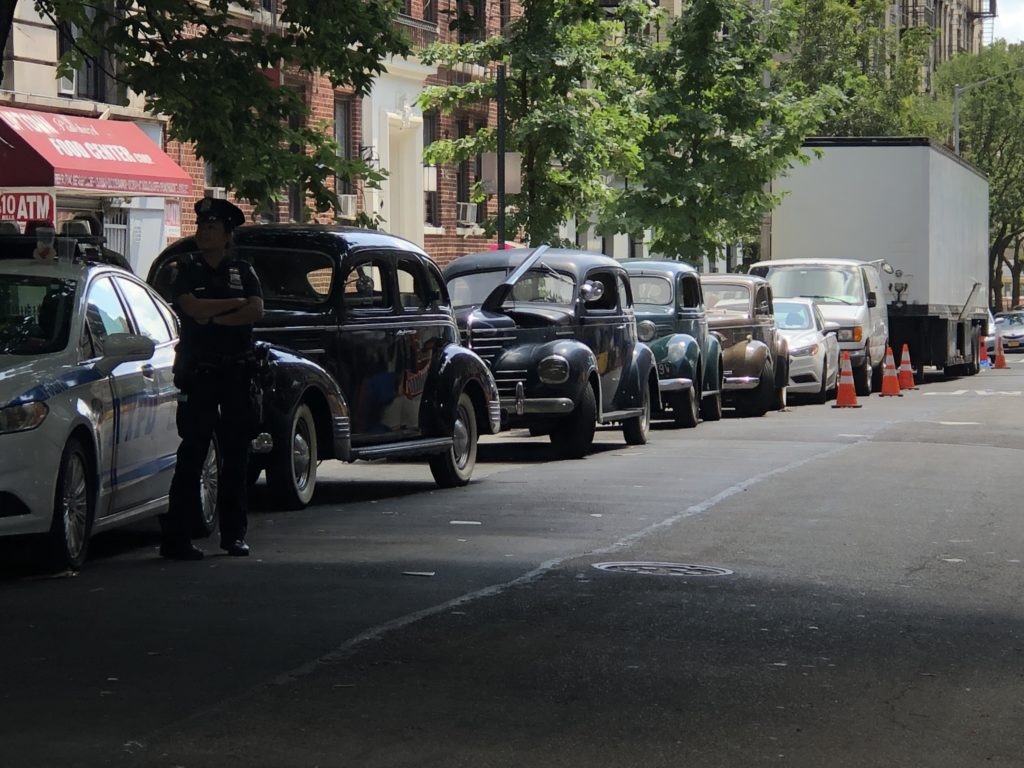
A recent film shoot brought an array of interesting, old-timey cars. There was a similar yet smaller array a few months ago, for what I later learned was a shoot for a film version of Philip Roth’s The Plot Against America, which is set in the early 1940s, in an alternate history wherein Charles Lindbergh defeats Franklin Delano Roosevelt for President, largely on an isolationist and anti-semitic campaign platform.
While that sounds bleak, the cars stand out on their own, irrespective of plot.
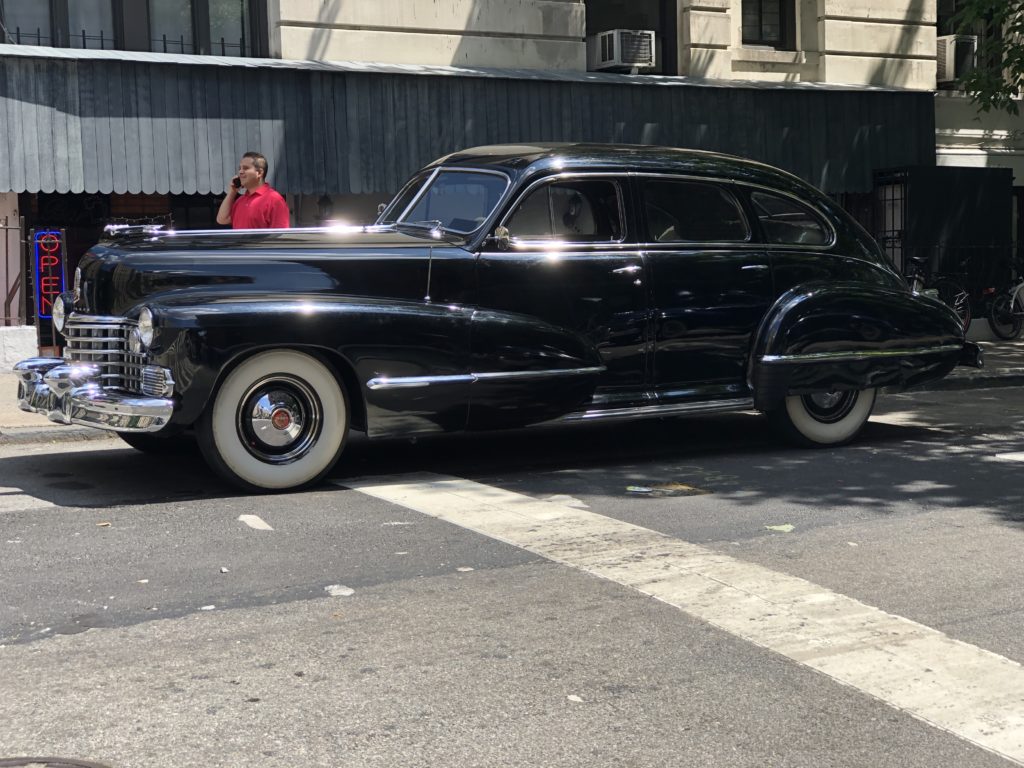
Black Cadillac, Film Shoot. July 2019
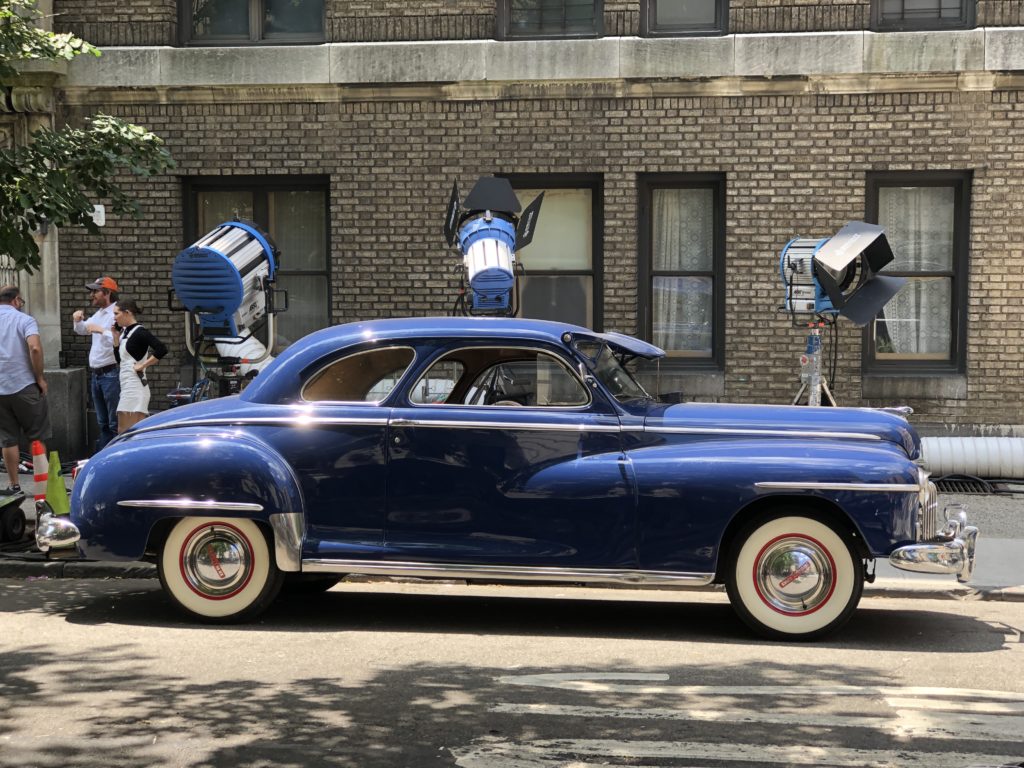
Blue Dodge. Film Shoot. July 2019
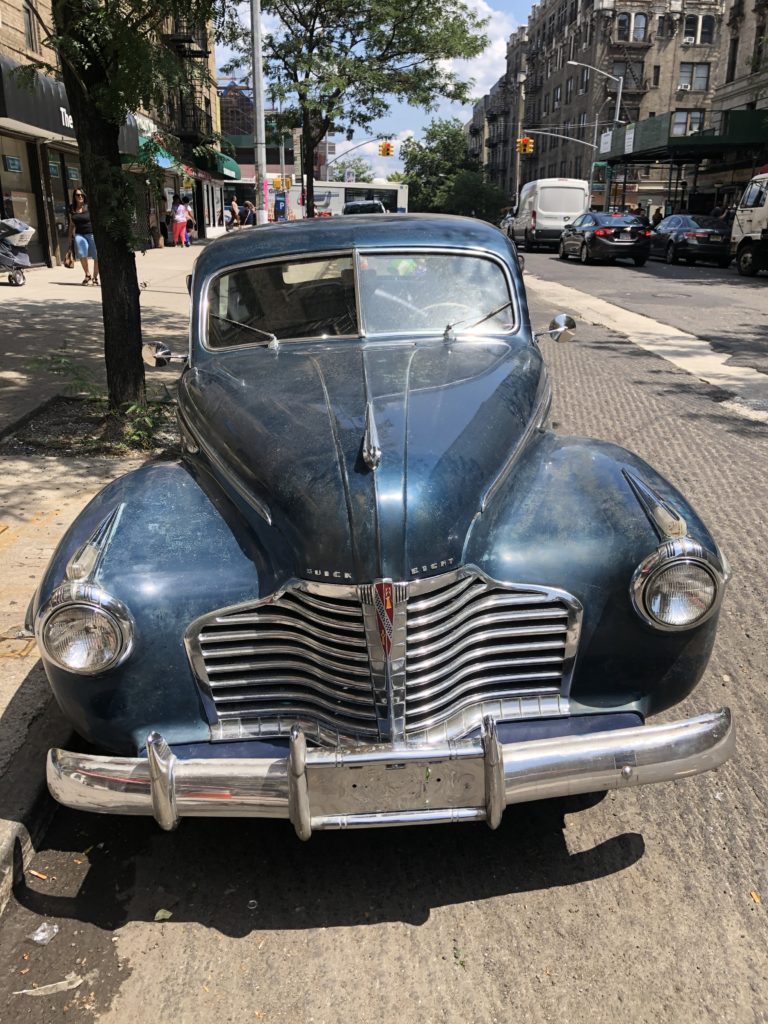
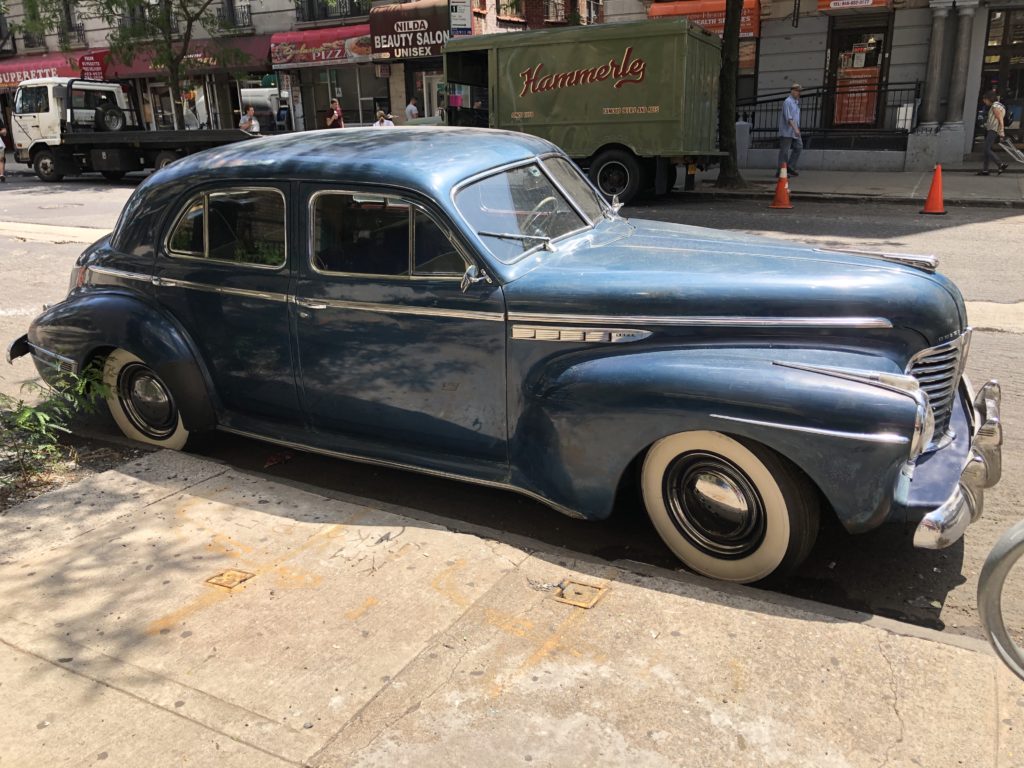
Buick Eight. Film Shoot. July 2019
Old Car. Film Shoot. July 2019
Box Truck. Film Shoot. July 2019
It’s the Caddy that really caught my eye. That thing was a beaut.
Black Cadillac, Film Shoot. July 2019
“Long, black Cadillac,” indeed.
While the Dodge was equally gorgeous, I was able to get closer to a Buick Eight, not quite as shiny, but seemingly all the more lovable for it.
Buick Eight. Film Shoot. July 2019
Look at that grille!
Buick Eight. Film Shoot. July 2019
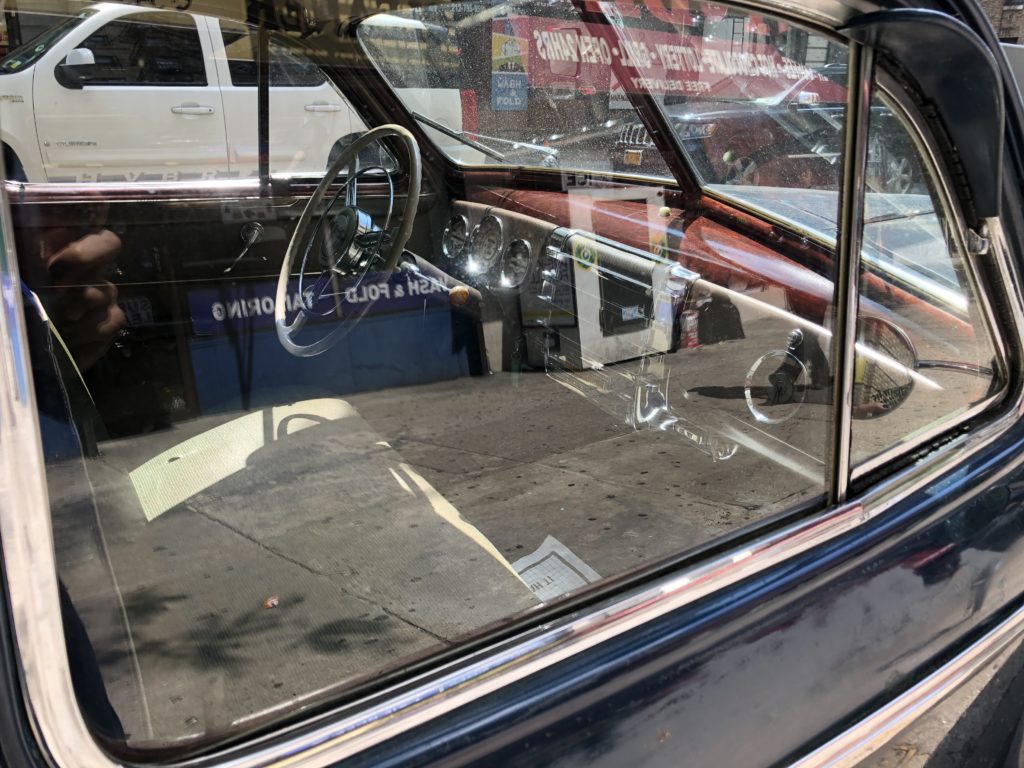
And now, the interior:
Buick Eight (interior). Film Shoot. July 2019
Back to a time of bench seats and solenoid buttons. I had to wonder, what would people then make today of our touchscreens for everything from music to phone calls to navigation?
There were some more cars staged down the block. Here’s the rest.